8.2 Lenz's law

🔋Electromagnetism II Unit 8 Review
8.2 Lenz's law
🔋 Electromagnetism II
Lenz's law describes how induced currents oppose the changes in magnetic flux that created them. It gives you the direction of the induced EMF in Faraday's law and connects electromagnetic induction directly to energy conservation.
Lenz's law basics
The core idea: whenever the magnetic flux through a conducting loop changes, the induced current flows in whichever direction creates a magnetic field that fights that change. The system always pushes back against whatever is happening to it.

Top images from around the web for Induced current direction
magnetic fields - How to correctly determine the direction of induced current flow? - Physics ... View original
Is this image relevant?
Lenz’s Law — Electromagnetic Geophysics View original
Is this image relevant?
Física Ilustrada: Lei de Lenz View original
Is this image relevant?
magnetic fields - How to correctly determine the direction of induced current flow? - Physics ... View original
Is this image relevant?
Lenz’s Law — Electromagnetic Geophysics View original
Is this image relevant?
Induced current direction
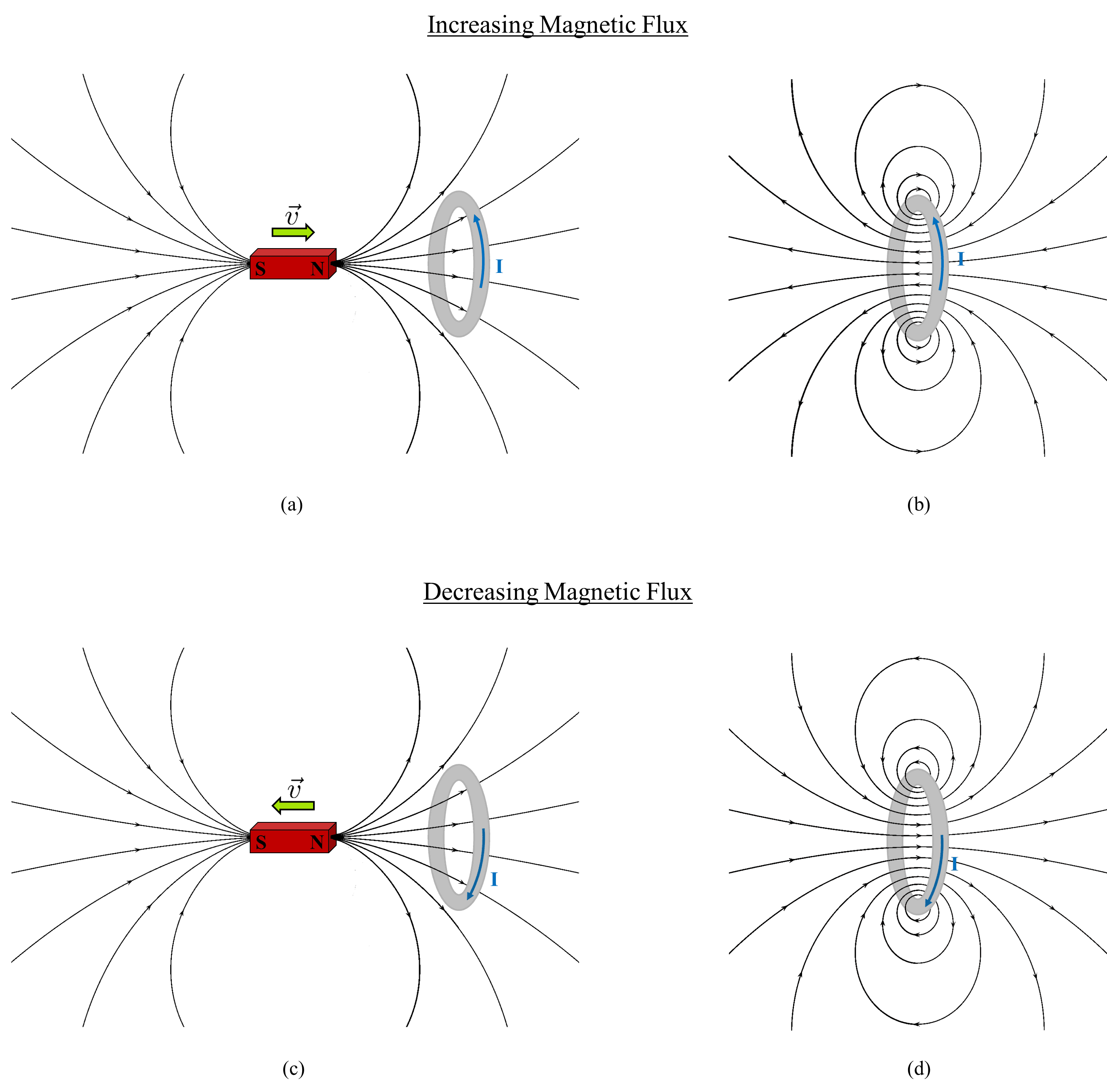
- If the magnetic flux through a loop is increasing, the induced current flows in a direction that produces a magnetic field opposing the increase (pointing opposite to the external field).
- If the magnetic flux is decreasing, the induced current flows so that its magnetic field supports the original field, opposing the decrease.
You can figure out the direction of the induced current using the right-hand rule: point your thumb in the direction of the opposing magnetic field the loop needs to create, and your fingers curl in the direction of induced current flow.
The negative sign in Faraday's law
Lenz's law is encoded directly in the minus sign of Faraday's law:
That negative sign isn't just a convention. It tells you that the induced EMF () always acts to oppose the change in magnetic flux (). Without it, Faraday's law would give you the magnitude of the EMF but not its direction.
For a coil with turns, this generalizes to:
Back EMF
The opposing magnetic field produced by the induced current is often called back EMF. This term shows up frequently in the context of motors and generators, where the back EMF opposes the driving voltage or the mechanical rotation. It's not a separate phenomenon; it's just Lenz's law at work inside a device.
Lenz's law and energy conservation
Lenz's law isn't an independent postulate. It's a direct consequence of conservation of energy applied to electromagnetic systems.
Why the opposition must happen
Suppose the induced current flowed in the same direction as the flux change instead of opposing it. That current would reinforce the changing flux, which would induce an even larger current, which would reinforce the flux further. You'd get a runaway positive feedback loop generating energy from nothing. That violates conservation of energy, so the induced current must oppose the change.
Work and energy dissipation
When you push a magnet toward a conducting loop, the induced current creates a field that repels the magnet. You have to do work against that repulsive force. That mechanical work is what gets converted into electrical energy in the loop, which then dissipates as Joule heating () in the conductor's resistance.
The energy balance is straightforward: the work you do pushing the magnet equals the electrical energy dissipated as heat in the conductor (assuming no other losses).
Factors affecting induced EMF
Several quantities control how large the induced EMF is. Understanding these helps you predict behavior in real devices.
Rate of flux change
The induced EMF is proportional to . A faster change in flux produces a larger EMF. This is why generators produce higher voltages at higher rotational speeds, and why transformers operate on alternating (not direct) current.

Number of coil turns
Each turn of a coil contributes to the total EMF. Doubling the number of turns doubles the induced EMF for the same rate of flux change. Transformers exploit this: the turns ratio between secondary and primary coils determines the voltage ratio.
Coil area and orientation
Magnetic flux depends on the component of the field perpendicular to the coil area:
where is the field magnitude, is the coil area, and is the angle between the field and the normal to the coil surface.
- Maximum flux (and maximum change in flux during rotation) occurs when (field perpendicular to the coil plane).
- Zero flux occurs when (field parallel to the coil plane).
- A larger coil area captures more flux, increasing the induced EMF.
Lenz's law applications
Electromagnetic braking
When a conductor moves through a magnetic field, eddy currents are induced in the conductor. These currents produce a magnetic field that opposes the motion, creating a braking force with no physical contact.
This is used in:
- Maglev and high-speed trains, where electromagnetic brakes supplement friction brakes
- Roller coasters, where permanent magnets on the track induce eddy currents in conducting fins on the car to control speed
- Truck retarders, where an electromagnetic brake reduces wear on conventional brakes during long descents
The braking force is proportional to the speed of the conductor, so it's strongest at high speeds and drops to zero when the conductor stops. There's no static friction equivalent.
Eddy current damping
Eddy current damping uses the same physics as electromagnetic braking, but the goal is to suppress unwanted oscillations rather than stop bulk motion.
- Analytical balances use eddy current damping to settle quickly to a reading.
- Seismometers use conducting plates moving through magnetic fields to damp the sensor's response and prevent ringing.
- Galvanometers are wound on aluminum frames so that eddy currents damp the needle's oscillation.
The damping force is always proportional to velocity, making this a form of viscous damping.
Induction cooktops
Induction cooktops pass a high-frequency alternating current (typically 20–100 kHz) through a coil beneath the cooking surface. This rapidly changing magnetic field induces eddy currents in the base of ferromagnetic cookware placed on top.
The cookware's electrical resistance converts these eddy currents into heat via Joule heating. The cooktop surface itself doesn't get hot directly; only the pan heats up. This makes induction cooking more efficient (around 85–90% energy transfer) than gas or resistive electric stoves.
Non-ferromagnetic cookware (aluminum, copper, glass) won't work on standard induction cooktops because it doesn't couple strongly enough to the alternating magnetic field.
Lenz's law in transformers
Transformers transfer electrical energy between circuits through mutual induction, and Lenz's law governs the phase relationship between primary and secondary voltages.
Mutual inductance
When the current in the primary coil changes, it produces a changing magnetic flux in the shared core. That changing flux induces an EMF in the secondary coil. The mutual inductance quantifies how effectively the two coils are coupled:
where is the primary current. Higher mutual inductance means more of the primary coil's flux links the secondary.

Primary and secondary coils
The primary coil connects to the AC source and establishes the changing magnetic field in the core. The secondary coil, wound on the same core, picks up that changing flux and delivers power to the load.
The voltage ratio follows from Faraday's law applied to both coils:
A step-up transformer has ; a step-down transformer has .
Transformer energy losses
Real transformers lose energy through several mechanisms:
- Copper losses (): resistive heating in the coil windings
- Eddy current losses: induced currents circulating in the core itself, dissipating energy as heat. Minimized by using laminated cores (thin insulated sheets of iron stacked together, which break up eddy current paths).
- Hysteresis losses: energy lost each cycle as the core's magnetic domains are repeatedly reoriented. Minimized by choosing soft magnetic materials with narrow hysteresis loops.
Well-designed power transformers achieve efficiencies above 95%.
Lenz's law in generators
Generators convert mechanical energy into electrical energy. Lenz's law is what makes this conversion require effort: the induced currents resist the rotation, so you must continuously supply mechanical power.
Armature reaction
The current induced in the rotating armature creates its own magnetic field, which distorts the main field produced by the stator magnets. This is called armature reaction. It can shift the neutral plane (the position where the EMF in a coil is zero), distort the output voltage waveform, and reduce the effective flux. Compensating windings or interpoles are used in large machines to counteract these effects.
Commutation and brushes
In DC generators, a commutator mechanically reverses the connection to each armature coil at the right moment so the output current always flows in one direction. Brushes (typically carbon) press against the commutator segments to carry current to the external circuit.
The rapid switching of coil connections means the current in each coil is changing direction, which by Lenz's law induces transient voltages that can cause sparking at the brushes. Interpoles and proper brush positioning help reduce this sparking.
Generator efficiency limits
Generator efficiency is limited by:
- Copper losses in the armature and field windings
- Core losses (eddy currents and hysteresis) in the iron
- Mechanical losses (friction in bearings, windage)
- Back EMF: the induced EMF opposes the rotation, so more mechanical torque is needed as the electrical load increases
Large generators can reach efficiencies of 95% or higher, but the back EMF from Lenz's law is the fundamental reason you can't get something for nothing.
Lenz's law demonstrations
These classic experiments make Lenz's law visible and are worth understanding both qualitatively and quantitatively.
Magnet falling through a conducting tube
Drop a strong neodymium magnet through a thick-walled copper or aluminum tube. As the magnet falls, the changing flux induces eddy currents in the tube walls. These currents create a magnetic field that opposes the magnet's motion, dramatically slowing its descent compared to free fall.
The magnet quickly reaches a low terminal velocity where the magnetic braking force balances gravity. A stronger magnet, a more conductive tube, or a thicker tube wall all increase the braking effect.
Pendulum damping
Swing a pendulum that has a conducting plate (or an attached magnet) between the poles of a strong magnet. Eddy currents induced in the plate oppose the plate's motion, and the pendulum's amplitude decays much faster than it would from air resistance alone.
If you cut slots in the conducting plate, the eddy current paths are disrupted and the damping effect is greatly reduced. This is a clean way to confirm that the damping really comes from induced currents, not some other mechanism.
Eddy current tube braking
A variation of the falling magnet demo: slide a conducting (non-magnetic) ring or tube down a vertical rod surrounded by strong magnets. The eddy currents induced in the ring create an opposing field that slows the descent. Comparing the fall time of a conducting ring to a non-conducting ring of similar mass makes the effect of Lenz's law unmistakable.
See Fiveable more often in Google
Mark Fiveable as a preferred source and Google is more likely to show you our guides in Top Stories, with a "preferred" badge in AI Mode and AI Overviews.