11.4 Grounding and bonding

🔋Electromagnetism II Unit 11 Review
11.4 Grounding and bonding
🔋 Electromagnetism II
Importance of Grounding and Bonding
Grounding and bonding serve two distinct but complementary roles in electrical systems. Grounding connects equipment to earth, which limits voltage rises and gives fault currents a defined path to follow. Bonding ties conductive parts together so no dangerous voltage differences develop between them. When both are done correctly, overcurrent protection devices (fuses, circuit breakers) can detect faults quickly and clear them before anyone gets hurt or equipment is damaged.
From an EMC perspective, grounding and bonding also control the paths that unwanted currents take, directly affecting radiated and conducted emissions. A poorly grounded system doesn't just create safety hazards; it creates noise problems.

Top images from around the web for Grounding for safety
23.8 Electrical Safety: Systems and Devices – College Physics View original
Is this image relevant?
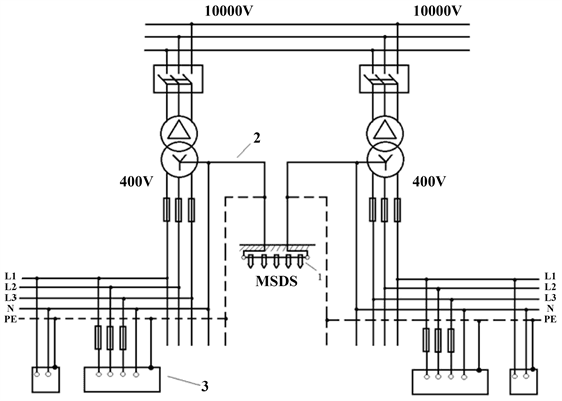
Grounding Systems for Power Supply Facilities View original
Is this image relevant?
Grounding and Lightning Protection View original
Is this image relevant?
23.8 Electrical Safety: Systems and Devices – College Physics View original
Is this image relevant?
Grounding Systems for Power Supply Facilities View original
Is this image relevant?
Grounding vs Bonding
Grounding for Safety
Grounding establishes a deliberate connection between an electrical system and the earth. During normal operation, this stabilizes voltage levels relative to earth potential. During a fault, the grounding path carries fault current back to the source so that overcurrent devices can trip.
The key point: grounding keeps exposed conductive surfaces at or near earth potential. If a fault energizes a metal enclosure, a proper ground path ensures the voltage on that enclosure stays low enough to prevent lethal shock while simultaneously allowing enough fault current to flow to trip the breaker.
Bonding for Potential Equalization
Bonding is about connecting conductive parts to each other so they all sit at the same potential. Even if that potential isn't zero volts relative to earth, what matters is that there's no voltage difference between surfaces a person might touch simultaneously.
Bonding is required for:
- Metal piping systems (water, gas)
- Structural steel
- Equipment enclosures
- Any conductive material that could become energized during a fault
Without bonding, a fault on one piece of equipment could create a dangerous voltage between its enclosure and a nearby pipe or structural member.
Grounding Electrode System
Grounding Electrode Conductor
The grounding electrode conductor (GEC) connects the system's grounded conductor (typically the neutral) to the grounding electrode. It's the link between your electrical system and the earth itself.
- GECs are sized per NEC Table 250.66, based on the largest ungrounded service-entrance conductor
- Typical materials: bare copper, aluminum, or copper-clad aluminum
- Install as straight as practical with minimal bends to keep impedance low
Grounding Electrodes
A grounding electrode is any conductive element intentionally connected to earth to establish a low-impedance fault current path. Common types include:
- Ground rods (typically 8 ft copper-clad steel driven into soil)
- Metal underground water pipes (at least 10 ft in direct contact with earth)
- Concrete-encased electrodes (Ufer grounds, using rebar in a building's foundation)
- Metal building frames effectively grounded
- Ground rings encircling the building
Electrode effectiveness depends heavily on soil resistivity, which varies with moisture content, temperature, and soil composition. Sandy, dry soil has much higher resistivity than moist clay, so electrode design must account for local conditions.
Made vs Natural Electrodes
Made electrodes are installed specifically for grounding: ground rods, ground plates, and ground rings. You put them there on purpose.
Natural electrodes already exist as part of the building: metal water pipes, structural steel, concrete-encased rebar. They serve a grounding function in addition to their primary purpose.
NEC 250.52 specifies minimum sizes, materials, and installation methods for both categories. Where available, natural electrodes are required to be bonded into the grounding electrode system; you don't get to ignore a qualifying natural electrode just because you've installed made electrodes.
Equipment Grounding
Equipment Grounding Conductor
The equipment grounding conductor (EGC) connects non-current-carrying metal parts (enclosures, frames, raceways) back to the system grounded conductor or the grounding electrode conductor. Its job is to carry fault current during a ground fault so the overcurrent device can clear the fault.
- Sized per NEC Table 250.122, based on the rating of the overcurrent device protecting the circuit
- Can be a wire, a metal raceway, or other recognized conductive path
- Must provide a low-impedance path; a high-impedance EGC means slow fault clearing and prolonged shock hazard

Grounded vs Ungrounded Systems
In a grounded system, one current-carrying conductor (usually the neutral) is intentionally connected to earth through the grounding electrode system. This is standard for most low-voltage installations (under 600 V). A ground fault produces high fault current that trips protective devices quickly.
In an ungrounded system, no current-carrying conductor is intentionally connected to earth. These systems are used in some medium- and high-voltage industrial applications because a single ground fault doesn't force an immediate shutdown. The tradeoff is that ungrounded systems require ground fault detection equipment, and a second ground fault on a different phase creates a phase-to-phase fault with severe consequences.
Bonding Methods
Exothermic Welding
Exothermic welding (often called Cadweld, a common brand name) uses a thermite-type reaction between copper oxide and aluminum powder to fuse conductors together. The reaction produces molten copper that flows around the joint, creating a molecular bond.
- Produces a permanent, low-resistance connection
- Highly resistant to corrosion, suitable for direct burial
- Preferred for critical connections: grounding electrode systems, cathodic protection, lightning protection
The connection is actually stronger than the conductor itself, so the conductor will fail before the joint does.
Compression Connectors
Compression connectors join conductors by mechanically deforming the connector body around the conductors under high pressure, using a hydraulic or mechanical crimping tool.
Common types:
- Crimp lugs for terminating conductors to equipment
- Split-bolt connectors for tapping or splicing
- C-type compression connectors for grounding applications
These provide reliable, low-resistance connections when properly sized and installed with the correct die and crimping tool. An improperly crimped connection can have high resistance and overheat under fault current.
Bonding Jumpers
A bonding jumper is a short conductor that bridges two conductive surfaces to ensure electrical continuity. You'll see them used to bond around water meters (which are sometimes removed for service), across sections of metal piping, and between equipment enclosures.
- Sized per NEC Table 250.102(C)(1), based on the overcurrent device rating
- Must be installed so they won't be damaged or accidentally disconnected
- Supply-side bonding jumpers (on the line side of the overcurrent device) are sized differently than load-side bonding jumpers
Ground Fault Protection
Ground Fault Circuit Interrupters (GFCIs)
A GFCI protects people from electric shock by detecting current imbalances between the hot and neutral conductors. Under normal conditions, current flowing out on the hot conductor returns on the neutral, and the two are equal. If some current leaks to ground through a person or a fault, the GFCI senses the imbalance and opens the circuit.
- Trip threshold: 4-6 mA of imbalance (well below the level that causes ventricular fibrillation, which starts around 100 mA)
- Trip time: within 25-40 milliseconds
- Required by NEC in wet or damp locations: bathrooms, kitchens, garages, outdoor receptacles, and others
GFCI Operation and Types
The GFCI uses a differential current transformer with both the hot and neutral conductors passing through its core. When currents are balanced, the net magnetic flux in the core is zero. Any imbalance produces a signal that triggers the trip mechanism.
Three main form factors:
- Receptacle-type: replaces a standard outlet, can protect downstream receptacles on the same circuit
- Circuit breaker-type: installed in the panel, protects the entire branch circuit
- Portable (plug-in) type: used with extension cords or at temporary job sites
Each suits different installation scenarios, but the operating principle is identical.
Special Grounding Situations

Isolated Grounds
Isolated ground (IG) systems use a separate, insulated equipment grounding conductor that runs directly back to the grounding point without connecting to the conduit or raceway along the way. The idea is to prevent noise currents flowing on the raceway from coupling into the equipment ground of sensitive electronics.
- IG receptacles are identified by an orange triangle on the faceplate
- The isolated EGC connects directly to the grounding bus at the panel (or further upstream to the service equipment)
- Common in installations with sensitive electronic equipment: data centers, medical imaging rooms, recording studios
From an EMC standpoint, IG systems reduce conducted noise on the grounding conductor, but they must still maintain a safety ground path. The conduit or raceway still serves as the required fault current path.
Separately Derived Systems
A separately derived system (SDS) has no direct electrical connection to the supply conductors of another system. The most common example is a transformer: the secondary winding is magnetically coupled to the primary but electrically isolated from it.
Each SDS needs:
- Its own grounding electrode connection
- A system bonding jumper connecting the grounded conductor to the equipment ground and grounding electrode conductor
- Proper sizing per NEC 250.30
Other examples include standby generators (when the transfer switch does not switch the neutral) and UPS systems with isolation transformers.
Hazardous Locations
In areas where flammable gases, vapors, dusts, or fibers may be present, a grounding or bonding failure can produce a spark that ignites the atmosphere. NEC Article 500 classifies these locations by:
- Class (type of hazard: gases/vapors, dusts, or fibers)
- Division (likelihood the hazard is present: normal conditions vs abnormal conditions)
Grounding and bonding in hazardous locations must be more robust than in ordinary locations. Techniques include:
- Intrinsically safe circuits that limit energy below ignition thresholds
- Explosion-proof enclosures that contain any internal explosion
- Increased safety equipment with enhanced insulation and connection integrity
Locknut-and-bushing grounding is generally not acceptable in hazardous locations; bonding jumpers or bonding-type locknuts are required.
Grounding and Bonding Best Practices
Minimizing Ground Loops
A ground loop forms when multiple ground paths exist between two points, creating a loop that can pick up magnetic fields and conduct noise currents. This is both a safety concern and a major EMC issue, since ground loops are one of the most common sources of conducted interference in electronic systems.
To minimize ground loops:
- Use single-point (star) grounding where all equipment connects to one common grounding point
- Avoid running grounding conductors in parallel paths that form loops
- Keep grounding conductors short and direct
- In mixed-signal systems, be deliberate about where analog and digital grounds connect
For high-frequency systems, single-point grounding breaks down (conductor inductance becomes significant), and multipoint grounding with a low-impedance ground plane is often more effective. The choice depends on the frequency range of the circuits involved.
Proper Conductor Sizing
Undersized grounding or bonding conductors can overheat during a fault, potentially failing before the overcurrent device clears the fault. NEC provides three key sizing tables:
| Purpose | NEC Table | Based On |
|---|---|---|
| Grounding electrode conductors | 250.66 | Largest service-entrance conductor |
| Equipment grounding conductors | 250.122 | Overcurrent device rating |
| Bonding jumpers | 250.102(C)(1) | Overcurrent device rating |
Also consider conductor material (copper vs aluminum), insulation temperature rating, and conduit fill. Aluminum conductors require larger sizes than copper for the same current capacity and need compatible connectors to avoid galvanic corrosion.
Regular System Maintenance
Grounding systems degrade over time. Connections corrode, soil conditions change, and mechanical damage occurs. A grounding system that tested well at installation may not perform adequately years later.
Maintenance should include:
- Inspecting connections for looseness, corrosion, or physical damage
- Verifying that bonding jumpers haven't been removed during plumbing or structural work
- Retesting ground resistance periodically, especially after soil disturbance or drought conditions
- Documenting all findings for compliance records
Testing and Verification
Earth Ground Resistance Testing
Earth ground resistance testing confirms that the grounding electrode system provides a sufficiently low-impedance path to earth. The standard method is the fall-of-potential (3-point) test:
- Drive two auxiliary test electrodes (stakes) into the ground at measured distances from the electrode under test
- The current stake goes far from the electrode (typically 100 ft or more)
- The potential stake is placed at 62% of the distance to the current stake (this is the point where the measurement is least sensitive to stake placement errors)
- The tester injects a known current between the electrode and the current stake, then measures the voltage at the potential stake
- gives the ground resistance
NEC 250.53(A)(2) requires that a single rod, pipe, or plate electrode not exceed 25 ohms. If it does, a supplemental electrode must be installed. Many facilities target 5 ohms or less for critical systems, and some specifications (telecommunications, lightning protection) require 1-5 ohms.
Continuity Testing
Continuity testing verifies that all grounding and bonding connections are intact and have acceptably low resistance. Use a low-resistance ohmmeter (not a standard multimeter, which may not resolve milliohm-level differences).
- Measure resistance between equipment enclosures and the grounding bus
- Check bonding jumpers across pipe joints, around meters, and at structural connections
- Acceptable values are typically less than 1 ohm, with most good connections reading in the milliohm range
A connection that reads several ohms may still show "continuity" on a basic tester but could fail to carry fault current safely.
Periodic Inspection Requirements
NEC 250.4(A)(1) establishes the performance requirement that grounding and bonding systems must be maintained in effective condition. In practice, this means:
- Initial installation: full inspection and testing before energizing
- After modifications or repairs: re-verify affected connections
- Periodic schedule: at least every 3-5 years for commercial and industrial facilities (some jurisdictions and insurance requirements mandate more frequent testing)
Document every inspection with dates, measurements, and any corrective actions taken. This record is valuable for both compliance and troubleshooting future problems.
See Fiveable more often in Google
Mark Fiveable as a preferred source and Google is more likely to show you our guides in Top Stories, with a "preferred" badge in AI Mode and AI Overviews.