11.2 Electromagnetic compatibility (EMC)

🔋Electromagnetism II Unit 11 Review
11.2 Electromagnetic compatibility (EMC)
🔋 Electromagnetism II
Principles of electromagnetic compatibility
Electromagnetic compatibility (EMC) ensures that electronic devices operate correctly in their intended electromagnetic environment without causing or suffering from electromagnetic interference (EMI). Every electronic system is both a potential source and a potential victim of EMI, so EMC engineering addresses both sides of that equation.
EMC work spans three core questions: Where does the interference come from? How does it reach the victim? And how sensitive is the victim to it? Applying these principles early in design is far cheaper than fixing problems after a prototype fails compliance testing.

Top images from around the web for Sources of electromagnetic interference
Electromagnetic spectrum - Wikipedia View original
Is this image relevant?
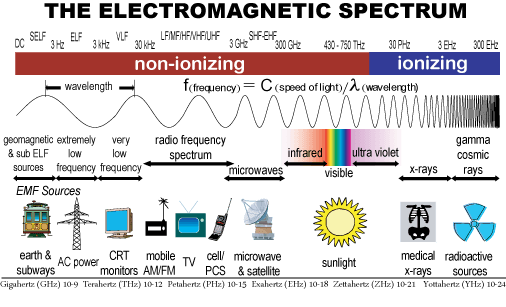
The Electromagnetic Spectrum ~ NEW TECH View original
Is this image relevant?
Electromagnetic spectrum - Wikipedia View original
Is this image relevant?
Electromagnetic spectrum - Wikipedia View original
Is this image relevant?
The Electromagnetic Spectrum ~ NEW TECH View original
Is this image relevant?
Sources of electromagnetic interference
EMI sources fall into two broad categories based on how the energy travels, and two based on origin.
By propagation path:
- Conducted EMI travels through physical conductors like power lines, signal cables, or PCB traces. Common examples are switching transients from power supplies and power line noise from rectifiers.
- Radiated EMI propagates as electromagnetic waves through free space. High-speed digital circuits and unintentionally resonant cable runs are frequent culprits, since any conductor carrying high-frequency current acts as an antenna.
By origin:
- Natural sources include lightning strikes, electrostatic discharge (ESD), and solar flares.
- Man-made sources include switching power supplies, electric motors, mobile devices, radio transmitters, and power lines.
Coupling mechanisms for EMI
There are four primary ways EMI transfers from source to victim:
- Conductive coupling occurs through shared conductors such as power supplies, ground planes, or signal lines. Ground loops and common-impedance coupling are classic examples.
- Capacitive coupling transfers energy through electric fields between conductors in close proximity. Parasitic capacitance between adjacent PCB traces is a typical scenario.
- Inductive coupling transfers energy through magnetic fields. Whenever two current loops share mutual inductance, changing current in one induces voltage in the other.
- Radiative coupling involves electromagnetic waves propagating through free space, typically dominant in the far field. Antenna-to-antenna coupling between separate systems is a common case.
Identifying which coupling mechanism dominates a particular EMI problem is the first step toward choosing the right mitigation technique.
Susceptibility of electronic systems
Susceptibility describes how easily a system's performance degrades when exposed to EMI. Three factors determine it: the sensitivity of the receiver or circuit, the strength and frequency of the interfering signal, and the efficiency of the coupling path.
- Digital systems are vulnerable because they depend on precise voltage thresholds and timing. EMI can cause clock jitter, bit errors, and signal integrity failures.
- Analog systems are vulnerable because they process small signal variations. EMI can saturate amplifiers, degrade signal-to-noise ratio, or introduce spurious tones.
A system with low susceptibility is said to have high immunity, which is the complementary concept tested during compliance.
EMC standards and regulations
EMC standards exist so that devices sharing the same electromagnetic environment don't interfere with each other. Compliance is typically a legal prerequisite for selling a product in a given market. Standards specify emission limits (how much EMI a device may produce), immunity requirements (how much EMI it must tolerate), and the test methods used to verify both.
International EMC standards
- The International Electrotechnical Commission (IEC) maintains the IEC 61000 series, which is the foundational framework covering EMC terminology, environment classification, emission limits, immunity levels, and test procedures.
- The International Special Committee on Radio Interference (CISPR) develops standards for controlling radio-frequency interference. CISPR 32 (which replaced CISPR 22) covers emissions from multimedia equipment, and CISPR 35 covers their immunity.
- The International Organization for Standardization (ISO) publishes EMC standards for specific sectors, such as ISO 7637 for electrical disturbances in road vehicles and ISO 14982 for agricultural and forestry machinery.
Regional EMC regulations
Different markets enforce their own regulatory frameworks, though many reference the international standards above:
- European Union: The EMC Directive 2014/30/EU sets essential requirements. Products must carry CE marking to demonstrate conformity.
- United States: The FCC regulates emissions through 47 CFR Part 15 for unintentional radiators and Part 18 for industrial, scientific, and medical equipment.
- Other regions: Canada (ISED), Japan (VCCI/MIC), Australia (ACMA), and others maintain their own requirements, often harmonized with CISPR standards but with region-specific testing or labeling rules.
Industry-specific EMC requirements
Some industries impose additional EMC requirements beyond the general standards:
- Automotive: ISO 11452 series (component-level immunity), CISPR 25 (radio disturbance characteristics of vehicles and components).
- Aerospace and defense: RTCA DO-160 (airborne equipment environmental conditions), MIL-STD-461 (military systems EMI requirements).
- Medical devices: IEC 60601-1-2 specifies EMC requirements tied directly to patient safety and essential device performance.
- Telecommunications: ETSI EN 301 489 series (radio equipment), CISPR 32 (multimedia equipment emissions).
EMC design considerations
Addressing EMC during initial design is significantly cheaper than retrofitting a failing product. The core strategies involve component selection, PCB layout optimization, grounding and shielding, and filtering. Electromagnetic simulation tools (using methods like FEM or MoM) can predict EMC performance before you build hardware, saving both time and cost.
PCB layout for EMC
Good PCB layout is one of the most effective and lowest-cost EMC measures:
- Partition the board by separating sensitive analog sections from noisy digital sections. Keep high-speed and high-power traces away from sensitive signal paths.
- Use continuous ground and power planes to provide low-impedance return paths for high-frequency currents. Gaps or slots in the ground plane force return currents to detour, increasing loop area and radiation.
- Minimize high-speed trace lengths and avoid unnecessary stubs or branches, which can resonate and radiate.
- Place decoupling capacitors as close as possible to IC power pins. These capacitors supply instantaneous current demand locally and suppress high-frequency noise before it propagates across the board. Use multiple values in parallel to cover a broad frequency range.

Grounding and shielding techniques
- Grounding: A solid, low-impedance ground reference minimizes ground loops and common-mode noise. At low frequencies, single-point (star) grounding avoids ground loops. At high frequencies, multi-point grounding to a continuous ground plane provides lower impedance. Many practical designs use a hybrid approach.
- Shielded cables and connectors (coaxial cables, shielded twisted pairs) prevent radiated EMI from entering or leaving the system through cable runs.
- Shielding enclosures made of metal or conductive coatings attenuate radiated emissions and improve immunity. Effectiveness depends on material conductivity, thickness, and the quality of seams and apertures.
- Bonding and termination of shields must be low-impedance and ideally 360-degree around the cable or connector. A pigtail ground connection on a shield can actually make things worse at high frequencies by creating an antenna.
Cable and connector design
- Select cables with shielding appropriate to the frequency range: foil shields offer good high-frequency coverage, braided shields provide better low-frequency performance, and combination shields cover both.
- Twisted-pair construction reduces inductive coupling by canceling magnetic flux pickup between the two conductors.
- Route cables away from known EMI sources and minimize the loop area of cable runs to reduce both pickup and radiation.
- Ferrite beads or common-mode chokes placed on cables suppress common-mode currents, which are often the dominant source of cable radiation.
Filtering and suppression methods
- Power line filters use common-mode chokes, X capacitors (differential-mode, line-to-line), and Y capacitors (common-mode, line-to-ground) to attenuate conducted EMI on supply lines.
- Transient voltage suppressors (TVS) and varistors clamp voltage spikes from ESD events or power surges, protecting sensitive downstream circuits.
- Ferrite beads in series with signal lines act as frequency-dependent resistors, damping high-frequency resonances and reducing ringing on fast edges.
- Spread-spectrum clocking modulates the clock frequency slightly over time, spreading the emission energy across a wider bandwidth and reducing the peak spectral amplitude. This can lower measured emissions by several dB without affecting system function.
EMC testing and measurement
EMC testing verifies that a device meets the emission limits and immunity requirements of the applicable standards. Testing can happen in-house during development (pre-compliance) or at accredited labs for formal certification. Both emissions and immunity are tested, covering conducted and radiated paths.
Conducted emissions testing
Conducted emissions testing measures EMI that the device under test (DUT) injects onto its power supply or signal lines.
- Connect the DUT's power input through a line impedance stabilization network (LISN), which presents a standardized impedance (typically 50 Ω) to the DUT and isolates it from external mains noise.
- Connect the LISN's measurement port to a spectrum analyzer or EMI receiver.
- Measure emissions across the specified frequency range (commonly 150 kHz to 30 MHz).
- Compare results against the applicable limits (e.g., CISPR 32 or FCC Part 15).
Radiated emissions testing
Radiated emissions testing measures the electromagnetic fields the DUT radiates into its surroundings.
- Place the DUT on a turntable inside an anechoic chamber (or on an open area test site, OATS) at a specified distance from the receiving antenna (typically 3 m or 10 m).
- Use a calibrated antenna connected to a spectrum analyzer or EMI receiver.
- Rotate the DUT and vary the antenna height to find the maximum emission at each frequency.
- Measure across the required frequency range (commonly 30 MHz to 1 GHz or higher, depending on the standard).
- Compare peak readings against the applicable emission limits.
Susceptibility testing methods
Susceptibility (immunity) testing applies controlled EMI to the DUT and monitors whether it continues to operate correctly.
- Conducted susceptibility: EMI signals are injected onto power or signal lines through a coupling/decoupling network (CDN) driven by a signal generator and power amplifier.
- Radiated susceptibility: The DUT is exposed to calibrated electromagnetic fields generated by antennas inside an anechoic chamber or reverberation chamber (which uses mode stirring to create a statistically uniform field).
- ESD testing: An ESD generator applies controlled discharges to the DUT using contact discharge (direct touch) and air discharge (approaching until arc occurs) methods, per IEC 61000-4-2.
Performance criteria defined in the standard specify what level of degradation, if any, is acceptable during and after each test.
Test equipment and setups
- Spectrum analyzers and EMI receivers measure emission amplitude vs. frequency. EMI receivers differ from general-purpose spectrum analyzers in that they include quasi-peak and average detectors required by EMC standards.
- Anechoic chambers are shielded rooms lined with RF-absorbing material, eliminating reflections and external interference for both emissions and immunity testing.
- Open area test sites (OATS) are outdoor facilities with a conductive ground plane and minimal nearby reflectors, used primarily for radiated emissions measurements.
- TEM and GTEM cells are enclosed transmission-line structures that generate uniform electromagnetic fields for radiated immunity testing of smaller devices, offering a compact alternative to full anechoic chambers.
EMC troubleshooting and mitigation
When a product fails EMC testing or exhibits interference problems in the field, a systematic troubleshooting approach saves time. The process follows three steps: characterize the problem, identify the source and coupling path, then apply targeted mitigation.

Identifying EMC issues
- EMC problems typically appear as functional symptoms: communication errors, display glitches, unexpected resets, audio noise, or degraded sensor readings.
- Note the circumstances carefully. Does the problem correlate with a specific operating mode, cable configuration, or nearby equipment? Frequency and timing clues narrow down the source.
- Compare measured emissions or immunity performance against the relevant standard's limits to identify exactly where and by how much the device fails.
Diagnostic tools and techniques
- Spectrum analyzers and EMI receivers reveal the frequency content and amplitude of emissions, helping you match interference signatures to known sources (e.g., switching converter harmonics).
- Near-field probes (small E-field and H-field antennas) let you scan across a PCB or cable to localize the physical origin of emissions. Moving the probe and watching the signal strength on the analyzer pinpoints hot spots.
- Current clamps measure common-mode and differential-mode currents on cables without breaking the circuit.
- Time-domain reflectometry (TDR) and vector network analyzers (VNA) characterize impedance discontinuities and signal integrity on PCB traces and cables.
- Thermal imaging can reveal unexpected current paths or component stress caused by EMI-induced currents.
Mitigation strategies for EMI
The classic EMC mitigation framework targets three points: the source, the coupling path, and the victim.
- Suppress at the source: Reduce high-frequency noise generation using snubber circuits on switching nodes, ferrite beads on noisy supply rails, and spread-spectrum clocking on oscillators.
- Block the coupling path: Add shielding, improve grounding, install filters, and reroute cables to reduce conductive, capacitive, inductive, or radiative transfer of EMI.
- Harden the victim: Increase the immunity of sensitive circuits through input filtering, transient suppression (TVS diodes), galvanic isolation (optocouplers, isolated DC-DC converters), and robust firmware that can tolerate brief signal corruption.
- Active cancellation: In some applications, adaptive algorithms or active filter circuits can dynamically cancel interference, though this adds complexity.
Retrofitting for EMC compliance
Retrofitting is more constrained and expensive than designing for EMC from the start, but it's sometimes unavoidable. Common retrofit measures include:
- Adding shielding enclosures, conductive gaskets at seams, or shielded cable assemblies to contain or exclude radiated EMI.
- Installing power line filters, ferrite clamp-on cores, or TVS devices to suppress conducted EMI.
- Rerouting cables to reduce loop area, improving ground bonding between chassis parts, or adding isolation barriers between noisy and sensitive subsystems.
- Updating firmware to implement frequency hopping, spread-spectrum modulation, or adaptive noise cancellation where hardware changes alone aren't sufficient.
Each retrofit should be verified with measurements to confirm it actually improves the specific failing parameter without introducing new issues elsewhere.
Future trends in EMC
As electronic systems grow faster, more connected, and more densely integrated, the electromagnetic environment becomes increasingly challenging. Several trends are shaping the future of EMC engineering.
Challenges of high-speed electronics
- Rising clock frequencies and data rates (multi-gigabit serial links, DDR5 memory) push significant spectral energy into frequency ranges where radiation is more efficient, demanding tighter PCB design discipline and more sophisticated shielding.
- Advanced packaging like system-in-package (SiP) and 3D integrated circuits (3D-IC) introduce vertical coupling between stacked die, creating EMI paths that traditional 2D layout rules don't address.
- Wide-bandgap semiconductors such as gallium nitride (GaN) and silicon carbide (SiC) switch faster than silicon, improving power converter efficiency but producing steeper voltage transients with broader spectral content. Their EMI profiles require updated filter and layout strategies.
EMC in wireless communication systems
- The expansion of 5G (and future 6G) into millimeter-wave bands, combined with the sheer density of wireless devices, creates a crowded and dynamic electromagnetic environment.
- Spectrum sharing and interference management between co-located wireless systems (Wi-Fi, cellular, Bluetooth, radar) are active EMC challenges.
- Massive MIMO and beamforming concentrate radiated energy in specific spatial directions, changing the interference landscape from omnidirectional to highly directional and time-varying.
Emerging technologies and EMC implications
- AI and machine learning are being applied to EMC problems: predicting emissions from design data, optimizing filter parameters, and enabling adaptive interference mitigation in real time.
- Quantum computing and communication devices are extraordinarily sensitive to electromagnetic noise, requiring isolation and shielding far beyond what conventional electronics demand.
- Electric and autonomous vehicles combine high-power inverters, wireless charging systems, and V2X communication in a compact space, creating a dense and demanding EMC environment.
Advancements in EMC simulation and modeling
- Full-wave electromagnetic solvers using finite-element method (FEM), method of moments (MoM), and finite-difference time-domain (FDTD) are becoming faster and more accurate, enabling EMC analysis of increasingly complex geometries.
- Multi-physics co-simulation (electromagnetic + thermal + structural) provides a more complete picture of how EMI interacts with other physical phenomena in a design.
- Machine-learning-assisted modeling can train surrogate models on simulation data, dramatically accelerating design-space exploration and optimization.
- Digital twin concepts allow real-time EMC monitoring and diagnosis of deployed systems, feeding field data back into models to improve predictions for future designs.
See Fiveable more often in Google
Mark Fiveable as a preferred source and Google is more likely to show you our guides in Top Stories, with a "preferred" badge in AI Mode and AI Overviews.