10.5 Total internal reflection

🔋Electromagnetism II Unit 10 Review
10.5 Total internal reflection
🔋 Electromagnetism II
Total internal reflection occurs when an electromagnetic wave traveling from a higher-index medium strikes the boundary with a lower-index medium at an angle exceeding the critical angle. At that point, no power transmits into the second medium; instead, the field beyond the interface takes the form of an evanescent wave. This topic ties together Snell's law, boundary conditions, and wave behavior in a way that shows up repeatedly in waveguide theory, spectroscopy, and photonic device design.
Conditions for total internal reflection
Two conditions must both be satisfied for total internal reflection:
- The wave must travel from a medium with refractive index into a medium with refractive index , where .
- The angle of incidence must exceed the critical angle .
If either condition fails, you get partial transmission and partial reflection as described by the Fresnel equations.

Top images from around the web for Snell's law and critical angle
4.3 The Law of Refraction – Snell’s Law – Douglas College Physics 1207 View original
Is this image relevant?
Snell's law - Wikipedia View original
Is this image relevant?
25.4 Total Internal Reflection – College Physics View original
Is this image relevant?
4.3 The Law of Refraction – Snell’s Law – Douglas College Physics 1207 View original
Is this image relevant?
Snell's law - Wikipedia View original
Is this image relevant?
Snell's law and critical angle
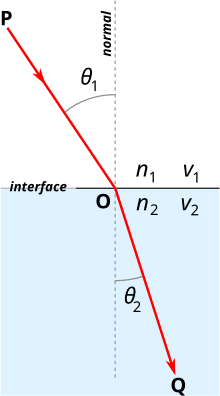
Snell's law relates the incidence and refraction angles at an interface:
The critical angle is the incidence angle at which , meaning the refracted ray grazes the interface. Setting :
For a glass-air interface (, ), this gives . For water-air (, ), . Any incidence angle above produces total internal reflection: the reflectance for both polarizations equals unity, and no time-averaged power crosses the boundary.
Refractive indices of media
The refractive index of a medium is defined as:
where is the speed of light in vacuum and is the phase speed in the medium. Higher means slower phase velocity and stronger bending of light toward the normal upon entry.
- Diamond: (very high, which is why diamonds have a small critical angle and exhibit strong internal reflections)
- Glass (typical):
- Water:
- Air:
The ratio directly sets the critical angle. A larger contrast between the two indices produces a smaller critical angle, making total internal reflection easier to achieve.
Evanescent waves
When total internal reflection occurs, the field doesn't abruptly vanish at the boundary. Instead, an evanescent wave exists in the lower-index medium. This wave carries no time-averaged power away from the interface but stores reactive energy near it.
Characteristics of evanescent waves
To see where the evanescent wave comes from, apply the boundary conditions. Beyond the critical angle, the transverse component of the wave vector in medium 2 becomes imaginary:
where is real and positive. The field in medium 2 then goes as (decaying away from the interface) while still propagating along the interface with a real tangential wave vector . Key properties:
- The amplitude decays exponentially perpendicular to the interface.
- The wave propagates parallel to the interface (it has a real ).
- There is a phase shift between the incident and reflected waves, different for s- and p-polarization. This phase shift is what gives rise to the Goos-Hänchen effect discussed below.
Penetration depth
The penetration depth is the distance into medium 2 at which the electric field amplitude drops to of its value at the interface (intensity drops to , though the conventional definition for ATR uses the intensity point):
Note: some references define penetration depth using the intensity decay (with a factor of in the denominator instead of ). Be careful about which convention your course uses. The version above corresponds to the field amplitude decay length, which is the more common convention in electromagnetic theory.
Penetration depth increases when:
- The wavelength is longer (infrared evanescent fields extend further than visible ones).
- The angle of incidence is closer to (at exactly , , and the wave becomes a propagating refracted beam).
- The index contrast is smaller.
Typical values range from a fraction of a wavelength to several wavelengths.
Intensity and phase
The intensity of the evanescent field decays as:
where the factor of 2 in the exponent comes from squaring the field amplitude. In terms of the penetration depth defined above, this is where for the intensity.
The reflected wave acquires a polarization-dependent phase shift relative to the incident wave. For s-polarization (TE):
For p-polarization (TM):
These phase shifts are physically meaningful: they shift the reflected beam laterally (Goos-Hänchen effect) and can convert linearly polarized light into elliptically polarized light upon reflection, since in general. Fresnel rhombs exploit this differential phase shift to act as quarter-wave retarders.
Frustrated total internal reflection
Frustrated total internal reflection (FTIR) occurs when a third medium is brought within the penetration depth of the evanescent wave. The evanescent field couples into that medium, and some power transmits across the gap. This is the optical analog of quantum mechanical tunneling.

Coupling of evanescent waves
Consider two glass prisms separated by a thin air gap. If the gap is much larger than , total internal reflection in the first prism is essentially complete. As the gap narrows to the order of or less, the evanescent field reaching the second prism is still significant, and it excites a propagating wave in the second prism.
The transmission coefficient depends exponentially on the gap width :
This means even small changes in gap size produce large changes in transmitted power, which is why FTIR is useful for switching and sensing.
Photon tunneling
"Photon tunneling" is the name given to this transmission process by analogy with quantum tunneling through a potential barrier. The tunneling probability increases when:
- The gap is smaller (exponential sensitivity to gap width).
- The angle of incidence is closer to (longer penetration depth).
- The refractive index contrast is smaller (again, longer penetration depth).
At nanoscale gaps between optical elements, tunneling efficiencies can approach unity. This effect is exploited in scanning tunneling optical microscopy and photonic crystal devices.
Applications in optical devices
Frustrated total internal reflection is used in several device types:
- Optical couplers and splitters: Light transfers between adjacent waveguides through evanescent coupling. By controlling the separation and interaction length, you can design 50/50 splitters or variable-ratio couplers.
- Optical switches and modulators: Applying an electric field or mechanical pressure changes the gap width or the refractive index in the gap region, modulating the transmitted power. Response times can be very fast for electro-optic materials.
- Sensors: The exponential sensitivity of tunneling to gap width makes FTIR-based sensors extremely responsive to displacement, pressure, or the presence of thin films.
Goos-Hänchen effect
When a spatially bounded beam (not an infinite plane wave) undergoes total internal reflection, the reflected beam is shifted laterally along the interface relative to the geometric prediction. This is the Goos-Hänchen shift, and it arises because the reflection phase varies with angle, and a real beam contains a spread of angles.
Lateral shift of reflected beam
You can think of it this way: during total internal reflection, the evanescent wave carries energy a short distance along the interface before re-radiating it back into the first medium. The reflected beam exits displaced from where geometric optics would predict.
The shift is typically a fraction of a wavelength to a few wavelengths. For visible light, that's on the nanometer scale; for infrared, it can reach the micrometer scale.
Dependence on polarization and angle
The Goos-Hänchen shift differs for the two polarizations. The standard Artmann formulas (valid for well-collimated beams away from ) are:
For s-polarized (TE) light:
For p-polarized (TM) light:
where is the free-space wave number. A simpler approximate form that captures the essential behavior:
The p-polarized shift is generally larger than the s-polarized shift. Both diverge as (where the penetration depth diverges), though the Artmann formula breaks down very close to the critical angle because the beam distortion becomes significant.
Implications for optical measurements
The Goos-Hänchen shift matters whenever you need sub-wavelength precision in beam positioning:
- Interferometry: The lateral shift introduces an effective path length difference between beams reflecting at different polarizations or angles, which can cause systematic errors in displacement measurements.
- Optical trapping: In tightly focused beams near interfaces, the shift can displace the trap center from its expected position.
- Resonator design: In whispering-gallery-mode resonators and integrated photonic circuits, accumulated Goos-Hänchen shifts over many reflections affect the resonant frequencies and mode structure.
For most everyday optics, the shift is negligible. It becomes important in high-precision metrology, gravitational wave detectors, and nanophotonic devices.

Attenuated total reflection (ATR)
Attenuated total reflection is a spectroscopic technique that uses the evanescent wave from total internal reflection to probe a sample placed at the interface. Because the evanescent wave only penetrates a short distance (typically 0.5 to 5 m in the mid-infrared), ATR is inherently surface-sensitive and requires minimal sample preparation.
Principles of ATR spectroscopy
The setup works as follows:
- An infrared beam enters a high-index crystal (the ATR element) at an angle above the critical angle.
- Total internal reflection occurs at the crystal-sample interface, generating an evanescent wave in the sample.
- The sample absorbs certain wavelengths of the evanescent wave according to its molecular vibrational modes.
- The reflected beam exits the crystal with reduced intensity at the absorbed wavelengths.
- A detector measures the reflected spectrum, which is then converted to an absorption spectrum.
The result is essentially an absorption spectrum of the sample, but only of the thin layer within the penetration depth of the evanescent wave.
Evanescent wave absorption
When the evanescent wave overlaps with a sample that has absorption bands (molecular vibrations, electronic transitions), energy is transferred from the wave to the sample. This reduces the reflected intensity at those specific frequencies.
The effective path length in ATR depends on:
- The number of reflections (more bounces = more interaction = stronger signal)
- The penetration depth at each reflection
- The absorption coefficient of the sample
Because the penetration depth is wavelength-dependent (longer wavelengths penetrate further), ATR spectra show slightly different relative band intensities compared to transmission spectra. Most spectrometer software includes a correction for this.
ATR prisms and waveguides
Common ATR crystal materials are chosen for their high refractive index and broad spectral transparency:
- Diamond (): Extremely hard and chemically inert. Ideal for corrosive or abrasive samples. Expensive but durable.
- Germanium (): Very high index gives a short penetration depth, useful for strongly absorbing samples or surface-sensitive measurements. Opaque below ~600 cm.
- Zinc selenide (): Good mid-IR transparency. Softer and less chemically resistant than diamond.
ATR can also be implemented in waveguide geometries. Optical fibers with exposed or thinned cladding sections act as ATR sensors, enabling remote or in-situ measurements in environments where a benchtop spectrometer can't go (industrial process monitoring, environmental sensing, biomedical probes).
Applications of total internal reflection
Optical fibers and waveguides
Optical fibers confine light by total internal reflection at the core-cladding interface. The core has a slightly higher refractive index than the cladding (typical difference of ~0.01 for single-mode telecom fiber). Light launched within the fiber's acceptance cone reflects repeatedly along the length with very low loss (as low as 0.2 dB/km at 1550 nm for silica fiber).
The evanescent field extending into the cladding is not wasted: it's essential for evanescent wave couplers (directional couplers), fiber Bragg gratings, and fiber-optic sensors that detect changes in the cladding environment.
Prisms and reflectors
Total internal reflection in prisms provides near-perfect reflectance without metallic coatings, which always introduce some absorption loss. Common examples:
- Dove prisms: Invert an image without deviating the beam direction. Used in beam rotators.
- Penta prisms: Deflect a beam by exactly 90° regardless of the input angle. Used in surveying instruments and SLR camera viewfinders.
- Retroreflectors (corner cubes): Return a beam exactly antiparallel to the input. Used in laser ranging (e.g., lunar retroreflectors left by Apollo missions) and safety reflectors.
- Polarizing beam splitters: Exploit the fact that at Brewster's angle, only s-polarized light reflects. Combined with total internal reflection geometry, these separate orthogonal polarizations with high extinction ratios.
Biosensors and surface plasmon resonance
Surface plasmon resonance (SPR) biosensing is one of the most important applications of evanescent waves. The setup uses total internal reflection at a glass-metal (typically gold, ~50 nm thick) interface. At a specific angle, the evanescent wave's in-plane wave vector matches the surface plasmon dispersion, and energy couples resonantly into the plasmon mode. This produces a sharp dip in reflected intensity.
The resonance angle is extremely sensitive to the refractive index within ~200 nm of the metal surface. When target molecules (proteins, DNA, small molecules) bind to receptor molecules immobilized on the gold surface, the local refractive index changes, shifting the resonance angle. SPR can detect binding events in real time without fluorescent labels, with sensitivity down to pg/mm surface coverage.
Fingerprint recognition and security systems
Fingerprint scanners based on total internal reflection work by pressing a finger against a glass prism. Where the skin ridges contact the glass, the evanescent wave is frustrated (the skin has , close to glass), and light escapes into the finger. Where the valleys don't contact the glass, total internal reflection is maintained and the light reflects strongly.
The result is a high-contrast image of the fingerprint pattern. This optical approach provides better image quality than capacitive sensors in many conditions, though it requires a larger optical assembly. Similar evanescent-wave imaging principles are used in some palm vein scanners and total internal reflection fluorescence (TIRF) microscopy in biological research.
See Fiveable more often in Google
Mark Fiveable as a preferred source and Google is more likely to show you our guides in Top Stories, with a "preferred" badge in AI Mode and AI Overviews.