13.3 Facts About the F Distribution

🎲Intro to Statistics Unit 13 Review
13.3 Facts About the F Distribution
🎲 Intro to Statistics
Key Characteristics and Applications of the F Distribution
The F distribution is a probability distribution used to compare variability between groups. It's central to ANOVA, regression analysis, and variance comparisons, helping you determine whether observed differences are statistically significant or just due to random chance.

Top images from around the web for Characteristics of F distribution
Facts about the F Distribution – Adapted By Darlene Young Introductory Statistics View original
Is this image relevant?
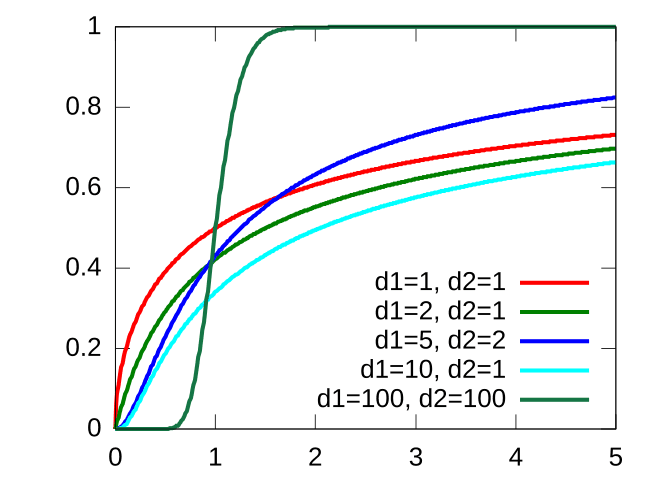
F-distribution - Wikipedia View original
Is this image relevant?
Facts about the F Distribution | Introduction to Statistics View original
Is this image relevant?
Facts about the F Distribution – Adapted By Darlene Young Introductory Statistics View original
Is this image relevant?
F-distribution - Wikipedia View original
Is this image relevant?
Characteristics of the F Distribution
The F distribution is a continuous probability distribution that is always positive and skewed to the right. The curve starts at zero and extends indefinitely to the right, approaching but never touching the x-axis. As the F-value increases, the probability density decreases, meaning larger F-values are increasingly unlikely to occur by chance alone.
Two parameters define every F distribution:
- (numerator degrees of freedom): tied to the number of groups being compared
- (denominator degrees of freedom): tied to the total sample size minus the number of groups
The mean of the F distribution is approximately , but only when . Notice that when is small (say, 3 or 4), the mean is noticeably greater than 1. As grows large, the mean approaches 1.

Impact of Degrees of Freedom
The shape of the F distribution changes depending on and :
- With smaller degrees of freedom, the distribution is heavily skewed to the right.
- As both degrees of freedom increase, the distribution becomes more symmetrical and starts to resemble a normal distribution.
- Increasing (holding constant) shifts the peak to the right.
- Increasing (holding constant) shifts the peak to the left and makes the right tail thinner.
A practical takeaway: larger sample sizes give you larger degrees of freedom, which makes the F distribution less skewed and your critical values easier to work with.

Applications in Statistical Analysis
Analysis of Variance (ANOVA)
ANOVA tests whether three or more population means are equal. The F-statistic is calculated as:
A large F-value means the differences between group means are large relative to the variability inside each group. That's evidence the group means aren't all the same.
Regression Analysis
In regression, the F-test checks whether your overall model explains a significant amount of variation in the response variable. The F-statistic here is:
A large F-value suggests that at least one predictor in your model is significantly related to the response variable, meaning the model fits better than a model with no predictors at all.
Comparison of Variances
You can also use the F distribution to compare the variances of two populations. The F-statistic is the ratio of the larger sample variance to the smaller sample variance. A large F-value indicates the two populations have significantly different spreads.
Hypothesis Testing with the F Distribution
When you run an F-test, you're testing a null hypothesis (e.g., all group means are equal) against an alternative (at least one mean differs). Here's the general process:
- Calculate the F-statistic from your data.
- Determine the critical value using your chosen significance level (commonly ) and the appropriate and .
- Compare: if your F-statistic exceeds the critical value, you reject the null hypothesis. Equivalently, if the p-value is less than , you reject.
The F-test is always right-tailed in ANOVA. You're only looking at whether the F-statistic is large enough to fall in the upper tail of the distribution, because only large ratios of between-group to within-group variability suggest real differences.
Keep in mind that statistical power (your ability to detect a real effect) depends on sample size, effect size, and your significance level. Larger samples and larger true differences between groups both make it easier to get a significant result.
See Fiveable more often in Google
Mark Fiveable as a preferred source and Google is more likely to show you our guides in Top Stories, with a "preferred" badge in AI Mode and AI Overviews.