13.2 The F Distribution and the F-Ratio

🎲Intro to Statistics Unit 13 Review
13.2 The F Distribution and the F-Ratio
🎲 Intro to Statistics
The F Distribution
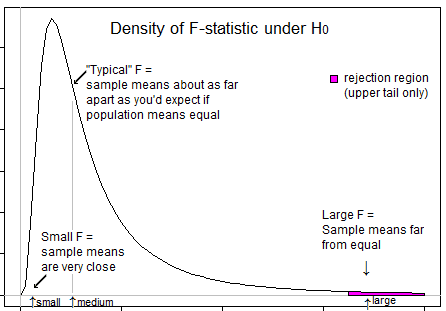
The F distribution is a right-skewed probability distribution used in ANOVA to determine whether the means of three or more groups are significantly different. It works by comparing two types of variance: the spread between group means and the spread within each group. If the between-group variance is much larger than the within-group variance, that's evidence the groups aren't all the same.

Top images from around the web for F-ratio calculation from variances
Test of Two Variances · Statistics View original
Is this image relevant?
Why do we use a one-tailed test F-test in analysis of variance (ANOVA)? - Cross Validated View original
Is this image relevant?
R Tutorial Series: R Tutorial Series: One-Way Omnibus ANOVA View original
Is this image relevant?
Test of Two Variances · Statistics View original
Is this image relevant?
Why do we use a one-tailed test F-test in analysis of variance (ANOVA)? - Cross Validated View original
Is this image relevant?
How the F-Ratio Works
The F-ratio is the core test statistic in one-way ANOVA. It asks a simple question: is the variation between groups large relative to the variation inside each group?
- (mean square between groups) captures how spread out the group means are from each other.
- (mean square within groups) captures the typical variability of individual observations around their own group mean.
When the null hypothesis is true (all group means are equal), both the numerator and denominator estimate the same underlying variance, so the F-ratio hovers around 1. When group means genuinely differ, grows larger than , pushing the F-ratio well above 1.

Calculating the F-Ratio Step by Step
Here's the full process for computing the F-ratio in a one-way ANOVA:
Step 1: Find the grand mean. The grand mean () is the mean of all observations across every group.
Step 2: Calculate .
- = number of groups
- = sample size of group
- = mean of group
This measures how far each group mean is from the grand mean, weighted by group size.
Step 3: Calculate .
- = the -th observation in group
This measures how much individual data points vary around their own group mean.
Step 4: Compute degrees of freedom.
- , where is the total number of observations across all groups
Step 5: Compute mean squares.
Step 6: Compute the F-ratio.
Interpreting the F-Statistic
Once you have the F-ratio, you need to decide whether it's large enough to reject the null hypothesis. There are two equivalent ways to do this:
Using a critical value: Look up the critical F-value from an F-distribution table using and at your chosen significance level (typically ).
- If your F-ratio > critical value, reject . At least one group mean is significantly different.
- If your F-ratio ≤ critical value, fail to reject . There isn't enough evidence to say the group means differ.
Using a p-value: The p-value tells you the probability of getting an F-ratio at least as large as yours if the null hypothesis were true.
- If p-value < , reject .
- If p-value ≥ , fail to reject .
One thing to keep in mind: the F-distribution is always right-skewed and only takes positive values, so ANOVA is always a right-tailed test. You're only looking at whether the F-ratio is unusually large, not unusually small.
Hypothesis Testing in ANOVA
Every one-way ANOVA follows the same hypothesis structure:
- Null hypothesis (): All group population means are equal ().
- Alternative hypothesis (): At least one group mean differs from the others.
Notice that the alternative doesn't say which mean is different or how many differ. ANOVA only tells you that at least one group stands apart. If you reject , you'd need follow-up tests (called post-hoc tests) to figure out which specific groups differ.
How Sample Size Affects the F-Distribution
The shape of the F-distribution depends entirely on its two degrees of freedom: and .
- With small degrees of freedom, the F-distribution is heavily right-skewed with a long tail. This means the critical value for rejection is relatively high, making it harder to reach significance.
- As degrees of freedom increase, the distribution becomes more symmetric and concentrated around 1. The critical value drops, so smaller differences between groups can reach significance.
Since , increasing your total sample size directly increases . This has two practical effects:
- becomes a more precise estimate of within-group variance.
- The F-distribution tightens, so the test becomes more sensitive to real differences between group means.
In short, larger samples give you more statistical power to detect genuine differences. With very small samples, only large differences between groups will produce a significant F-ratio.
See Fiveable more often in Google
Mark Fiveable as a preferred source and Google is more likely to show you our guides in Top Stories, with a "preferred" badge in AI Mode and AI Overviews.