4.3 Conservation of Linear Momentum

🎡AP Physics 1 Unit 4 Review
4.3 Conservation of Linear Momentum
🎡 AP Physics 1
Conservation of linear momentum means the total momentum of a system stays constant when no net external force acts on it. You use this idea to predict velocities before and after collisions and explosions by setting the total momentum before an interaction equal to the total momentum after.
Why This Matters for the AP Physics 1 Exam
Conservation of momentum is one of the most useful tools in mechanics because it lets you analyze interactions without knowing the messy details of the forces involved. On the AP Physics 1 exam, you can expect to:
- Set up momentum equations for collisions and explosions in one dimension and reason through two-dimensional setups.
- Connect momentum conservation back to Newton's third law and the impulse-momentum theorem.
- Reason about how changing a mass, speed, or angle changes the outcome without solving simultaneous equations.
This topic also supports experimental reasoning. Since the third free-response question is the Experimental Design and Analysis question, you may need to design a collision experiment, collect data, linearize it, and use a best-fit line to support a claim about momentum.
Key Takeaways
- Total momentum of a system is the vector sum of each part's momentum: add magnitudes and directions, not just numbers.
- If the net external force on your chosen system is zero, total momentum stays constant.
- Momentum is conserved in every interaction; the system you pick decides whether you call a force internal or external.
- Internal forces come in equal and opposite pairs (Newton's third law), so they cannot change a system's total momentum.
- A nonzero net external force transfers momentum between the system and its surroundings, and that transfer equals the impulse.
- The center-of-mass velocity of a system stays constant when no net external force acts, even during internal collisions or explosions.
Center-of-Mass Velocity
The center of mass of a system represents the average position of all the mass, and it moves as if all the mass were concentrated at that point.
A group of objects, each with its own momentum, can be treated as a single system with one center-of-mass velocity that represents the overall motion.
- The center-of-mass velocity is found from: where is the sum of all individual momenta and is the total mass of the system.
- This treats the whole system as if its momentum were concentrated at one point.
- In the absence of a net external force, the center-of-mass velocity stays constant, no matter what happens internally.
Application: when a rocket in space ejects fuel, the center-of-mass velocity of the rocket-fuel system stays unchanged, even though the rocket itself accelerates opposite to the ejected fuel.
Total System Momentum
The total momentum of a system equals the vector sum of the momenta of all its parts. Because momentum is a vector, you have to track both magnitude and direction.
- In a collision between two objects, the total system momentum before equals the total system momentum after.
- This holds even when the individual momenta change dramatically.
- Written out:
Application: when two billiard balls collide on a frictionless table, their individual momenta change, but the sum stays the same before and after.
Momentum Changes Within Systems
Internal forces between objects can shift individual momenta around while keeping the total momentum of the system fixed.
With no net external force, any change in one object's momentum must be balanced by an equal and opposite change in another object's momentum. This follows directly from Newton's third law.
- When two objects interact, the impulse object A exerts on object B is equal and opposite to the impulse B exerts on A.
- You can keep a system's total momentum constant by choosing system boundaries that include all interacting objects.
- If a system's total momentum does change, that change equals the impulse exerted on the system:
Application: when a person jumps from a boat to a dock, the boat moves the opposite way. The person gains momentum one direction while the boat gains an equal amount the other direction, so the person-boat total stays constant.
System Selection for Momentum
Conservation in All Interactions
Momentum is conserved in every interaction, no matter which system you choose. Your choice of system changes how you interpret and calculate momentum changes, but not the underlying conservation principle.
- Defining clear system boundaries makes complex problems simpler.
- Expanding or shrinking the system can turn an external force into an internal force, or the reverse.
Zero Net External Force
When the net external force on your selected system is zero, the total momentum of that system stays constant. This works for both elastic and inelastic collisions.
- Written out: or
- This lets you find final velocities after collisions when you know the initial velocities and masses.
- In a perfectly inelastic collision, the objects stick together and move with one common final velocity, which you can find from momentum conservation.
Application: two ice skaters pushing off each other on frictionless ice move in opposite directions, with their momenta canceling out.
Nonzero Net External Force
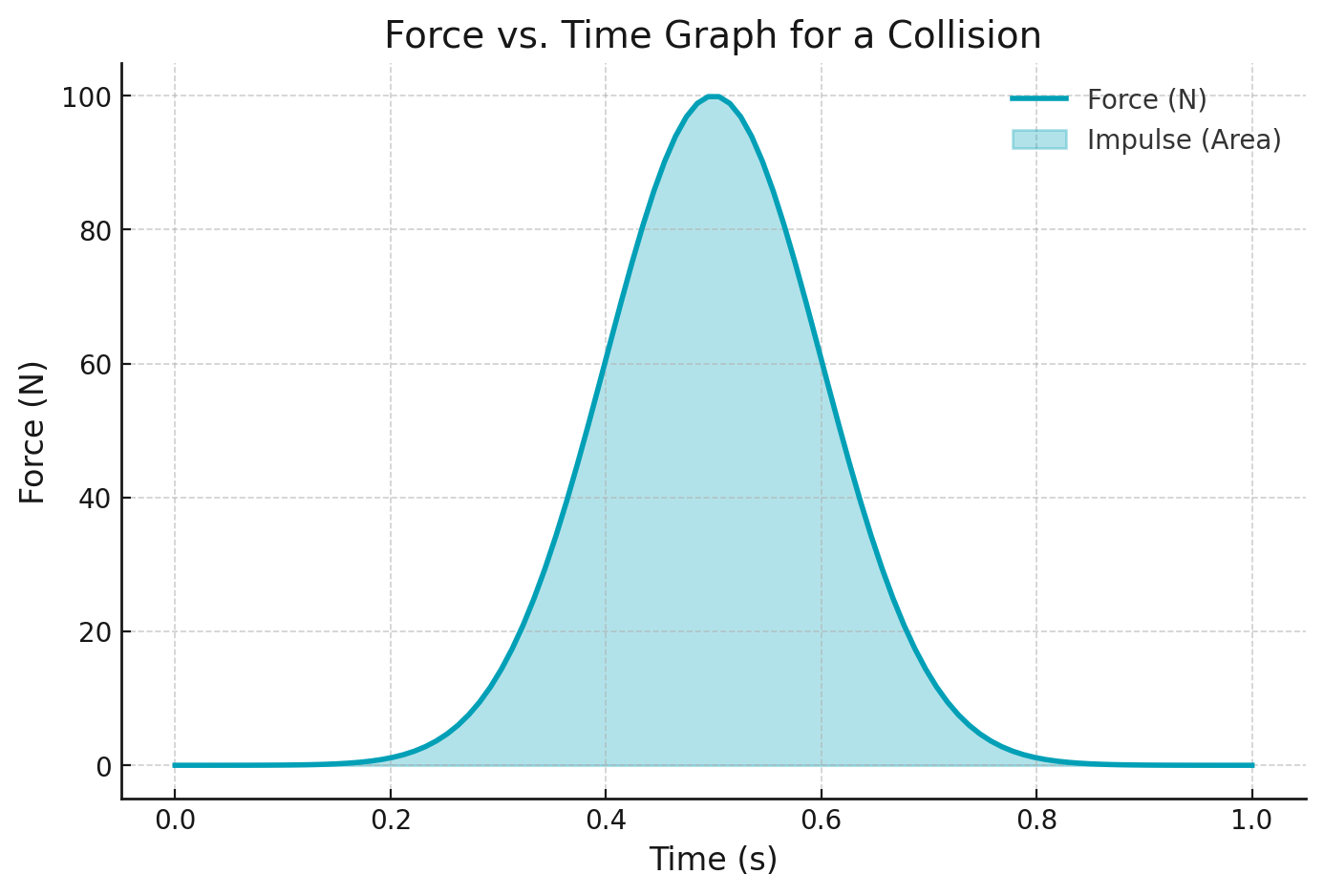
If there is a nonzero net external force on your selected system, momentum is transferred between the system and its surroundings. The change in the system's momentum equals the impulse from that external force.
- When a ball bounces off the ground, the ground exerts an external force on the ball, transferring momentum between the ball and the Earth.
- Friction between moving objects and the ground is an external force that can change a system's total momentum over time.
- Expanding the system to include all interacting objects (like including the Earth) often restores momentum conservation.
🚫 Boundary Statements:
- AP Physics 1 covers conservation of momentum in one dimension quantitatively and qualitatively, and in two dimensions semi-quantitatively.
- The exam may ask you to set up equations and reason about how changing mass, speed, or angle affects other quantities, but will not require solving simultaneous equations.
- AP Physics 2 includes full treatment of two-dimensional conservation of momentum problems with one unknown final velocity.
How to Use This on the AP Physics 1 Exam
Problem Solving
- Define your system first, then check whether the net external force is zero. If it is, set total momentum before equal to total momentum after.
- Pick a positive direction and stick with it. Momentum is a vector, so leftward or downward values are negative.
- For a perfectly inelastic collision, the objects share one final velocity, so use on the final side.
Two-Dimensional Setups
- Split momentum into x and y components and conserve each direction separately.
- You are expected to set up the equations and reason qualitatively, not solve simultaneous equations.
Free Response
- For the Experimental Design and Analysis question, be ready to describe how you would collect collision data, linearize it, and use a best-fit line to support a claim.
- When asked to justify, connect equal and opposite impulses back to Newton's third law to explain why internal forces cannot change total momentum.
Common Misconceptions
- Misconception: Momentum is the same as kinetic energy.Actually: Momentum is not the same as kinetic energy. Momentum can be conserved in a collision even when kinetic energy is not, like in an inelastic collision.
- Misconception: "Conserved" means each object keeps its own momentum.Actually: "Conserved" does not mean each object keeps its own momentum. It means the system total stays constant while individual momenta can change.
- Misconception: Momentum is a scalar.Actually: Momentum is a vector. You cannot just add speeds or magnitudes; opposite directions partly or fully cancel.
- Misconception: Conservation depends on the collision being elastic.Actually: Conservation does not depend on the collision being elastic. Total momentum is conserved in elastic, inelastic, and perfectly inelastic collisions as long as the net external force is zero.
- Misconception: An external force breaks the law of conservation.Actually: An external force does not break the law of conservation. It transfers momentum to or from the system, equal to the impulse delivered.
- Misconception: Whether momentum is conserved does not depend on your system choice.Actually: Whether momentum is "conserved" for a system depends on your system choice. Picking a wider system can turn an external force into an internal one.
Practice Problem 1: Conservation of Linear Momentum
Two ice skaters are initially stationary, standing face to face. The first skater has a mass of 60 kg, and the second has a mass of 40 kg. The first skater pushes the second, causing the second skater to move away at 3 m/s. Assuming friction is negligible, determine the velocity of the first skater after the push.
Solution:
-
Identify the initial and final states:
- Initial: Both skaters are stationary, so
- Final: Second skater moves at m/s, and we need to find
-
Apply conservation of momentum:
- Initial momentum:
- Final momentum:
- Since momentum is conserved:
-
Solve for the unknown velocity:
- m/s
-
The negative sign indicates that the first skater moves in the opposite direction to the second skater, with a speed of 2 m/s.
Practice Problem 2: Center-of-Mass Velocity
Three objects are moving along the x-axis. Object A has mass 2 kg and velocity 3 m/s. Object B has mass 4 kg and velocity -2 m/s. Object C has mass 1 kg and velocity 6 m/s. What is the velocity of the center of mass of this system?
Solution:
-
Identify the masses and velocities:
- kg, m/s
- kg, m/s
- kg, m/s
-
Calculate the total momentum:
-
Calculate the total mass:
- kg
-
Find the center-of-mass velocity:
- m/s
-
The center of mass of the system moves at approximately 0.57 m/s in the positive x-direction.
Practice Problem 3: Two-Dimensional Momentum Setup
Two carts collide and stick together. Cart 1 moves east before the collision, and Cart 2 moves north before the collision. Describe how to set up the momentum equations for the x- and y-directions, and explain qualitatively how increasing the mass of Cart 2 would affect the direction of the final velocity.
Solution:
-
Choose east as the +x-direction and north as the +y-direction.
-
Apply conservation of momentum separately in each direction:
- x-direction:
- y-direction:
-
The final velocity points somewhere northeast because the system has momentum in both x and y.
-
If the mass of Cart 2 increases while its initial speed stays the same, the y-component of momentum increases, so the final direction becomes more northward.
-
This kind of setup and qualitative reasoning is within AP Physics 1 scope; fully solving simultaneous two-dimensional momentum equations is not required.
Related AP Physics 1 Guides
Practice Questions for 4.3
1 of 10
Puck A of mass travels east with speed and collides with Puck B of mass initially at rest, as shown in the figure. After the collision, Puck A moves northeast. Based on the conservation of linear momentum, which claim about Puck B's motion is correct?
Which of the following must be true about the velocity of Puck B immediately after the collision?
A.
Puck B must have a velocity component directed to the south.
B.
Puck B must remain at rest.
C.
Puck B must move due east.
D.
Puck B must have a velocity component directed to the north.
Vocabulary
The following words are mentioned explicitly in the AP® course framework for this topic.Term | Definition |
|---|---|
center of mass | The point in a system where all the mass can be considered to be concentrated for the purpose of analyzing motion and forces. |
center-of-mass velocity | The velocity of the center of mass of a system, calculated as the total momentum divided by the total mass. |
collision | An interaction between objects where the forces exerted between them are much larger than external forces, allowing analysis of initial and final states. |
conservation of momentum | The principle that the total momentum of a system remains constant when no net external force acts on the system. |
explosion | An interaction in which internal forces within a system move objects apart. |
impulse | The change in momentum of an object, equal to the force applied multiplied by the time interval over which it acts. |
momentum | A vector quantity that describes the motion of an object, equal to mass times velocity, with direction matching the velocity. |
net external force | The vector sum of all forces acting on a system from outside the system. |
Newton's third law | The principle that forces always occur in equal and opposite pairs: if object A exerts a force on object B, then object B exerts an equal and opposite force on object A. |
system | A collection of objects and their interactions that are studied together as a single unit. |
Frequently Asked Questions
What does conservation of linear momentum mean?
Conservation of linear momentum means the total momentum of a selected system stays constant when the net external force on that system is zero. Individual objects can change momentum, but the system total does not.
How do I choose a system for momentum conservation?
Choose a system that includes the objects interacting with each other. If the important forces are internal to that system and the net external force is zero or negligible, total momentum is conserved.
What is the center-of-mass velocity equation for AP Physics 1?
For a collection of objects, v_cm equals the sum of individual momenta divided by total mass, or sum(m_i v_i) divided by sum(m_i). With no net external force, the center-of-mass velocity stays constant.
How are Newton's third law and momentum conservation connected?
During an interaction, the impulses two objects exert on each other are equal and opposite. Those internal impulses change individual momenta but cancel for the whole system.
What is the AP Physics 1 boundary for two-dimensional momentum?
AP Physics 1 treats conservation of momentum quantitatively in one dimension and semiquantitatively in two dimensions. You may need to set up component equations or reason about changes, but not solve simultaneous equations.
What is a common mistake in conservation of momentum problems?
A common mistake is treating momentum like speed. Momentum is a vector, so direction and signs matter. Pick a positive direction and keep it consistent before and after the interaction.
See Fiveable more often in Google
Mark Fiveable as a preferred source and Google is more likely to show you our guides in Top Stories, with a "preferred" badge in AI Mode and AI Overviews.