2.5 Newton's Second Law

🎡AP Physics 1 Unit 2 Review
2.5 Newton's Second Law
🎡 AP Physics 1
Newton's second law says the acceleration of a system's center of mass is set by the net force divided by the system's mass, and that acceleration points in the same direction as the net force. If the net external force is not zero, the system's velocity changes. Use this idea to connect free-body diagrams, equations, and motion predictions.
Why This Matters for the AP Physics 1 Exam
Newton's second law is one of the tools you will reach for over and over in AP Physics 1. It connects free-body diagrams to actual numbers and predictions, so it shows up in force and motion problems across the whole course, including later topics like friction, circular motion, and rotational dynamics.
This topic is a strong fit for translating between representations. You might describe forces in words, draw a free-body diagram, set up , and then explain how your equation matches your prediction. That kind of back-and-forth between words, diagrams, and math is exactly what the Qualitative/Quantitative Translation (QQT) free-response question asks you to do, and that question can pull from any unit. Building fluency here pays off on both multiple-choice and free-response questions.
Key Takeaways
- A nonzero net external force is what changes a system's velocity. No net force means no change in velocity.
- Acceleration is proportional to net force and inversely proportional to mass: .
- Acceleration always points in the same direction as the net force.
- The law describes the motion of the system's center of mass, not every individual part.
- Internal forces between parts of a system cannot change the center-of-mass velocity. Only external forces can.
- Force is measured in newtons, where .
Conditions for a Velocity Change
Unbalanced Forces
Forces are unbalanced when they do not cancel out, so the net force on the system is not zero. Unbalanced forces produce acceleration in the direction of the net force.
- Push a box harder than friction resists it, and the box speeds up in the direction you push.
- In a tug-of-war, if one side pulls with more force, the rope accelerates toward that side.
When forces are balanced, the net force is zero and the velocity stays constant. A book resting on a table has gravity pulling down and the normal force pushing up with equal magnitude, so it does not accelerate. That is the Newton's first law situation.
Newton's Second Law of Motion
Newton's second law states that the acceleration of a system's center of mass is proportional to the net force and in the same direction as that net force:
Where:
- is the acceleration of the system's center of mass
- is the net force on the system
- is the mass of the system
What this relationship tells you:
- Doubling the net force doubles the acceleration.
- Doubling the mass cuts the acceleration in half.
- Acceleration points in the same direction as the net force.
Example: a 2 kg object with a 10 N net force accelerates at , while a 5 kg object with that same 10 N net force accelerates at only . More mass means more resistance to a change in motion.
Net External Force
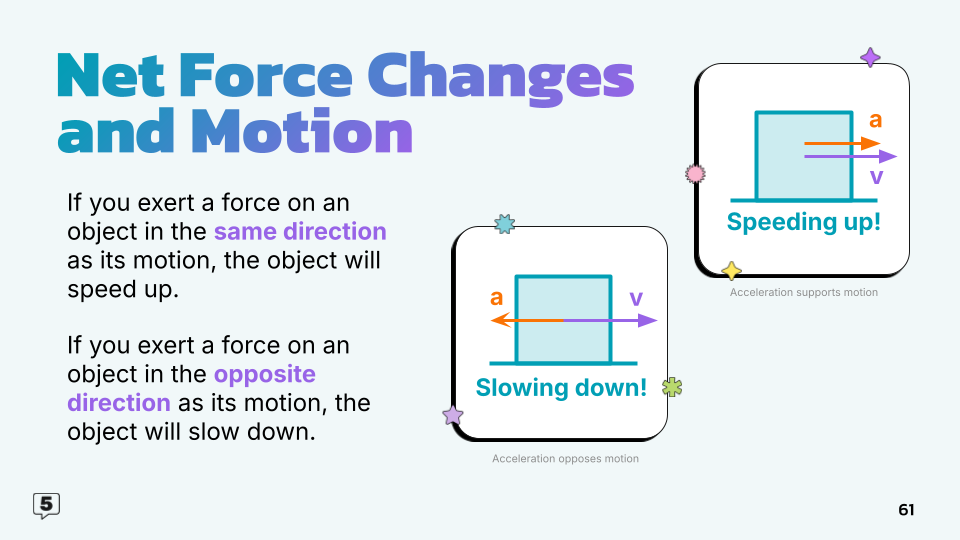
For a system's center-of-mass velocity to change, there must be a nonzero net external force. Keeping external and internal forces straight is what makes this law work correctly.
External forces come from outside the chosen system and can change the system's overall motion:
- Friction between an object and a surface
- The gravitational pull from Earth
- Air resistance
- A push or pull from a person or machine
Internal forces act between parts of the system and do not change the center-of-mass motion. If your system is a person plus a boat, the forces between the person and the boat are internal. Those forces can make the person and boat move relative to each other, but they cannot change the velocity of the system's center of mass. Only a nonzero net external force can do that.
When the net external force is zero:
- An object at rest stays at rest.
- An object in motion keeps moving at constant velocity in a straight line.
When the net external force is not zero:
- The object accelerates following Newton's second law.
- The acceleration direction matches the net force direction.
- The size of the acceleration depends on both the net force and the mass.
Application: a skydiver first accelerates downward because gravity is larger than air resistance. As speed increases, air resistance grows until it balances gravity. The net force becomes zero, and the skydiver falls at constant terminal velocity.
How to Use This on the AP Physics 1 Exam
Problem Solving
A reliable order for force problems:
- Choose your system and draw a free-body diagram with each force as a separate arrow from the center-of-mass dot.
- Pick axes, ideally with one axis along the direction of acceleration.
- Write for each direction separately.
- Solve for the unknown, then check that units work out to newtons or .
Free Response
For a translation-style question, be ready to make a claim in words first, support it with reasoning that does not lean on equations, then derive the equation, and finally explain how your equation backs up your original claim. Practice connecting the verbal reasoning to the math instead of jumping straight to numbers.
Common Trap
Forces in two dimensions may be balanced in one direction and unbalanced in another. The velocity only changes in the direction with a nonzero net force, so handle each axis on its own.
Practice Problem 1: Unbalanced Forces
A 5 kg box is sitting on a horizontal surface. If you push horizontally with a force of 20 N and the box experiences a friction force of 15 N in the opposite direction, what will be the box's acceleration?
Solution: First, identify all horizontal forces and find the net force.
Forces acting horizontally:
- Applied force: 20 N (to the right)
- Friction force: 15 N (to the left)
Net force = 20 N - 15 N = 5 N (to the right)
Now apply Newton's second law:
The box accelerates at in the direction of the applied force (to the right).
Practice Problem 2: Mass and Acceleration Relationship
Two objects are pushed with the same force. Object A has a mass of 2 kg and accelerates at 4 m/s². What is the mass of object B if it accelerates at 1 m/s² when pushed with the same force?
Solution: From Newton's second law, . Since the force is the same for both objects:
You know:
Solving for :
Object B has a mass of 8 kg, which is why it accelerates less than Object A under the same force.
Common Misconceptions
- Misconception: Force causes velocity.Actually: Force causes acceleration, which is a change in velocity. An object can be moving fast with zero net force on it.
- Misconception: Heavier objects always accelerate more.Actually: For the same net force, more mass means less acceleration, not more.
- Misconception: Any force on the system changes its motion.Actually: Only the net external force matters. Internal forces between parts of the system cannot change the center-of-mass velocity.
- Misconception: Acceleration follows the direction of motion.Actually: Acceleration follows the direction of the net force, which may differ from the direction the object is currently moving.
- Misconception: Balanced forces mean the object is at rest.Actually: Balanced forces mean constant velocity, which can be zero or a steady nonzero speed in a straight line.
- Misconception: You can use the net force in one direction to predict motion in every direction.Actually: Treat each axis separately. Forces can be balanced along one axis and unbalanced along another.
Related AP Physics 1 Guides
Practice Questions for 2.5
1 of 10
A object moves along a straight horizontal track. The position of the object as a function of time is shown in the graph, where the curve is a parabola passing through the origin.
Which of the following is most nearly the magnitude of the net force exerted on the object?
A.
B.
C.
D.
Vocabulary
The following words are mentioned explicitly in the AP® course framework for this topic.Term | Definition |
|---|---|
acceleration | The rate of change of velocity with respect to time. |
center of mass | The point in a system where all the mass can be considered to be concentrated for the purpose of analyzing motion and forces. |
net force | The vector sum of all forces acting on an object or system. |
Newton's second law of motion | The principle stating that the acceleration of a system's center of mass is proportional to the net force exerted on it and occurs in the same direction as that force. |
nonzero net external force | A net force applied to a system from outside that is not equal to zero, causing the system's velocity to change. |
unbalanced forces | A configuration of forces where the net force exerted on a system is not equal to zero, resulting in acceleration. |
velocity | A vector quantity that describes both the speed and direction of an object's motion. |
Frequently Asked Questions
What is Newton's second law in AP Physics 1?
Newton's second law says a system's center-of-mass acceleration is proportional to the net external force and points in the same direction: a_sys = F_net / m_sys.
What does net force mean?
Net force is the vector sum of all external forces on a system. A nonzero net force causes acceleration.
Why does acceleration point in the direction of net force?
Newton's second law is a vector relationship, so the acceleration vector has the same direction as the net external force vector.
What is the difference between internal and external forces?
Internal forces act between parts of the chosen system and cannot change the center-of-mass motion. External forces come from outside the system and can change it.
How should you use Newton's second law on AP Physics 1 FRQs?
Choose a system, draw a free-body diagram, write sum of forces equals ma for each axis, and connect the equation back to the physical prediction.
See Fiveable more often in Google
Mark Fiveable as a preferred source and Google is more likely to show you our guides in Top Stories, with a "preferred" badge in AI Mode and AI Overviews.