1.3 Representing Motion

🎡AP Physics 1 Unit 1 Review
1.3 Representing Motion
Representing motion means describing how an object moves using diagrams, graphs, equations, and words, and being able to switch between those forms. The big skills are reading slopes and areas off motion graphs, using the three constant acceleration kinematic equations, and tracking signs to show direction.
Why This Matters for the AP Physics 1 Exam
This topic builds the core toolkit you use across all of AP Physics 1: turning one description of motion into another. On the exam, you will read position, velocity, and acceleration graphs, pull values from them, and use the kinematic equations to solve for missing quantities. Translating between representations (a sketch, a graph, an equation, and a verbal description) is exactly the kind of thinking the free-response section rewards, and graph analysis shows up heavily in multiple choice. Getting comfortable with these representations now makes forces, energy, and momentum much easier later.
Key Takeaways
- Motion can be shown as a motion diagram, a figure, a graph, an equation, or a written description, and you should be able to move between them.
- The three constant-acceleration kinematic equations only work when acceleration is constant.
- On a position-time graph, the slope of the tangent line is instantaneous velocity. On a velocity-time graph, the slope of the tangent line is instantaneous acceleration.
- Area under a velocity-time graph is displacement; area under an acceleration-time graph is change in velocity.
- Near Earth's surface, gravity gives a constant downward acceleration of about , independent of mass.
- Signs carry direction: pick a positive direction first and stay consistent the whole problem.
Motion Representations
Motion diagrams and descriptions
Motion can be represented in several ways, and each one highlights something different:
- Motion diagrams show an object's position at evenly spaced moments in time. Spacing between dots tells you whether the object is speeding up, slowing down, or moving at constant speed.
- Figures like labeled sketches, paths, or position snapshots help you picture how position changes.
- Graphs connect kinematic quantities (position, velocity, acceleration) to time.
- Equations describe motion mathematically and let you solve for unknowns.
- Narrative descriptions explain the motion in words and often give context.
Being able to start from any one of these and produce the others is the main skill here.
Kinematic equations
When an object has constant acceleration, three equations describe its linear motion in one dimension. They relate position, velocity, acceleration, and time.
This relates final velocity to initial velocity and acceleration. Velocity changes linearly with time under constant acceleration.
This gives position as a function of time, accounting for both initial velocity and acceleration.
This relates velocity directly to position and leaves out time, which is handy when you do not know the time.
These equations work in any single direction. Just swap variables for the direction you need (for example, use for vertical motion). They only apply when acceleration is constant.
Variable interpretation: is displacement in the chosen direction (meters), is final velocity (m/s), is initial velocity (m/s), is acceleration (m/s²), and is time (s). Working specifically in the x-direction, use and consistently.
To solve a problem, list what you know and what you need. Then choose the equation that contains only one unknown.
EXAMPLE:
A super car races by at a speed of 68 m/s and slows down at a rate of 4 m/s². How much runway is needed to stop the car? We are given , , and , but we are missing and .
Use . Since the car stops, .
STEP 1: Substitute:
STEP 2: Solve: , so
Final answer:
Acceleration due to gravity

Near Earth's surface, all objects experience a constant downward acceleration due to gravity, no matter their mass.
This rounded value is what AP Physics 1 uses for numerical work, but you will not be penalized for correctly using or . This acceleration acts only vertically and stays constant near Earth's surface.
For falling objects, plug into the kinematic equations as the acceleration. For objects thrown upward, gravity still points downward (negative if you choose upward as positive).
EXAMPLE: A ball is dropped from the top of a building. It falls for 2.8 s. What is the displacement of the ball?
Choose a sign convention first. If upward is positive, then and .
We are given , , and , but we are missing and .
Using :
STEP 1: Drop because a dropped object starts with velocity 0 m/s.
STEP 2: Plug in:
The negative sign means the ball is 39.2 m below its starting point.
What is the ball's final velocity?
Using :
STEP 1: Drop because a dropped object starts with velocity 0 m/s.
STEP 2: Plug in:
The negative sign means the final velocity points downward.
Note: If downward is chosen as positive, then the answers are +39.2 m and +28 m/s, but state the sign convention explicitly.
Motion graphs
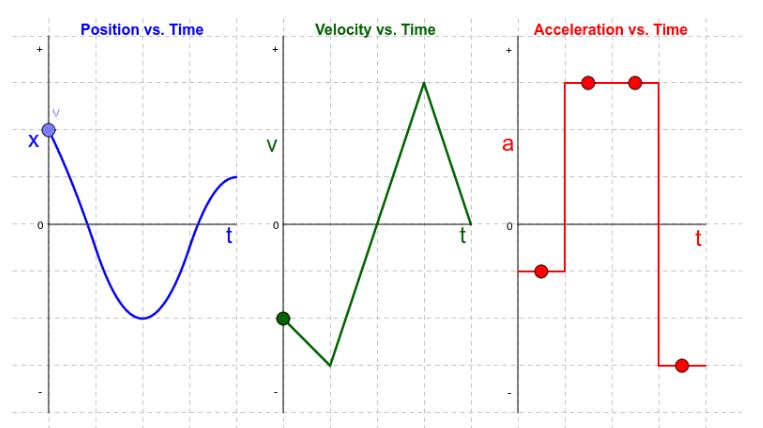
Motion graphs show how position, velocity, and acceleration change over time. They reveal relationships you can read at a glance.
Position-time graphs show where an object is at each moment:
- The slope at any point equals instantaneous velocity.
- For a curved position-time graph, instantaneous velocity at a moment is the slope of the tangent line at that point.
- Positive slope means motion in the positive direction.
- Steeper slopes mean faster movement.
- Horizontal sections mean the object is momentarily stopped.
Velocity-time graphs show how fast an object moves at each moment:
- The slope at any point equals instantaneous acceleration.
- For a curved velocity-time graph, instantaneous acceleration at a moment is the slope of the tangent line at that point.
- Positive slope means positive acceleration; negative slope means negative acceleration.
- An object speeds up when velocity and acceleration have the same sign.
- An object slows down when velocity and acceleration have opposite signs.
- Displacement during a time interval equals the signed area between the velocity-time curve and the time axis. Areas above the axis count as positive displacement; areas below count as negative.
Acceleration-time graphs show how the rate of velocity change varies:
- The area under the curve equals the change in velocity during that interval.
- Constant acceleration appears as a horizontal line.
- Zero acceleration (constant velocity) appears as a line along the time axis.
🚫 Boundary Statement
AP Physics 1 does not require you to quantitatively analyze nonuniform acceleration on the exam. You should still be able to qualitatively analyze, sketch appropriate graphs of, and discuss situations with nonuniform acceleration.
🚫 Boundary Statement
For exam questions that require a numerical value for , use . You will not be penalized for correctly using more precise values like or .
How to Use This on the AP Physics 1 Exam
Problem Solving
- List your known and unknown variables before picking an equation. Choose the kinematic equation with only one unknown.
- Pick a positive direction at the very start and keep your signs consistent for the whole problem.
- Confirm acceleration is constant before using any kinematic equation. If it is not, switch to graph reasoning.
- Check that your answer's sign makes physical sense (for example, a downward displacement should be negative if up is positive).
Free Response
- Practice translating between a graph, an equation, a sketch, and a verbal description, since switching representations is a tested skill.
- When you sketch a graph, label axes and key values, and make slopes and curvature match the motion you are describing.
- Use slope for instantaneous velocity or acceleration, and use area for displacement or change in velocity. Say which one you are using and why.
Common Trap
- Remember that the slope of a position-time graph is velocity, not acceleration. The slope of a velocity-time graph is acceleration.
Practice Problem 1: Kinematic Equations
A car starts from rest and accelerates uniformly at 3 m/s² for 8 seconds. It then maintains a constant velocity for 12 seconds before applying brakes and coming to a stop with a uniform deceleration of 2 m/s². What is the total distance traveled by the car?
Solution
Break this into three phases:
- Acceleration phase (0-8s)
- Constant velocity phase (8-20s)
- Deceleration phase (20-? s)
For phase 1 (acceleration):
- Initial velocity m/s
- Acceleration m/s²
- Time s
- Using
- m
- Final velocity m/s
For phase 2 (constant velocity):
- Velocity m/s
- Time s
- Distance m
For phase 3 (deceleration):
- Initial velocity m/s
- Final velocity m/s
- Acceleration m/s²
- Using
- m
Total distance = m
Practice Problem 2: Motion Graphs
A position-time graph for an object moving along a straight line is shown below. The graph consists of three segments: from t=0s to t=2s, a straight line with positive slope; from t=2s to t=4s, a horizontal line; and from t=4s to t=6s, a straight line with negative slope. If the object's position at t=0s is x=0m, at t=2s is x=8m, and at t=6s is x=0m:
a) Sketch the corresponding velocity-time graph. b) Calculate the average acceleration of the object during the time interval from t=4s to t=6s.
Solution
a) To sketch the velocity-time graph, find the velocity in each segment:
Segment 1 (0-2s):
- Slope of position-time graph = velocity
- Slope = (8m - 0m)/(2s - 0s) = 4 m/s
- Velocity is constant at 4 m/s
Segment 2 (2-4s):
- Horizontal line means zero velocity
- Velocity is constant at 0 m/s
Segment 3 (4-6s):
- Slope = (0m - 8m)/(6s - 4s) = -4 m/s
- Velocity is constant at -4 m/s
The velocity-time graph would show:
- A horizontal line at 4 m/s from t=0s to t=2s
- A horizontal line at 0 m/s from t=2s to t=4s
- A horizontal line at -4 m/s from t=4s to t=6s
b) To calculate the average acceleration during t=4s to t=6s:
Average acceleration = change in velocity / change in time
- Initial velocity at t=4s: 0 m/s
- Final velocity at t=6s: -4 m/s
- Time interval: 2s
Average acceleration = (-4 m/s - 0 m/s) / (2s) = -2 m/s²
The negative sign indicates the acceleration is in the negative direction.
Practice Problem 3: Acceleration Due to Gravity
A stone is thrown vertically upward from the ground with an initial velocity of 30 m/s. Using g = 10 m/s², determine: a) The maximum height reached by the stone b) The total time the stone is in the air before hitting the ground c) The velocity of the stone just before it hits the ground
Solution
a) To find the maximum height: At maximum height, the velocity becomes zero. Use the equation:
Where:
- m/s (at maximum height)
- m/s
- m/s² (negative because gravity acts downward)
- is the maximum height
Substituting:
The maximum height reached is 45 meters.
b) To find the total time in the air: The motion has two parts: going up and coming down.
Time to reach maximum height, using :
Since the acceleration is constant and the initial and final positions are the same (ground level), the time to come down equals the time to go up.
Total time = 3 + 3 = 6 seconds
c) To find the velocity just before hitting the ground: By the symmetry of the motion, the stone hits the ground with the same speed it was thrown, but in the opposite direction.
Velocity just before hitting the ground = -30 m/s
The negative sign indicates the stone is moving downward.
Common Misconceptions
- Misconception: Negative acceleration always means slowing down.Actually: Not true. An object slows down only when velocity and acceleration have opposite signs. If both are negative, the object speeds up in the negative direction.
- Misconception: The slope of a position-time graph is acceleration.Actually: It is velocity. Acceleration is the slope of a velocity-time graph.
- Misconception: A horizontal line on a position-time graph means constant velocity.Actually: A horizontal position-time line means the object is at rest. A horizontal velocity-time line means constant velocity.
- Misconception: Heavier objects fall faster.Actually: Near Earth's surface, gravity gives the same downward acceleration to all objects regardless of mass.
- Misconception: I can use the kinematic equations any time.Actually: They only apply when acceleration is constant. For changing acceleration, reason with graphs instead.
- Misconception: Distance and displacement are the same.Actually: Displacement is signed and depends on direction, while distance is the total path length. They can differ when the object reverses direction.
Related AP Physics 1 Guides
Practice Questions for 1.3
1 of 10
A drone takes off from the ground and accelerates vertically upward with constant acceleration , as shown in the figure. After reaching a height , its upward velocity is .
If the drone instead accelerates upward from the ground with constant acceleration , what is its upward velocity when it reaches the same height ?
A.
B.
C.
D.
Vocabulary
The following words are mentioned explicitly in the AP® course framework for this topic.Term | Definition |
|---|---|
acceleration | The rate of change of velocity with respect to time. |
constant acceleration | Motion in which an object's acceleration remains the same throughout the time interval being analyzed. |
displacement | A vector quantity representing the change in position of an object from its initial to final location. |
gravitational acceleration | The constant downward acceleration of objects near Earth's surface due to gravity, approximately 10 m/s². |
instantaneous acceleration | The acceleration of an object at a specific instant in time, equal to the slope of the tangent line to a velocity-time graph. |
instantaneous velocity | The velocity of an object at a specific instant in time, equal to the slope of the tangent line to a position-time graph. |
kinematic equations | Mathematical equations used to describe the motion of an object under constant acceleration in one dimension. |
motion diagrams | Visual representations of an object's motion showing its position at successive time intervals. |
position | A vector quantity describing the location of an object relative to a reference point. |
velocity | A vector quantity that describes both the speed and direction of an object's motion. |
Frequently Asked Questions
What does representing motion mean in AP Physics 1?
Representing motion means describing an object's position, velocity, and acceleration using motion diagrams, graphs, equations, figures, and words. AP Physics 1 expects you to translate between these representations and explain what each one shows.
What are the kinematic equations for constant acceleration?
For one-dimensional motion with constant acceleration, use vx = vx0 + axt, x = x0 + vx0t + (1/2)axt^2, and vx^2 = vx0^2 + 2ax(x - x0). These equations work in any single direction when acceleration is constant.
How do you read motion graphs in AP Physics 1?
On a position-time graph, slope gives instantaneous velocity. On a velocity-time graph, slope gives instantaneous acceleration and area gives displacement. On an acceleration-time graph, area gives change in velocity.
What value of g should I use in AP Physics 1?
For AP Physics 1 numerical work, use g ≈ 10 m/s^2 near Earth's surface unless a problem gives another value. The CED says students are not penalized for correctly using 9.8 m/s^2 or 9.81 m/s^2, but AP problems generally use 10 m/s^2.
When can I use kinematic equations?
Use the standard kinematic equations only when acceleration is constant in the direction you are analyzing. If acceleration is changing, AP Physics 1 expects qualitative graph analysis, sketches, and reasoning rather than quantitative nonuniform-acceleration calculations.
What is a common AP Physics 1 mistake with motion graphs?
A common mistake is mixing up slope and area. Slope of position-time gives velocity, slope of velocity-time gives acceleration, area under velocity-time gives displacement, and area under acceleration-time gives change in velocity.
See Fiveable more often in Google
Mark Fiveable as a preferred source and Google is more likely to show you our guides in Top Stories, with a "preferred" badge in AI Mode and AI Overviews.