AP exam review verified for 2027
AP Physics 1 Unit 4 Review: Linear Momentum
Review AP Physics 1 Unit 4 to build fluency with linear momentum, impulse, and the conservation laws that govern collisions and explosions. This unit carries 10-15% of the exam and connects directly to force, energy, and rotational momentum in later units.
Use the topic guides, practice questions, and FRQ practice available here to work through every major concept before exam day.
AP exam review verified for 2027
What is AP Physics 1 unit 4?
Linear momentum is one of the most powerful tools in mechanics because it lets you analyze interactions between objects without tracking every detail of the forces involved. Unit 4 builds from the definition of momentum through impulse, conservation laws, and collision types.
Linear momentum (p = mv) is a vector. When no net external force acts on a system, total momentum is conserved. Impulse equals the change in momentum. Collisions are elastic if kinetic energy is conserved and inelastic if it is not.
Impulse connects force and momentum
The impulse-momentum theorem states J = F_avg * delta_t = delta_p. This means a large force over a short time or a small force over a long time can produce the same momentum change. The area under a force-time graph equals the impulse delivered.
System selection determines conservation
Momentum is conserved only when the net external force on the chosen system is zero. Choosing which objects to include in your system determines whether momentum is constant or changes due to an external impulse from the surroundings.
Why momentum conservation is so useful
During a collision, internal forces between objects are enormous and short-lived, making Newton's second law hard to apply directly. Momentum conservation sidesteps this by comparing only the total momentum before and after the interaction. As long as the system is isolated, the messy details of the collision forces do not matter.
AP Physics 1 unit 4 topics
Linear Momentum
Defines momentum as p = mv, establishes its vector nature, and introduces the collision and explosion models as frameworks for analyzing interactions using only initial and final states.
Change in Momentum and Impulse
Connects force and time to momentum change through the impulse-momentum theorem J = F_avg * delta_t = delta_p, and links force-time graphs and momentum-time graphs to these quantities.
Conservation of Linear Momentum
Establishes that total momentum is constant in an isolated system, introduces center-of-mass velocity, and explains how system selection determines whether momentum is conserved or changes.
Elastic and Inelastic Collisions
Classifies collisions by kinetic energy behavior: elastic (KE conserved), inelastic (KE decreases), and perfectly inelastic (objects stick together). Momentum is conserved in all types.
practice snapshot
Hardest AP Physics 1 unit 4 topics
This snapshot uses Fiveable practice activity to show where students tend to miss questions and which review moves are worth prioritizing first.
Across 3.6k multiple-choice practice attempts for this unit.
Practice activity included in this snapshot.
Across 12 scored free-response attempts for this unit.
Hardest topics in unit 4
MCQ miss rate4.4
Review Elastic and Inelastic Collisions with attention to how the concept appears in AP-style source and evidence questions.
46%746 tries
4.2
Review Change in Momentum and Impulse with attention to how the concept appears in AP-style source and evidence questions.
39%1,204 tries
Unit 4 review notes
4.1
Linear Momentum
Linear momentum is defined as p = mv, where p is a vector pointing in the same direction as velocity. For a system of objects, the total momentum is the vector sum of each object's individual momentum. Momentum is the primary tool for analyzing collisions and explosions because it compares only initial and final states.
- p = mv: Linear momentum equals mass times velocity. Doubling speed doubles momentum; doubling mass doubles momentum.
- Vector direction: Momentum points in the same direction as velocity. In 1D problems, assign positive and negative signs carefully before calculating.
- Collision model: A collision is modeled as an interaction where internal forces between objects far exceed any net external force, so the object model applies and only initial and final states are analyzed.
- Explosion model: An explosion is an interaction where internal forces push objects within the system apart. Total momentum before and after is still conserved if the system is isolated.
A 2 kg cart moves at 3 m/s east. What is its momentum? If it reverses direction at the same speed, what is the new momentum?
| Interaction type | Internal forces | Objects before | Objects after |
|---|---|---|---|
| Collision | Push objects together or apart briefly | Separate, moving | May stick or bounce |
| Explosion | Push objects apart | Together or at rest | Separate, moving apart |
4.2
Change in Momentum and Impulse
Impulse J equals the average net force times the time interval over which it acts: J = F_avg * delta_t. By the impulse-momentum theorem, this equals the change in momentum: J = delta_p. The net force also equals the rate of change of momentum: F_net = delta_p / delta_t. On a force-time graph, the area under the curve is the impulse; on a momentum-time graph, the slope is the net force.
- Impulse J = F_avg * delta_t: Impulse is a vector with the same direction as the net force. Units are Ns, which are equivalent to kgm/s.
- Impulse-momentum theorem: J = delta_p. The impulse delivered to an object equals its change in momentum, regardless of how the force varies during the interval.
- Force-time graph area: The area under a force vs. time curve equals the impulse. For a constant force, the area is a rectangle; for a variable force, estimate or calculate the area geometrically.
- Momentum-time graph slope: The slope of a momentum vs. time graph at any point equals the net force acting on the object at that moment.
- Rebound sign reversal: When an object bounces back, its momentum changes direction. Calculate delta_p = p_final - p_initial carefully using signed values, not just magnitudes.
A 0.5 kg ball hits a wall at 4 m/s and rebounds at 4 m/s. What is the magnitude of the impulse delivered to the ball? If the contact time is 0.02 s, what is the average force?
| Graph type | Slope represents | Area represents |
|---|---|---|
| Force vs. time | Rate of change of force (not directly useful) | Impulse delivered |
| Momentum vs. time | Net force on the object | Not directly used |
4.3
Conservation of Linear Momentum
In an isolated system (net external force = 0), the total momentum before an interaction equals the total momentum after. Any momentum change in one object within the system is balanced by an equal and opposite change in another object, consistent with Newton's third law. The center-of-mass velocity of the system remains constant when no net external force acts.
- Isolated system condition: Momentum is conserved only when the net external force on the system is zero. If a nonzero external force acts, momentum is transferred between the system and its surroundings.
- Total momentum conservation: Sum of p_i before = sum of p_i after. In 1D, use signed values. In 2D, apply conservation separately to x and y components.
- Center-of-mass velocity: v_cm = (sum of m_i * v_i) / (sum of m_i). This velocity is constant when no net external force acts on the system.
- Newton's third law link: The impulse one object exerts on another is equal in magnitude and opposite in direction, so internal forces cannot change the total momentum of the system.
- System selection: Choosing which objects to include in the system determines whether momentum is conserved. A force that is external to one system choice may be internal to a larger system choice.
A 3 kg cart moving at 2 m/s east collides with a stationary 1 kg cart. After the collision, the 3 kg cart moves at 0.5 m/s east. What is the velocity of the 1 kg cart after the collision?
| System condition | Net external force | Total momentum |
|---|---|---|
| Isolated system | Zero | Constant (conserved) |
| Non-isolated system | Nonzero | Changes by the external impulse |
4.4
Elastic and Inelastic Collisions
Collisions are classified by what happens to the total kinetic energy of the system. In an elastic collision, total kinetic energy is conserved. In an inelastic collision, total kinetic energy decreases because some energy is converted to thermal energy, sound, or deformation. In a perfectly inelastic collision, the objects stick together and move at a single shared velocity, which represents the maximum possible kinetic energy loss. Momentum is conserved in all collision types.
- Elastic collision: Total kinetic energy of the system is the same before and after. Individual objects may exchange kinetic energy, but the total does not change.
- Inelastic collision: Total kinetic energy decreases. The lost kinetic energy is converted to other forms by nonconservative forces during the interaction.
- Perfectly inelastic collision: Objects stick together and move with a common velocity after the collision. Use p_total_before = (m1 + m2) * v_common to find the shared velocity.
- Kinetic energy loss calculation: delta_KE = KE_final - KE_initial. This value is zero for elastic, negative for inelastic. It is never positive in a standard collision.
- Momentum conserved in all cases: Regardless of collision type, if the system is isolated, total momentum is conserved. Kinetic energy conservation is an additional condition only for elastic collisions.
A 4 kg block moving at 6 m/s collides and sticks to a stationary 2 kg block. Find the common velocity after the collision and the kinetic energy lost.
| Collision type | Momentum conserved? | Kinetic energy conserved? | Objects after |
|---|---|---|---|
| Elastic | Yes | Yes | Separate, may exchange speeds |
| Inelastic | Yes | No (decreases) | Separate, some KE lost |
| Perfectly inelastic | Yes | No (maximum loss) | Stick together, one velocity |
Practice AP Physics 1 unit 4 questions
Try stimulus-based AP practice questions and written prompts after you review the notes.
Example stimulus-based MCQs
open all practiceTwo carts containing strong magnets, with masses and , slide toward each other on a horizontal frictionless track, as shown in the figure. The carts repel and reverse direction without touching.
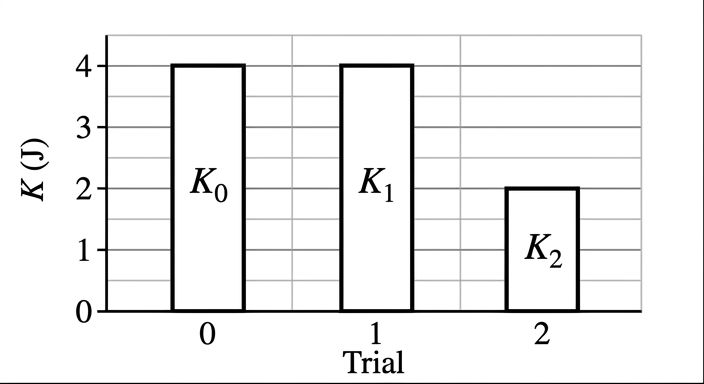
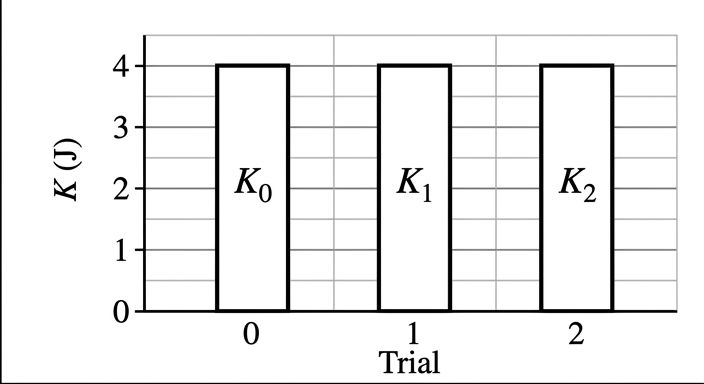
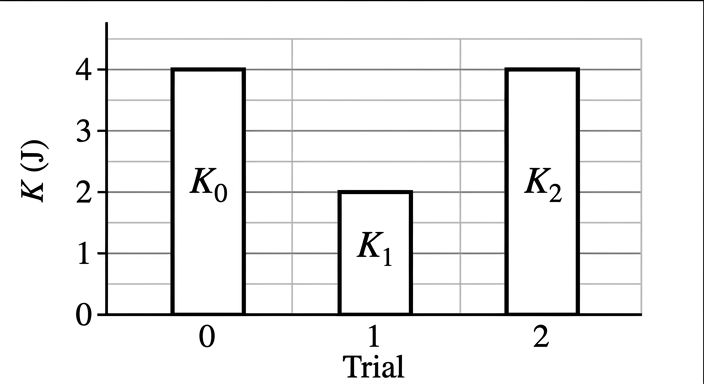
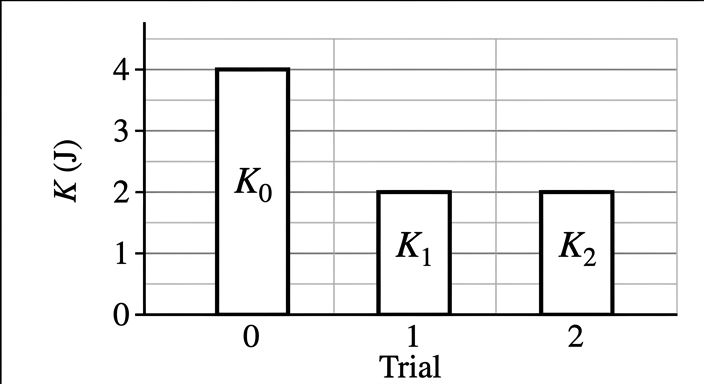
Cart 1 of mass travels at speed and collides with stationary Cart 2 of mass . The graph shows the velocities of both carts before and after the collision for two different trials. Trial 1 shows the carts exchanging velocities. Trial 2 shows the carts moving together at the same final velocity.
Which of the following energy bar charts could represent the total kinetic energy of the two-cart system after the collision in Trial 1 () and Trial 2 (), compared to the initial total kinetic energy ()?
Take a unit 4 test
A timed, AP-style test built only from unit 4 questions — multiple choice plus free response, scored with AI feedback. Use the standard format or build your own.
Key terms
| Term | Definition |
|---|---|
| explosion | A model for an interaction in which internal forces within a system move objects within that system apart. Total momentum of the system is conserved if no net external force acts. |
| force-time graph | A graphical representation of force as a function of time, where the area under the curve represents the impulse delivered to an object. |
| object model | A simplification in which an object's size, shape, and internal configuration are ignored, and the object is treated as a single point with properties such as mass. Used when analyzing collisions. |
Common unit 4 mistakes
Ignoring the sign of momentum in 1D problems
Momentum is a vector. If an object moves left and you assign rightward as positive, its momentum is negative. Forgetting signs when objects move in opposite directions leads to incorrect conservation equations.
Assuming kinetic energy is always conserved in collisions
Kinetic energy is conserved only in elastic collisions. Most real collisions are inelastic. Do not use energy conservation to find post-collision velocities unless the problem explicitly states the collision is elastic.
Applying momentum conservation to a non-isolated system
Momentum is conserved only when the net external force on the system is zero. If friction, gravity, or a normal force has a net effect on the system during the interaction, total momentum changes.
Confusing impulse magnitude with force magnitude
A large impulse does not require a large force. A small force acting over a long time can produce the same impulse as a large force over a short time. Always account for both force and time interval.
Using magnitudes instead of signed values when calculating delta_p
When an object rebounds, its momentum changes direction. delta_p = p_final - p_initial must use signed values. For a ball bouncing back at the same speed, the magnitude of delta_p is twice the magnitude of the initial momentum, not zero.
How this unit shows up on the AP exam
Quantitative reasoning with conservation equations
Free-response questions in this unit typically ask you to set up and solve a conservation of momentum equation for a collision or explosion, then calculate a post-interaction velocity. You may also be asked to calculate kinetic energy before and after to determine whether a collision is elastic or inelastic and to find the energy lost.
Graph interpretation for impulse and force
Multiple-choice and free-response questions frequently present force-time or momentum-time graphs and ask you to extract impulse from area, net force from slope, or to compare impulses delivered to two objects. Be ready to connect a graph feature to a physical quantity using the impulse-momentum theorem.
Justifying system selection and conservation conditions
Questions often ask you to explain why momentum is or is not conserved in a given scenario. You need to identify the system, state whether the net external force is zero, and explain how that determines whether total momentum changes. This reasoning task appears in both short justification items and longer free-response parts.
Final unit 4 review checklist
- Calculate momentum correctly as a vector
Apply p = mv with correct sign conventions in 1D. For 2D problems, resolve velocity into components before calculating momentum in each direction.
- Apply the impulse-momentum theorem
Use J = F_avg * delta_t = delta_p to connect force, time, and momentum change. Extract impulse from the area under a force-time graph and net force from the slope of a momentum-time graph.
- Set up conservation of momentum equations
Write sum of p_before = sum of p_after for the system. Confirm the system is isolated (net external force = 0) before applying conservation. Use signed values in 1D.
- Identify the collision type and apply the right tools
Determine whether a collision is elastic, inelastic, or perfectly inelastic. For perfectly inelastic collisions, use (m1 + m2) * v_common. For elastic collisions, both momentum and kinetic energy are conserved.
- Calculate kinetic energy loss in inelastic collisions
Find KE_initial and KE_final using KE = (1/2)mv^2 for each object, then compute delta_KE = KE_final - KE_initial. This value should be negative or zero.
- Use center-of-mass velocity for system analysis
Apply v_cm = (sum of m_i * v_i) / (sum of m_i) to describe the system as a whole. Recognize that v_cm is constant when no net external force acts on the system.
- Connect momentum to Newton's third law
Explain why internal forces cannot change total system momentum: the impulse one object exerts on another is equal and opposite, so internal impulses cancel in the total.
How to study unit 4
Start with Topic 4.1: momentum as a vector
Read the Topic 4.1 guide and practice calculating p = mv with correct signs. Work through examples involving objects moving in opposite directions and confirm you can describe the total momentum of a two-object system.
Move to Topic 4.2: impulse and force-time graphs
Study the impulse-momentum theorem using the Topic 4.2 guide. Practice reading force-time graphs to find impulse from area and momentum-time graphs to find net force from slope. Try rebound problems where momentum changes sign.
Work through Topic 4.3: conservation of momentum
Use the Topic 4.3 guide to set up conservation equations for collisions and explosions. Practice choosing a system, checking whether it is isolated, and applying sum of p_before = sum of p_after in 1D scenarios.
Finish with Topic 4.4: collision types and energy
Review the Topic 4.4 guide to distinguish elastic, inelastic, and perfectly inelastic collisions. Practice calculating kinetic energy before and after to classify a collision and find energy lost. Use the AP score calculator to estimate your overall exam standing.
More ways to review
Topic study guides
Open the individual guides for Unit 4 when you want a closer review of one topic.
Practice questions
Use AP-style practice after you review the notes so you can check what you understand.
FRQ practice
Practice free-response reasoning and compare your answer with scoring guidance.
Cram archive videos
Watch past review streams filtered to Unit 4 when you want a video walkthrough.
Official unit cheatsheet
Open the Fiveable one-page unit review, then explore visual cheatsheets for a quick refresher.
Score calculator
Estimate your broader AP score goal after you review the course and exam format.
Unit 4 printables
Print the unit cheatsheets ($3) or unit exams ($5) for Unit 4. Yours to keep, no subscription needed.
get printablesFrequently Asked Questions
What topics are covered in AP Physics 1 Unit 4?
AP Physics 1 Unit 4 covers four topics: **4.1 Linear Momentum**, **4.2 Change in Momentum and Impulse**, **4.3 Conservation of Linear Momentum**, and **4.4 Elastic and Inelastic Collisions**. Together, these topics build from defining momentum as mass times velocity all the way to predicting what happens when objects collide or explode apart. See practice and study materials at AP Physics 1 Unit 4.
How much of the AP Physics 1 exam is Unit 4?
Unit 4: Linear Momentum makes up 10-15% of the AP Physics 1 exam, making it one of the more heavily tested units. That weight covers momentum, impulse, conservation of linear momentum, and elastic and inelastic collisions. Expect at least a few multiple-choice questions and a possible FRQ drawing from these concepts.
What's on the AP Physics 1 Unit 4 progress check (MCQ and FRQ)?
The AP Physics 1 Unit 4 progress check includes both MCQ and FRQ parts drawn from all four unit topics: linear momentum, impulse and change in momentum, conservation of linear momentum, and elastic and inelastic collisions. The MCQ section tests conceptual understanding and calculations, while the FRQ part asks you to explain and justify momentum-based reasoning in multi-step scenarios. For matched practice problems that mirror the progress check format, visit AP Physics 1 Unit 4.
How do I practice AP Physics 1 Unit 4 FRQs?
The best way to practice AP Physics 1 Unit 4 FRQs is to focus on the topics that generate the most free-response questions: conservation of linear momentum and elastic and inelastic collisions. These questions typically ask you to set up momentum equations, justify whether momentum is conserved, and compare kinetic energy before and after a collision. Practice by writing out full solutions with clear diagrams and written justifications, not just numbers. Find Unit 4 FRQ practice at AP Physics 1 Unit 4.
Where can I find AP Physics 1 Unit 4 practice questions?
You can find AP Physics 1 Unit 4 multiple-choice and practice test questions at AP Physics 1 Unit 4. That page has MCQ practice covering momentum calculations, impulse problems, and collision scenarios, along with FRQ-style questions to help you prep for the full exam. Working through a mix of question types is the most effective way to get ready for the Unit 4 content on test day.
How should I study AP Physics 1 Unit 4?
Start by making sure you can define momentum and set up the impulse-momentum theorem before moving on to conservation problems. A solid study plan for Unit 4 looks like this: 1. **Learn the definitions first.** Know that momentum equals mass times velocity, and that impulse equals force times time. 2. **Practice impulse problems.** These show up constantly and require connecting force, time, and change in momentum. 3. **Master conservation of linear momentum.** Identify isolated systems and write out momentum equations for both objects before and after an interaction. 4. **Distinguish collision types.** Know what makes a collision elastic versus inelastic, and what is and is not conserved in each case. 5. **Do timed FRQ practice.** Write out full justifications, not just equations. Visit AP Physics 1 Unit 4 for practice materials organized by topic.