4.4 Elastic and Inelastic Collisions

🎡AP Physics 1 Unit 4 Review
4.4 Elastic and Inelastic Collisions
🎡 AP Physics 1
A collision is elastic when the system keeps all its kinetic energy and inelastic when total kinetic energy goes down. In a perfectly inelastic collision, the objects stick together and move at one shared velocity, and that case loses the most kinetic energy.
Why This Matters for the AP Physics 1 Exam
This topic is part of Unit 4 on linear momentum, which carries real weight on the exam. The main skill here is deciding what kind of collision you are looking at and then choosing the right conservation laws.
The key reasoning move is this: momentum is conserved in all collisions when the net external force is zero, but kinetic energy is only conserved in elastic collisions. On multiple-choice and free-response questions you are often asked to compare kinetic energy before and after, classify the collision, or reason about how changing a mass or speed affects the outcome. Collision setups also show up well in experimental questions, since carts and tracks are easy to use for collecting data and analyzing momentum and energy.
Key Takeaways
- Elastic collision: total kinetic energy stays the same before and after.
- Inelastic collision: total kinetic energy decreases, with the lost energy turning into heat, sound, or deformation.
- Perfectly inelastic collision: objects stick together, share one final velocity, and lose the most kinetic energy possible for that situation.
- Momentum is conserved in every collision when the net external force on the system is zero, including inelastic ones.
- In an elastic collision, individual objects can gain or lose kinetic energy even though the system total stays constant.
- "Lost" kinetic energy is never harmed; it transforms into other forms, so total energy is still conserved.
Elastic vs Inelastic Interactions

Collisions are sorted by what happens to the system's total kinetic energy during the interaction. Momentum behaves the same way in all of them when no net external force acts, so kinetic energy is what tells the two types apart.
- Elastic collisions keep the system's total kinetic energy the same, like pool balls bouncing off each other.
- Inelastic collisions convert some kinetic energy into other forms like heat or sound.
- Most real collisions land between perfectly elastic and perfectly inelastic. Billiard ball hits are close to elastic, while car crashes are highly inelastic.
Elastic Collision Energy Conservation
In an elastic collision, the system's total kinetic energy is preserved. Nothing is converted to heat, sound, or permanent deformation.
The energy condition for an elastic collision is:
This means:
- The sum of kinetic energies before the collision equals the sum after.
- You need both momentum conservation and kinetic energy conservation to solve for unknown velocities.
For a two-object collision:
Individual Object Energy Changes
In an elastic collision, the system's total kinetic energy stays constant, but each object's kinetic energy can still change. Energy transfers between the objects in ways that depend on their masses and initial velocities.
When objects of different masses collide elastically:
- A heavier object transfers only part of its energy to a lighter one.
- A lighter object can bounce off a heavier one with a much higher speed.
- When equal masses collide head-on, they effectively swap velocities.
For example, when a moving ball elastically strikes an identical stationary ball head-on, the first ball stops and the second moves off with the first ball's original velocity.
Inelastic Collision Energy Decrease
In an inelastic collision, some kinetic energy turns into other forms, so the system's total kinetic energy goes down.
The "missing" kinetic energy does not break energy conservation. It transforms into things like:
- Thermal energy from friction and deformation
- Sound energy carried by vibrations in the air
- Potential energy stored in deformed materials
Car crumple zones are designed to make a crash more inelastic on purpose, absorbing energy that would otherwise reach the passengers.
Energy Transformation in Collisions
The energy that seems "lost" in an inelastic collision is actually transformed, which keeps total energy conserved. In these collisions, nonconservative forces like friction and deformation do work on the objects and convert kinetic energy into other forms.
During a collision, kinetic energy can transform through several mechanisms:
- Friction between surfaces generates heat through molecular vibrations.
- Deformation stores energy temporarily (elastic) or permanently (plastic).
- Vibrations in the objects produce sound waves that travel outward.
- Internal friction within materials turns mechanical energy into thermal energy.
How much energy transforms depends on the materials, collision speed, and geometry. Softer materials usually convert more kinetic energy to other forms than harder ones.
Perfectly Inelastic Collisions
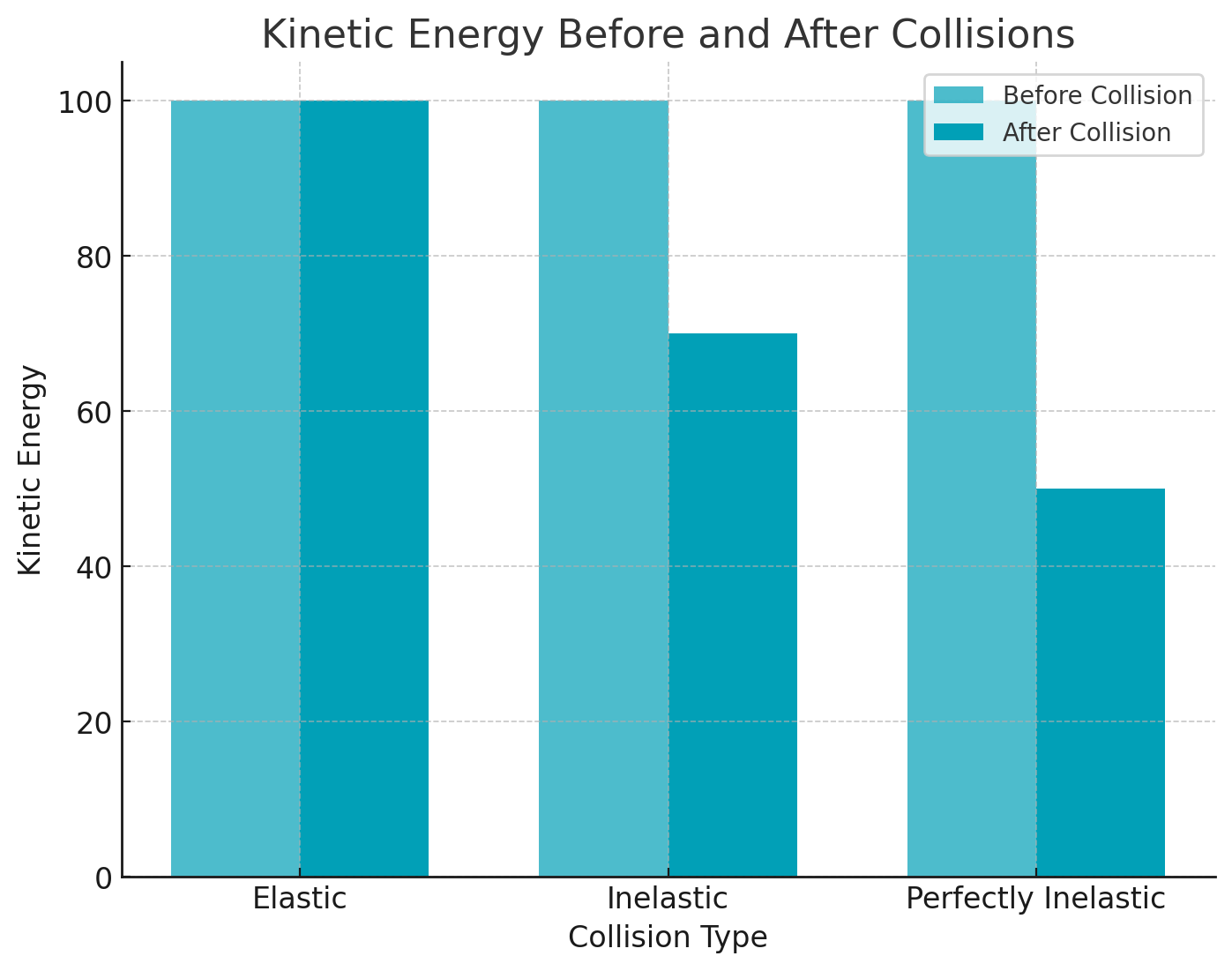
A perfectly inelastic collision is the extreme case: the objects stick together after impact. This loses the most kinetic energy possible for that situation while still conserving momentum.
In perfectly inelastic collisions:
- The objects move together with one common final velocity after the collision.
- That final velocity comes from conservation of momentum alone:
- The amount of kinetic energy lost depends on the masses and initial velocities, but the defining feature is that the objects stick together and share a final velocity while momentum stays conserved and total kinetic energy decreases.
- Examples include a bullet embedding in a target, vehicles crashing and locking together, or objects sticking with adhesive.
To find the kinetic energy lost, take the difference between the system's initial and final kinetic energies.
How to Use This on the AP Physics 1 Exam
Problem Solving
Start every collision problem by asking what kind of collision it is, since that decides which equations you can use.
- For any collision with no net external force, write conservation of momentum first: .
- Only add the kinetic energy conservation equation if the collision is stated or shown to be elastic.
- For a perfectly inelastic collision, the objects share one final velocity, so momentum alone gives you .
- To check if a collision is elastic, compare total kinetic energy before and after. Equal means elastic; smaller after means inelastic.
Free Response
You may be asked to set up equations and reason rather than grind through heavy algebra.
- Be ready to explain why momentum is conserved (net external force is zero) while kinetic energy may not be.
- Practice predicting how changing a mass, speed, or whether objects stick together would change the final velocity or energy loss.
- When energy "disappears," name where it goes: heat, sound, or deformation.
Common Trap
Do not assume kinetic energy is conserved just because momentum is. Momentum is conserved in inelastic collisions too, but kinetic energy is not.
Practice Problem 1: Elastic Collisions
A 2.0 kg ball moving at 3.0 m/s collides elastically with a stationary 1.0 kg ball. What are the velocities of both balls after the collision?
Solution
Apply both conservation of momentum and conservation of kinetic energy:
-
Conservation of momentum:
-
Conservation of kinetic energy:
Solving these equations:
After the collision, the 2.0 kg ball keeps moving in the same direction at 1.0 m/s, while the 1.0 kg ball moves at 4.0 m/s in the same direction.
Practice Problem 2: Perfectly Inelastic Collisions
A 1500 kg car moving at 20 m/s collides with and sticks to a stationary 2500 kg truck. What is the velocity of the combined vehicles immediately after the collision, and how much kinetic energy is lost in the collision?
Solution
For a perfectly inelastic collision, use conservation of momentum to find the final velocity:
-
Conservation of momentum:
-
Calculating kinetic energy loss: Initial kinetic energy: Final kinetic energy: Energy lost:
The combined vehicles move at 7.5 m/s after the collision, and 187,500 J of kinetic energy is lost, converted mostly to heat, sound, and deformation of the vehicles.
Practice Problem 3: Classifying a Collision
Two carts collide and separate. The total kinetic energy before the collision is 12 J and after the collision is 9 J. Classify this collision and explain what happened to any missing energy.
Solution
Because the system's total kinetic energy drops from 12 J to 9 J, the collision is inelastic.
The missing 3 J of kinetic energy was transformed into other forms such as thermal energy, sound, or deformation of the carts. That is the signature of an inelastic collision: total kinetic energy is not conserved, even though total momentum still is.
If the total kinetic energy had stayed at 12 J after the collision, it would have been elastic. If the two carts had stuck together and moved with the same velocity, it would have been perfectly inelastic.
Common Misconceptions
- Misconception: Momentum and kinetic energy are conserved under the same conditions.Actually: Momentum and kinetic energy are not the same conservation rule. Momentum is conserved in all collisions with no net external force, but kinetic energy is only conserved in elastic collisions.
- Misconception: "Lost" kinetic energy is harmed.Actually: "Lost" kinetic energy is not harmed. It becomes heat, sound, or deformation, so total energy is still conserved.
- Misconception: In an elastic collision, each object keeps its own kinetic energy.Actually: Elastic does not mean each object keeps its own kinetic energy. The system total stays the same, but individual objects can speed up or slow down.
- Misconception: A perfectly inelastic collision means all kinetic energy is lost.Actually: Perfectly inelastic does not mean all kinetic energy is lost. The objects still move together afterward, so they keep some kinetic energy; momentum conservation forbids losing it all unless the total momentum was zero.
- Misconception: A perfectly inelastic collision is defined by losing a lot of energy.Actually: Sticking together is the defining feature of a perfectly inelastic collision, not just "a lot of energy lost." Any inelastic collision loses kinetic energy, but only perfectly inelastic ones end with one shared velocity.
Related AP Physics 1 Guides
Practice Questions for 4.4
1 of 10
A block of mass is released from rest at height on a frictionless curved ramp. At the bottom, it collides perfectly inelastically with a stationary block of mass , as shown in the figure. The two blocks then slide together up a second frictionless curved ramp.
Which expression gives the maximum height reached by the combined blocks?
A.
B.
C.
D.
Vocabulary
The following words are mentioned explicitly in the AP® course framework for this topic.Term | Definition |
|---|---|
elastic collision | A collision between objects in which the total kinetic energy of the system is conserved, remaining equal before and after the collision. |
inelastic collision | A collision between objects in which the total kinetic energy of the system decreases, with some kinetic energy transformed into other forms of energy by nonconservative forces. |
kinetic energy | The energy possessed by an object due to its motion, equal to one-half the product of its mass and the square of its velocity. |
nonconservative force | A force for which the work done is path-dependent, such as friction or air resistance. |
perfectly inelastic collision | A collision in which the colliding objects stick together and move with the same velocity after the collision. |
Frequently Asked Questions
What is an elastic collision?
An elastic collision is a collision where the system conserves both momentum and total kinetic energy. Individual objects can still exchange kinetic energy.
What is an inelastic collision?
An inelastic collision conserves momentum but not total kinetic energy. Some kinetic energy transforms into sound, thermal energy, or deformation.
What is a perfectly inelastic collision?
A perfectly inelastic collision is the case where objects stick together after the collision and move with a shared final velocity.
Is momentum conserved in inelastic collisions?
Yes, momentum is conserved in any collision if the net external force on the system is zero, including inelastic and perfectly inelastic collisions.
Is kinetic energy conserved in inelastic collisions?
No. Kinetic energy decreases in inelastic collisions, although total energy is still conserved because the energy changes form.
How are elastic and inelastic collisions tested on AP Physics 1?
You may need to classify a collision, compare kinetic energy before and after, use momentum conservation, and explain where energy goes in an inelastic collision.
See Fiveable more often in Google
Mark Fiveable as a preferred source and Google is more likely to show you our guides in Top Stories, with a "preferred" badge in AI Mode and AI Overviews.