4.3 Harmonic Progression, Functional Harmony, and Cadences

🎶AP Music Theory Unit 4 Review
4.3 Harmonic Progression, Functional Harmony, and Cadences
🎶 AP Music Theory
Harmonic progression is the ordered sequence of chords under a passage, and in tonal music every chord acts as tonic (T), dominant (D), or predominant (PD). Cadences are the resting points that end phrases, with the perfect authentic cadence (PAC) being the strongest.
Why This Matters for the AP Music Theory Exam
This topic trains you to think about chords as connected pieces of a system, not random stacks. That thinking shows up across the AP Music Theory exam:
- In score analysis and harmonic listening, you label chords with Roman numerals and explain whether each one functions as tonic, dominant, or predominant.
- In outer-voice dictation, recognizing tonic-dominant-tonic motion helps you predict the bass line and check your work.
- When you identify cadences, you locate phrase endings, which connects to phrase and form questions later in the course.
- When you build or realize progressions, knowing normative chord successions keeps your harmony in the common-practice style.
You do not need to memorize the physics of overtones or full music history. You do need to recognize function and cadence type quickly, both by ear and from notation.
Key Takeaways
- Tonal music organizes all pitches around a central tonic, the system used in Western common-practice music from about 1650 to 1900.
- Every chord in a progression has a function: tonic (T), dominant (D), or predominant (PD).
- Tonic-dominant-tonic is the most fundamental progression for establishing a key.
- Harmonic rhythm is how fast chords change; faster harmonic rhythm can make a passage feel like it is moving more, even at the same tempo.
- Cadences split into conclusive (perfect authentic, plagal) and inconclusive (half, imperfect authentic, deceptive).
- A PAC is V-I with both chords in root position and scale degree 1 in the soprano; any other V-I that breaks one of those conditions is an IAC.
Tonal Music and Function
Music is tonal when all the pitch content is organized around a central pitch called the tonic, with every other pitch relating to it in a fixed, hierarchical way. This is the system that ran through Western common-practice music from roughly 1650 to 1900, and you will also hear tonal organization in popular music, folk music, and jazz.
The tonic is the focal point and usual goal of the music. Every other diatonic chord helps the music move toward or away from that tonic. The tonic triad is labeled with the Roman numeral I (or i in minor).
In tonal music, chord order is governed by a web of relationships, and each chord has a contextual role called its function. Every chord in a progression can be described as one of three functions:
- Tonic (T): the point of rest and resolution (I/i).
- Dominant (D): strong pull back toward tonic, usually right before it.
- Predominant (PD): sets up the dominant.
Dominant Function
Dominant chords usually come right before the tonic, and moving from dominant to tonic creates a feeling of resolution. The V chord and the vii° chord both carry dominant function. Even in a minor key, the dominant-functioning versions are V and vii°, not v or VII.
Look at why these pull so strongly toward tonic. In the key of B♭ major:

The V chord contains scale degrees 5, 7, and 2, and the vii° chord contains scale degrees 7, 2, and 4. Scale degrees 7 and 2 both resolve to tonic (scale degree 1) by step, so they act as tendency tones. Scale degree 7 is the leading tone, which gives it an especially strong pull upward to tonic.
The V chord is the stronger dominant of the two. It contains scale degree 5, which pulls toward scale degree 1, and it shares its root with the fifth of the tonic chord, so V to I voice leading tends to be smooth.
Predominant Function
Predominant chords usually appear before dominant chords and prepare them. Several chords can fill this role, and you will study them in more detail in 5.1 Adding Predominant Function IV (iv) and ii (ii0) to a Melodic Phrase. For now, know that IV (iv) and ii (ii°) commonly act as predominant chords.
Harmonic Progression and Harmonic Rhythm
A harmonic progression (or chord progression) is the specific sequence of chords under a passage. You write it as a string of Roman numerals, adding Arabic numerals for inversions, just like the figured-bass work from Unit 3.
Harmonic rhythm is the rate at which chords change. A phrase in 4/4 might begin with one chord per measure and then shift to chords changing every half note or quarter note, which is an acceleration of harmonic rhythm. Even if the tempo stays the same, faster chord changes make a passage feel like it is moving more quickly.
The most fundamental progression for establishing a key is tonic-dominant-tonic (I-V-I in major, i-V-i in minor). Most tonal progressions are some expansion of tonic-predominant-dominant-tonic.
Common-practice style favors certain chord successions and avoids others. Moving in the "wrong" direction, such as V to IV, is called a retrogression. V to IV is common in some popular styles but is generally avoided in common-practice writing.
Application example, not required AP content: many songs use familiar tonic-dominant patterns, so you can hear this motion in repertoire ranging from Baroque chorales to modern pop. Use these only as listening practice, not as official course examples.
Cadences
A cadence is the point of relative repose that ends a harmonic progression or phrase. Cadences act like punctuation, marking where phrases end and shaping musical form. They fall into two groups:
- Conclusive: perfect authentic and plagal cadences.
- Inconclusive: half, imperfect authentic, and deceptive cadences.
Inconclusive cadences are usually followed by more music. Conclusive cadences tend to close off a phrase, section, or whole piece.
Half Cadence
A half cadence ends a phrase on a V chord. Because V has dominant function, a half cadence sounds unresolved, like a musical question waiting for an answer.

Deceptive Cadence
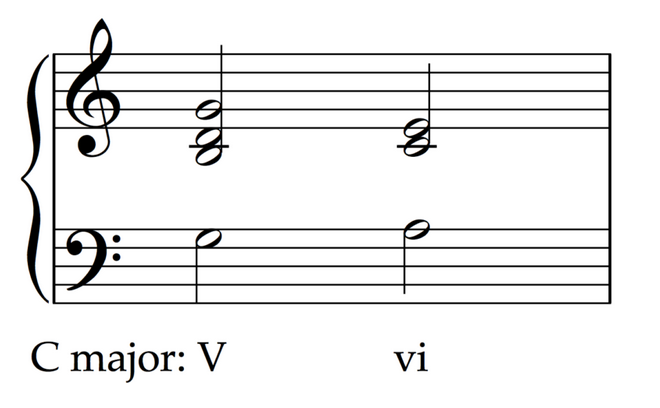
A deceptive cadence sets up a V chord that sounds like it should resolve to tonic, but instead moves to a non-tonic chord, often vi (VI). The "surprise" resolution is what makes it deceptive.
Plagal Cadence
A plagal cadence moves from IV (iv) to the tonic. It is sometimes called the "amen" cadence because of its use in hymns. Even without a dominant chord, the plagal cadence counts as a conclusive resolution.

Authentic Cadences: PAC and IAC
The authentic cadence is a V-I (or dominant-to-tonic) motion and comes in two forms.
- Perfect authentic cadence (PAC): V-I with both chords in root position and scale degree 1 in the soprano. This is the strongest, most final cadence.
- Imperfect authentic cadence (IAC): still a V-I progression, but at least one of the PAC conditions is broken. That means one or both chords are inverted, and/or the soprano ends on a chord tone other than scale degree 1.
Imperfect authentic cadence (IAC):

Perfect authentic cadence (PAC):

A leading-tone chord (vii°) has dominant function, but it is not part of the PAC or IAC definitions. Both authentic cadences are V-I, and a textbook PAC is specifically a root-position V-I with scale degree 1 in the soprano.
Picardy Third
Some progressions are distinctive enough to earn a special label. The Picardy third is a major tonic chord ending a section that is in a minor key. Watch for the raised third that makes the final tonic major instead of minor.

How to Use This on the AP Music Theory Exam
Score Analysis
- Label each chord with a Roman numeral, then tag it T, D, or PD so you can see the shape of the progression.
- Check the final chord of each phrase for cadence type. Look at the last two chords, whether they are in root position or inverted, and what scale degree is in the soprano.
- Watch for retrogressions like V to IV, which signal either a stylistic choice outside common practice or a possible error to flag.
Listening and Dictation
- Train your ear to hear tonic-dominant-tonic motion. Hearing where the dominant pulls back to tonic helps you predict the bass line in outer-voice dictation.
- Listen for the feeling of arrival. A strong, settled ending with the melody landing on tonic usually signals a PAC; an "unfinished question" ending usually signals a half cadence.
- Track harmonic rhythm. Noticing when chords start changing faster helps you place chords accurately in time.
Common Trap
- Do not assume any V-I is a PAC. Confirm root position in both chords and scale degree 1 in the soprano before you call it perfect.
- Do not confuse a deceptive cadence (V to a non-tonic chord, often vi) with a half cadence (phrase actually ends on V).
Common Misconceptions
- Misconception: Dominant function means the v chord.Actually: In minor keys, the dominant-functioning chords are V and vii°, with a raised leading tone, not v or VII.
- Misconception: Any V-I is a perfect authentic cadence.Actually: A PAC requires both chords in root position and scale degree 1 in the soprano. Break either condition and it becomes an IAC.
- Misconception: Plagal cadences are weak because they have no dominant.Actually: The plagal cadence (IV-I) is still classified as a conclusive cadence.
- Misconception: A deceptive cadence is the same as a half cadence.Actually: A half cadence ends on V; a deceptive cadence reaches V and then resolves to a non-tonic chord, often vi.
- Misconception: vii° is just a weaker tonic chord.Actually: The vii° chord carries dominant function and pulls toward tonic, because it contains the leading tone and other tendency tones.
- Misconception: Faster music means faster harmonic rhythm.Actually: Harmonic rhythm is about how often chords change, not tempo. Chords can change quickly at a slow tempo or slowly at a fast tempo.
Quick Check
In Roman numerals, what are the basic tonic-dominant-tonic progressions in both major and minor? Try writing them out: I-V-I for major and i-V-i for minor. Remember that the dominant uses a raised leading tone in minor, so it stays V rather than v.
Related AP Music Theory Guides
Practice Questions for 4.3
1 of 10
A score notates a cadence in G Major consisting of a D Major triad followed by a G Major triad. In the notation, the soprano voice moves from scale degree 2 to scale degree 1, and the bass moves from scale degree 5 to scale degree 1. In the performance, the soprano voice ends on scale degree 3 instead of the notated scale degree 1. Which statement accurately describes the discrepancy?
A.
The notation shows an imperfect authentic cadence, but the performance is a perfect authentic cadence.
B.
The notation shows a perfect authentic cadence, but the performance results in a deceptive cadence.
C.
The notation shows a perfect authentic cadence, but the performance is an imperfect authentic cadence.
D.
The notation shows a half cadence, but the performance results in an imperfect authentic cadence.
Vocabulary
The following words are mentioned explicitly in the AP® course framework for this topic.Term | Definition |
|---|---|
cadence | A harmonic progression that marks the end of a phrase and provides punctuation in musical flow. |
chord inversion | A chord voicing in which a chord member other than the root appears in the bass, resulting in first or second inversion. |
common practice | The system of tonal musical organization that prevailed in Western music from approximately 1650 to 1900. |
conclusive cadence | A cadence that provides a strong sense of harmonic repose and finality, typically ending on the tonic. |
deceptive cadence | A cadence that avoids the expected V-I resolution of an authentic cadence by substituting a non-tonic chord for the tonic. |
dominant | The fifth scale degree and its associated chord (V), which creates tension and typically resolves to the tonic. |
half cadence | An inconclusive cadence that typically ends on the dominant chord (V). |
harmonic function | The role a chord plays in a harmonic progression, such as tonic, predominant, or dominant function. |
harmonic progression | A sequence of chords that move from one harmony to another, creating the harmonic structure of a musical passage. |
harmonic rhythm | The rate at which chords change in a given musical passage or composition. |
imperfect authentic cadence | An inconclusive cadence created by a V-I progression where chords may be inverted and any chord tone may appear in the soprano. |
inconclusive cadence | A cadence that does not provide a sense of finality or completion, typically ending on a non-tonic harmony. |
inversions | Different voicings of a chord where the root is not in the lowest voice, indicated by Arabic numerals in harmonic analysis. |
musical form | The overall structural organization and design of a musical composition. |
perfect authentic cadence | A conclusive cadence created by a V-I progression with both harmonies in root position, ending with scale degree 1 in the soprano. |
phrase structure | The organization and division of musical material into distinct sections or phrases. |
Picardy third | A major tonic chord that ends a section in a minor key, creating a distinctive harmonic effect. |
plagal cadence | A cadence that moves from a subdominant chord (IV or iv) to a tonic chord (I or i), also known as an 'Amen cadence.' |
predominant | A harmonic function that typically occurs between the tonic and dominant, preparing for the resolution to the dominant. |
retrogression | A chord progression that deviates from common-practice norms, such as V to IV, which is generally avoided in traditional tonal composition. |
Roman numeral analysis | A system of notation using Roman numerals to identify chords and their harmonic function within a key. |
root position | A chord voicing in which the chordal root appears in the bass (lowest part) of the chord. |
scale degree | The position of a pitch within a scale, identified by name or number relative to the tonic. |
soprano line | The highest melodic line in a musical composition, typically sung by the highest voices or played by the highest instruments. |
tonal | Music organized around a central pitch (tonic) where all other pitches relate hierarchically in a pre-established system. |
tonic | The first scale degree and the primary harmonic center of a key, providing the sense of resolution and stability. |
Frequently Asked Questions
What is harmonic progression in AP Music Theory?
A harmonic progression is the ordered sequence of chords underneath a passage. AP Music Theory often represents this sequence with Roman numerals and inversion figures.
What are tonic, dominant, and predominant functions?
Tonic function provides rest and resolution, dominant function pulls back to tonic, and predominant function prepares the dominant. Together they organize tonal progressions.
What is harmonic rhythm?
Harmonic rhythm is the rate at which chords change in a passage. Chords can change once per measure, every half note, every quarter note, or at another pace.
What is a perfect authentic cadence?
A perfect authentic cadence is a V-I progression with both chords in root position and scale degree 1 in the soprano. It is the strongest authentic cadence.
What is the difference between a half cadence and a deceptive cadence?
A half cadence ends on V and feels unresolved. A deceptive cadence sets up V but then moves to a non-tonic chord, often vi or VI, instead of resolving to I or i.
What is a Picardy third?
A Picardy third is a major tonic chord that ends a section in a minor key. The raised third changes the final tonic from minor to major.
See Fiveable more often in Google
Mark Fiveable as a preferred source and Google is more likely to show you our guides in Top Stories, with a "preferred" badge in AI Mode and AI Overviews.