2.1 Pliny Letter 6.16.1-12 Study Guide

🏛AP Latin Unit 2 Review
2.1 Pliny Letter 6.16.1-12 Study Guide
🏛 AP Latin
TLDR
Letter 6.16.1-12 is Pliny the Younger's eyewitness account of the 79 CE eruption of Mt. Vesuvius, written to the historian Tacitus and focused on how his uncle, Pliny the Elder, responded to the disaster. For AP Latin, this passage is your introduction to polished Roman prose, and it leans heavily on ablative absolutes, purpose and result clauses, and place constructions, all wrapped around a vivid narrative you need to translate accurately and analyze for style.
Why This Matters for the AP Latin Exam
This is the first required syllabus author you read, so it sets the standard for the prose skills you use all year. Pliny writes long, continuous narrative, which means you practice using context to support literal translation instead of guessing word by word.
The passage gives you concrete material for the core skills AP Latin tests: producing an accurate literal translation, summarizing what actually happens, and explaining how style and context shape meaning. The heroism question here also sets up comparisons you can make later with Vergil's Aeneas, since both works ask what counts as heroic behavior.
When you write analysis, remember that interpretation means explaining how or why a passage creates a meaning, effect, or point of view. Just pointing out a device or naming a fact will not earn the credit. You need to connect the Latin to the idea it supports.
Key Takeaways
- Pliny the Younger wrote this letter to the historian Tacitus; the central figure of the action is his maternal uncle, Pliny the Elder, an admiral stationed at Misenum.
- The passage is dense with ablative absolutes, so train yourself to spot a noun and participle in the ablative and translate them as a time or circumstance clause.
- Distinguish purpose clauses (ut or ne plus subjunctive showing why) from result clauses (often signaled by a degree word like tam, ita, tot, or tantus).
- Know your place constructions: locative for cities and towns, accusative for motion toward, ablative for motion from.
- This is an epistle, a major Roman genre, and Pliny's letters are highly literary because he revised them for publication, not just private reading.
- Watch for repetition devices like anaphora and parallelism, which build tension and momentum in the narrative.
How to Use This on the AP Latin Exam
Translation
A required free-response task asks you to translate Latin into English that accounts for the sense of every word, including small words like adjectives and conjunctions. This does not mean one English word per Latin word. Some phrases naturally combine in idiomatic English.
When you hit a complex Plinian sentence, work in this order:
- Find the main verb and subject.
- Bracket off each subordinate clause.
- Translate the main clause.
- Slot the subordinate clauses into idiomatic English.
Latin word order is not English word order, so resist translating straight left to right.
Ablative Absolutes
A noun and participle in the ablative form an ablative absolute that shows the time or circumstance of an action. Translate them flexibly:
- sole occidente: literally "with the sun setting," better as "as the sun was setting"
- nube apparente: literally "with a cloud appearing," better as "when a cloud appeared"
Choose "when," "after," "while," "since," or "because" based on context. Do not leave the clunky "with ... -ing" version in a final translation.
Purpose vs. Result Clauses
Both use ut plus the subjunctive, so context decides:
- Purpose answers why someone acts. It often follows a verb of motion or effort and can use ut or ne.
- Result answers what actually happened. It usually has a degree word in the main clause such as tam, ita, sic, tantus, tot, or talis.
When ut takes an indicative verb instead, translate it as "like," "as," or "when."
Place Constructions
Keep movement straight or your translation will have people appearing in the wrong spots:
- Location at a city or town: locative case (Miseni, "at Misenum")
- Motion toward: accusative without a preposition for cities, or ad/in plus accusative otherwise
- Motion from: ablative, with a/ab/ex for most nouns
Summary and Analysis
Be ready to summarize the sequence of events: the cloud appears, Pliny the Elder investigates, and he turns his observation into a rescue mission. For analysis, cite specific Latin and explain how it supports your reading. For example, anaphora and parallel structure can show how Pliny builds momentum as the danger grows, and his formal, controlled language reflects his concern for his uncle's reputation and his own.
Common Trap
Do not confuse the two Plinys. Pliny the Elder is the uncle and admiral who dies pursuing the eruption; Pliny the Younger is the nephew who survives and writes the letter years later. Mixing them up will wreck both your summary and your analysis.
Vocabulary by Theme
Grouping the required vocabulary by theme helps you see how Pliny builds the scene as conditions worsen.
Disaster and Natural Phenomena
| Latin | Definition |
|---|---|
| cinis, -eris (m.) | ashes |
| densus, -a, -um | thick, dense, crowded |
| caelum, -i (n.) | sky, heaven |
| cresco, -ere, crevi, cretum | to grow, arise, spring up |
| appareo, -ere, -ui, -itum | to appear, come in sight |
| figura, -ae (f.) | form, shape, figure |
| nubes, -is (f.) | cloud, mist, vapor |
| pumex, -icis (f.) | pumice stone |
| lapis, -idis (m.) | stone |
| nox, noctis (f.) | night |
The word nubes carries weight here, since Pliny's description of the cloud is one of the most famous parts of the letter.
Movement and Action
| Latin | Definition |
|---|---|
| accedo, -ere, -cessi, -cessum | to approach, draw near |
| egredior, -gredi, -gressus sum | to go out, come forth |
| flecto, -ere, flexi, flexum | to turn, bend, curve |
| cunctor, -ari, -atus sum | to delay, linger, hesitate |
| rapio, -ere, -pui, -ptum | to seize, snatch, hurry away |
| incido, -ere, -cidi | to fall in, strike, reach |
| occido, -ere, -cidi, -casum | to fall down, fall |
These verbs track movement during the crisis. Watch the contrast between hesitation, shown by cunctor and incertus, and decisive action.
Family and Social Relations
| Latin | Definition |
|---|---|
| avunculus, -i (m.) | maternal uncle |
| celebro, -are, -avi, -atum | to celebrate, honor, publicize |
| Plinius, -i (m.) | a Roman family name (nomen) |
| Gaius (Caius), -i (m.) | Gaius, a Roman first name |
Avunculus is the precise term for a mother's brother, which fits the real relationship between the two Plinys.
Time, Place, and Sequence
| Latin | Definition |
|---|---|
| Misenum, -i (n.) | Misenum, a harbor town in Campania |
| Italia, -ae (f.) | Italy |
| ora, -ae (f.) | shore, edge, boundary |
| ibi | there, then, thereupon |
| interdum | sometimes, now and then |
| forte | by chance |
| paulum, paulo | slightly, a little |
Pliny keeps the geography clear because the movement of people and ships around the Bay of Naples drives the whole story.
Historical and Literary Context
The Eruption and the People
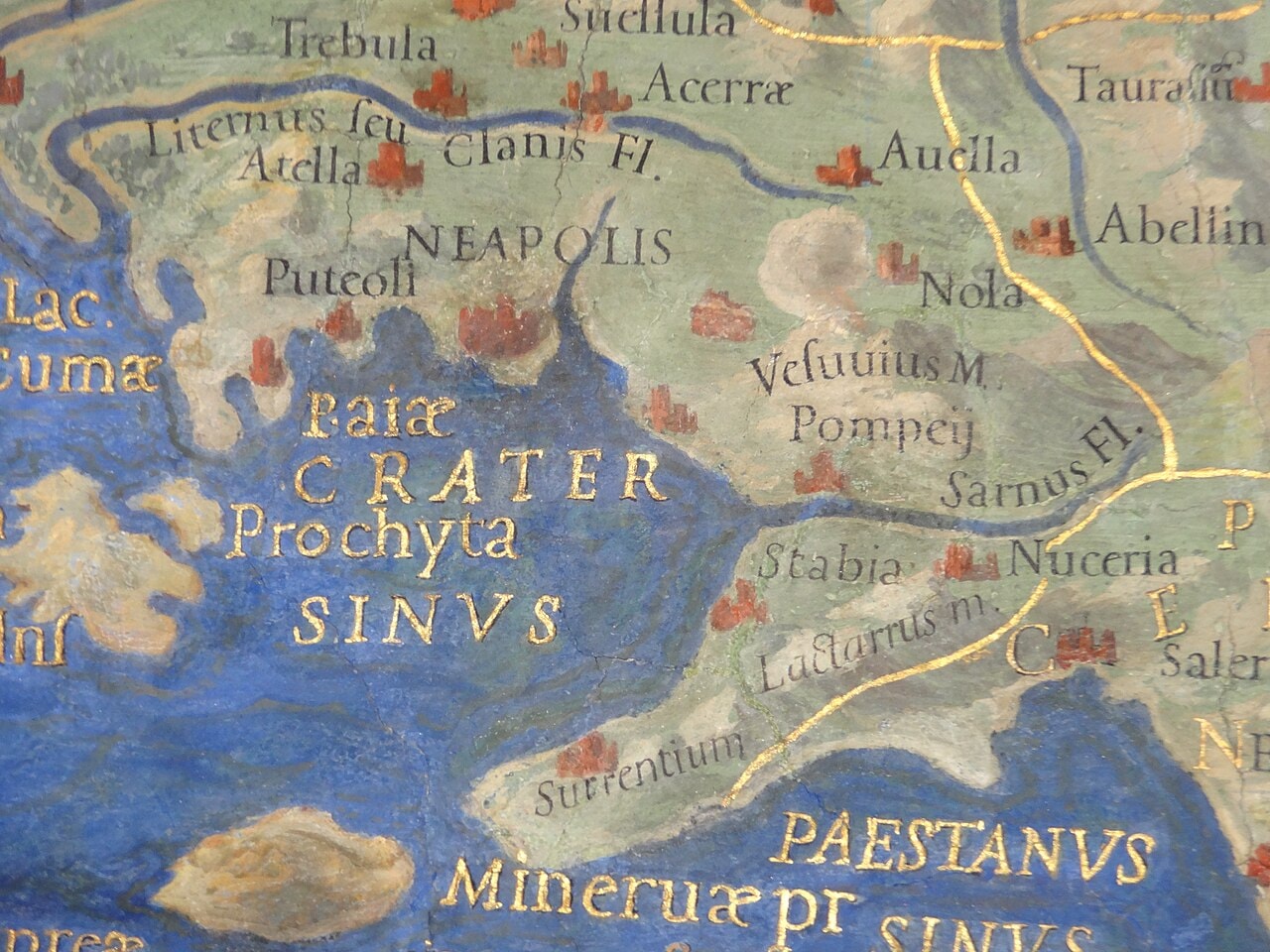
Mt. Vesuvius erupted in 79 CE and buried Pompeii, Herculaneum, Oplontis, and Stabiae. Pliny the Elder was stationed at Misenum, at the northern end of the Bay of Naples, because the Roman navy was based there and he served as its admiral. Stabiae, which the letter mentions, sat south of Vesuvius in the direct path of the ash and cinder.
Two people anchor the narrative:
- Pliny the Elder (c. 23-79 CE): the maternal uncle, an admiral and scholar who wrote the Natural History, the largest surviving single work from the Roman Empire and a model for the modern encyclopedia. He adopted his nephew in his will.
- Pliny the Younger (61-c. 113 CE): the nephew, a lawyer and magistrate under the emperor Trajan, who wrote hundreds of letters that reveal daily life, the legal system, and Roman administration.
The Letter and Its Audience
Pliny addressed these Vesuvius letters to his friend, the historian Tacitus (c. 56-c. 120 CE), known for his Annals and Histories. Because the letters were meant for publication and heavily revised, they are highly literary, not casual notes. Knowing Pliny's other work and his concern for reputation can sharpen your interpretation of choices in the text.
The Epistolary Genre
Letters were a major Roman literary genre. Some writers, including Pliny the Younger, Ovid, and Seneca, published real or fictional letters, while others, like Cicero, had private letters published after death. Letters give a first-person window into daily life, and Pliny's polish reminds you that you are reading a carefully shaped account, not a raw diary entry.
Roman Timekeeping
Romans divided daylight into 12 hours from sunrise to sunset, so the first hour began at sunrise and the sixth hour was roughly midday. When Pliny gives a time, translate it with that system in mind rather than modern clock hours.
Common Misconceptions
- Misconception: The two Plinys are interchangeable.Actually: They are not. The Elder is the uncle and admiral who dies; the Younger is the nephew who writes the letter years later.
- Misconception: This is a private, off-the-cuff letter.Actually: Pliny revised it carefully for publication, so its style and emphasis are deliberate choices you can analyze.
- Misconception: Naming a device like anaphora is enough for analysis.Actually: You also need to explain how that device shapes meaning, effect, or point of view in the passage. Identification alone does not support a stronger score.
- Misconception: Ablative absolutes should be translated literally as 'with ... -ing.'Actually: That phrasing is awkward English. Convert them into natural time or circumstance clauses.
- Misconception: Every Latin word needs exactly one English word in a translation.Actually: The requirement is to account for the sense of every word, which sometimes means combining words into a single idiomatic English phrase.
- Misconception: Roman emotional restraint means Pliny feels nothing.Actually: The controlled tone is a stylistic convention. Grief and admiration still come through in his word choices and focus.
Related AP Latin Guides
Practice Questions for 2.1
1 of 10
Vergil, Georgics 2.136-138
Sed neque Medorum silvae, ditissima terra, nec pulcher Ganges atque auro turbidus Hermus laudibus Italiae certent.
This passage's technique of comparing Italy favorably to exotic foreign lands while maintaining focus on agricultural instruction demonstrates which complex generic synthesis characteristic of the Georgics?
A.
Rejection of foreign agricultural methods in favor of Roman techniques
B.
Fusion of didactic instruction with encomium and geographical poetry traditions
C.
Epic catalogue adapted for agricultural rather than military purposes
D.
Ethnographic survey supporting practical farming recommendations
Frequently Asked Questions
What is Pliny Letter 6.16.1-12 about?
Pliny Letter 6.16.1-12 describes the eruption of Mt. Vesuvius in 79 CE and Pliny the Elder's decision to investigate and help others.
Who wrote Pliny Letter 6.16?
Pliny the Younger wrote Letter 6.16 to the historian Tacitus. The letter focuses on his uncle, Pliny the Elder.
Why is Pliny Letter 6.16 important for AP Latin?
It introduces AP Latin prose translation and asks students to summarize events, analyze context, and explain stylistic features in a polished Roman letter.
What grammar is important in Pliny 6.16.1-12?
Key grammar includes ablative absolutes, purpose clauses, result clauses, ut with indicative or subjunctive, infinitives, and place constructions.
How should you translate ablative absolutes in Pliny?
Translate an ablative absolute as a natural time or circumstance clause, such as when, after, while, since, or because, instead of leaving clunky with ... -ing wording.
What stylistic devices should students watch for in Pliny 6.16?
Watch for anaphora, parallel structure, vivid imagery, and the polished epistolary style Pliny uses to shape Tacitus's view of the eruption and his uncle.
See Fiveable more often in Google
Mark Fiveable as a preferred source and Google is more likely to show you our guides in Top Stories, with a "preferred" badge in AI Mode and AI Overviews.