8.1 Materials, Processes, and Techniques in South, East, and Southeast Asian Art

🖼AP Art History Unit 8 Review
8.1 Materials, Processes, and Techniques in South, East, and Southeast Asian Art
🖼 AP Art History
8.1
Materials, Processes, and Techniques in South, East, and Southeast Asian Art
8.2
Purpose and Audience in South, East, and Southeast Asian Art
8.3
Interactions Within and Across Cultures in South, East, and Southeast Asian Art
8.4
Theories and Interpretations of South, East, and Southeast Asian Art
8.5
Unit 8 Required Works
South, East, and Southeast Asian art covers some of the world's oldest and most varied visual traditions, built on materials like ceramics, metal, ink, stone, wood, and textiles. For this topic, explain how a material or technique, such as high-fire porcelain, cast bronze, monochromatic ink painting, or woodblock printing, shapes how a work looks and functions.
Why This Matters for the AP Art History Exam
This topic builds your skill at connecting materials and techniques to the look and purpose of a work. That skill shows up across the exam:
- On multiple-choice questions, you may need to attribute or identify a work based on its medium, technique, or regional style.
- On free-response questions, you can use specific material evidence (porcelain, bronze, ink on silk, woodblock print) to support claims about meaning, function, or cultural context.
- Comparison questions reward you for explaining not just what a work means, but how the chosen material or process helps convey that meaning.
Knowing the toolkit of Asian art making gives you precise evidence to cite instead of vague description.
Key Takeaways
- Asia has some of the oldest ceramic traditions in the world, and major advances like high-fire porcelain developed here. The David Vases show white porcelain with cobalt-blue underglaze.
- Metal was used for sculpture, ritual vessels, arms and armor, and decorative objects. Shang dynasty bronzes used a piece-molding technique that has never been replicated.
- Monochromatic ink painting on silk and paper developed in China, and painting in India and East Asia favors contour line over heavy three-dimensional modeling.
- Stone and wood carving were central to architecture, including rock-cut cave temples that stretch from India through Central Asia to China.
- Calligraphy was a highly valued art form, and in China it was at times ranked above painting.
- Distinctive forms include Buddhist reliquary stupas, the pagoda, rock gardens and tea ceremony settings, and Japanese woodblock printing.
Art Forms and Styles of South, East, and Southeast Asia
This region is huge, so the range of materials and styles is wide. Here are patterns worth knowing for identification and comparison.
- Art commonly depicts gods or nature. The vast scale of nature is a theme in Daoist-influenced painting, as in the elongated mountains of 201. Travelers among Mountains and Streams.
- Floral and vegetal motifs are common in art from Mughal India, which you can see in both the 209. Taj Mahal and 208. Jahangir Preferring a Sufi Shaikh to Kings.
- Many of this unit's buildings are temples with carved figures in wood or stone. Outside temples, the unit also includes some of the largest structures in the course, such as the Forbidden City and the Taj Mahal.
- Paintings tend to read as two-dimensional, without the deep perspective common in European painting. They are often in ink on paper or silk, so you see flat colors with minimal shading and no heavy textured brushwork. Painting and calligraphy frequently appear together, as in 203. Night Attack on the Sanjô Palace.
Distinctive art forms from South, East, and Southeast Asia include:
- Buddhist reliquary stupas, dome-shaped monuments built to house relics.
- Monochromatic ink painting on silk and paper, which developed in China and influenced painting in nearby regions.
- The pagoda, an architectural form based on a Chinese watchtower.
- Japanese rock gardens, tea houses, and related ceremonies.
- Japanese woodblock printing, such as 211. Under the Wave off Kanagawa, from the series Thirty-six Views of Mount Fuji. These prints later influenced European artists in the 19th century.
Painting and Calligraphy
Painting in this unit usually takes two forms: wall painting and manuscript or album painting.
A hanging work like 205. Portrait of Sin Sukju (1417-1475) would have been displayed on a wall, while manuscript or album paintings were viewed at smaller, private gatherings. Some paintings, such as the handscroll 203. Night Attack on the Sanjô Palace, were so long that they were unrolled section by section as a viewer moved through the scene.
The painting styles that developed in India and East Asia favor contour drawing of forms over modeling. Figures are defined through an emphasis on line rather than the three-dimensional modeling you see in much European painting. You will not find the heavy light-and-dark contrast (chiaroscuro) or the hazy transitions (sfumato) common in some European art.
Calligraphy was a major art form in these regions. In China, calligraphy was at times considered the highest art form, even above painting, and lines of poetry often accompany Chinese paintings. Calligraphy was also prominent in Islamic art in Asia, which in this course mainly appears in Mughal India. You can find it on architecture, decorative arts objects, ceramic tiles, and in manuscripts written on paper, cloth, or vellum.
Ceramics and Metal Art
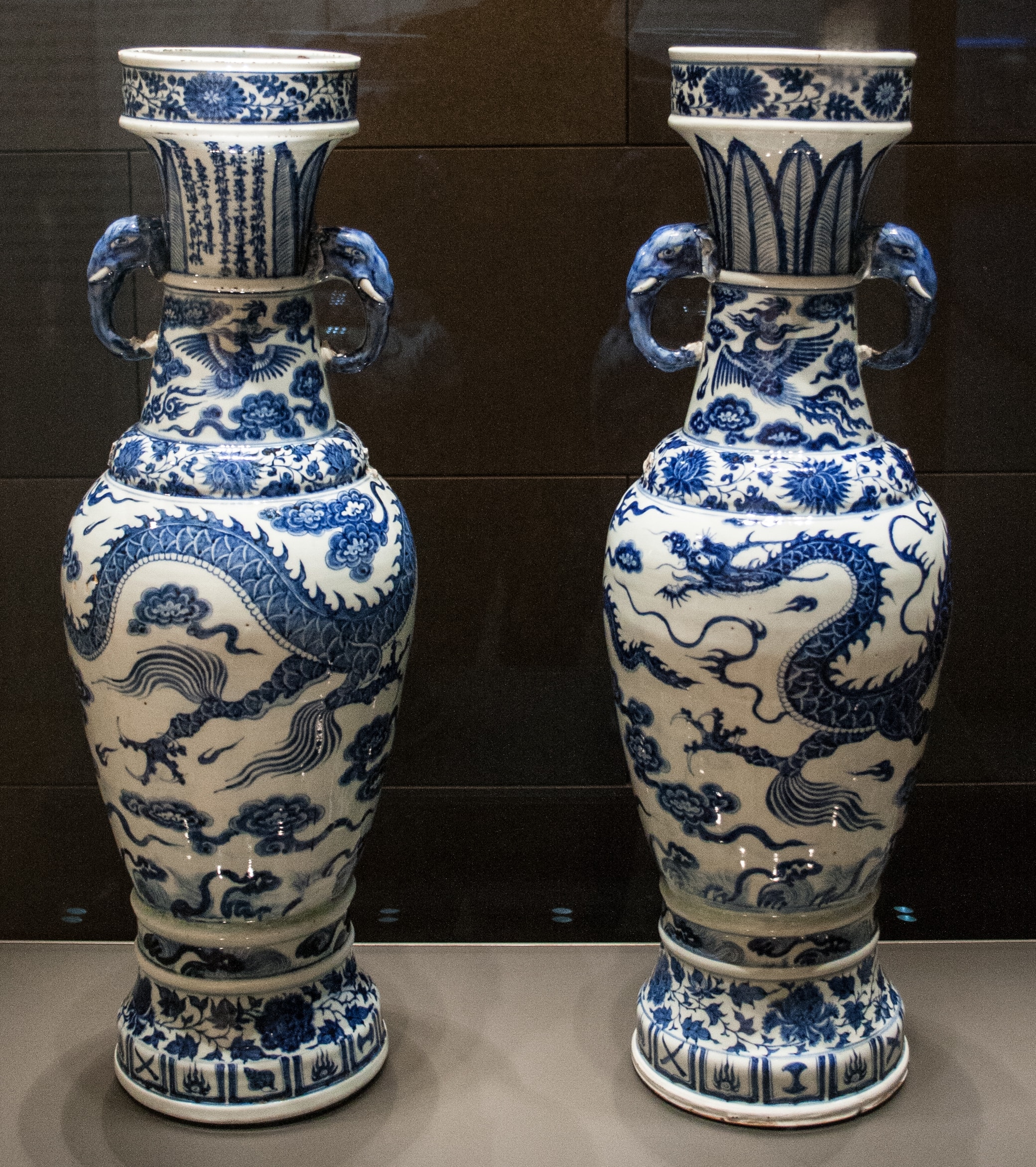
Ceramic arts have flourished in Asia since the prehistoric era. Some of the earliest known ceramic vessels come from this region, and major advances, including high-fire porcelain, developed here.
A key ceramic work to know is 204. The David Vases, made of white porcelain with cobalt-blue underglaze during the Yuan Dynasty. The 193. Terra cotta warriors from the mausoleum of the first Qin emperor of China are another major ceramic work, made of painted terra cotta.
Comparison practice: How do the ceramic works from China compare to ceramics from other units, such as the Niobid Krater? Focus on material, technique, and function, not just appearance.
Metal was also used to create sculpture, arms and armor, ritual vessels, and decorative objects. Shang dynasty bronze vessels from China used a distinctive piece-molding technique that has never been successfully replicated. Cast bronze also appears in works like 202. Shiva as Lord of Dance (Nataraja), and metalwork shapes the 196. Gold and jade crown from the Silla Kingdom in Korea.
Sculpture and Construction
This unit includes a lot of monumental architecture in the form of temples, palaces, and tombs.
Temples are a major part of this unit's architecture, usually built in stone or wood. You will see a lot of stone and wood carving in these temples, in the form of reliefs (carvings cut into the wall) and freestanding statues.
Rock-cut caves containing Buddhist imagery, shrines, stupas, and monastic spaces stretch across Asia from India through Central Asia to China. In this unit you study the 195. Longmen caves in China, carved into limestone.
It helps to separate South and Southeast Asian buildings from the East Asian ones in this unit. East Asian buildings show strong Chinese influence, so you see related features like wood structures and tile roofs in both 197. Todai-ji and the 206. Forbidden City.
Textiles
Textiles are an important but often overlooked part of art history.
Important textile forms from this region include:
- silk and wool-tapestry weaving
- cotton weaving
- printing
- painting
- carpet weaving
Two works connect to textiles in this unit. 194. Funeral banner of Lady Dai (Xin Zhui) is painted silk. 205. Portrait of Sin Sukju (1417-1475) is ink and color on silk, and a notable detail is the embroidered rank badge on Sin Sukju's chest.
How to Use This on the AP Art History Exam
MCQ
Use medium and technique as identification clues. If a work is white porcelain with cobalt-blue underglaze, think Chinese ceramics like The David Vases. If it is a polychrome woodblock print, think Japanese printing like Under the Wave off Kanagawa. Ink on silk or paper with contour lines and calligraphy points toward East Asian painting.
Free Response
When a question asks how a work conveys meaning, name the specific material or process and connect it to effect. For example, monochromatic ink and contour line create a flat, atmospheric landscape, or cast bronze allows the detailed, freestanding form of a religious icon. Always pair the material evidence with what it does.
Comparison
Comparison questions want similarities and differences in how works convey meaning, plus why that matters. Lining up two materials or techniques (porcelain versus terra cotta, or ink painting versus relief carving) gives you concrete evidence to build that argument.
Common Trap
Describing what a work means without explaining how the medium or technique conveys it. The how is where the points are.
Common Misconceptions
- "Asian ink paintings are just unfinished sketches." The emphasis on contour line and flat color is a deliberate tradition, not a lack of skill or finish.
- "Paint and ink are the same thing here." Many works in this unit are ink on silk or paper, which produces flat color and fine line rather than the textured brushwork of European oil painting.
- "All of these buildings look the same." East Asian architecture shows strong Chinese influence with wood structures and tile roofs, while South and Southeast Asian temples often rely on carved stone. Sorting them by region and material helps with identification.
- "Porcelain and terra cotta are interchangeable terms." They are different ceramic materials. High-fire porcelain, like The David Vases, is not the same as painted terra cotta, like the terra cotta warriors.
- "The gold and jade crown is a Buddhist sculpture." Work 196 is a metalwork crown from the Silla Kingdom in Korea, not a devotional figure.
Related AP Art History Guides
Vocabulary
The following words are mentioned explicitly in the AP® course framework for this topic.Term | Definition |
|---|---|
Buddhist reliquary stupas | Dome-shaped Buddhist monuments constructed to house sacred relics and serve as objects of veneration. |
calligraphy | The art of beautiful handwriting and letter forms, particularly prominent in Islamic art for transmitting sacred texts. |
carpet weaving | A textile technique used to create decorative and functional carpets, an important art form in South, East, and Southeast Asian regions. |
ceramic vessels | Pottery objects made from clay and hardened through firing, representing one of the earliest art forms in Asia dating back to prehistoric times. |
contour drawing | A painting technique that emphasizes the outline and edges of forms rather than modeling through shading and volume. |
cotton weaving | A textile technique using cotton fibers to create woven fabrics, an important textile form in South, East, and Southeast Asia. |
Japanese woodblock printing | A printmaking technique where images are carved into wooden blocks and used to create multiple prints, a distinctive art form from Japan. |
manuscript painting | The art of creating painted illustrations and decorations within written manuscripts, a major painting form in West and Central Asia. |
monochromatic ink painting | A painting technique using black ink in varying tones on silk or paper, developed in China and emphasizing brushwork and composition. |
pagoda | An architectural form developed in Asia, based on Chinese watchtowers, typically featuring multiple tiers and used in Buddhist contexts. |
piece-molding technique | A unique bronze casting method used by the Shang dynasty in China where separate mold pieces are assembled to create a vessel. |
porcelain | A high-fire ceramic material developed in Asia, characterized by its strength, whiteness, and refined quality. |
rock gardens | Carefully composed landscapes using rocks, plants, and water as distinctive art forms in East Asian aesthetics. |
rock-cut caves | Caves carved into stone to create Buddhist shrines, stupas, and monastic spaces, found across Asia from India through Central Asia to China. |
silk-tapestry weaving | A textile technique using silk threads to create tapestry fabrics, a form developed in West and Central Asia. |
stone carving | The process of shaping stone to create sculptures, architectural elements, and decorative features in South, East, and Southeast Asian art. |
tea houses | Architectural structures in East Asia designed for the practice of tea ceremonies and related aesthetic rituals. |
wall painting | A painting technique applied directly to walls, one of the two primary forms of painting in Asian art traditions. |
wood carving | An artistic technique of shaping and carving wood into functional and decorative objects in Indigenous American art. |
wool-tapestry weaving | A textile technique using wool threads to create woven tapestries, practiced in South, East, and Southeast Asian regions. |
Frequently Asked Questions
What does AP Art History 8.1 focus on?
AP Art History 8.1 focuses on how materials, processes, and techniques shape art from South, East, and Southeast Asia. You should connect media like porcelain, bronze, ink, wood, stone, and textiles to what a work looks like, how it was made, and how it functioned.
What materials should I know for South, East, and Southeast Asian art?
Key materials include high-fire porcelain, bronze, ink on silk or paper, wood, stone, jade, gold, painted silk, and textiles. The AP exam often expects you to use those materials as evidence when explaining meaning, function, or cultural context.
Why is Chinese porcelain important in AP Art History?
Chinese porcelain matters because high-fire ceramic technology developed in Asia and became a major artistic and trade medium. The David Vases are the required work to know for blue-and-white porcelain with cobalt-blue underglaze.
What is piece-mold casting?
Piece-mold casting is a bronze-making technique associated with Shang dynasty ritual vessels. Artisans used sectioned clay molds to cast detailed bronze forms. In AP Art History, it is useful evidence for explaining technical skill and ritual function in early Chinese metalwork.
How are ink painting and calligraphy different from European oil painting?
Many East Asian works use ink on silk or paper, with contour line, brush control, and tonal washes instead of heavy modeling or thick oil paint. Calligraphy also carries artistic and cultural value, so text and image often work together.
Is Pattachitra art a required AP Art History work?
Pattachitra is a South Asian painting tradition, but it is not one of the required AP Art History 250 works. If your teacher mentions it, use it as an extra example of regional materials and processes, but prioritize required works like the David Vases, Longmen caves, and Under the Wave off Kanagawa for exam review.