10.4 Totem poles and wood carving

🏹Native American History Unit 10 Review
10.4 Totem poles and wood carving
🏹 Native American History
Origins of totem poles
Totem poles are monumental wood carvings created by Native American and First Nations peoples of the Pacific Northwest Coast. They function as visual narratives, encoding complex stories, histories, clan lineages, and spiritual beliefs into towering cedar sculptures. Understanding totem poles offers a window into the social and spiritual fabric of the communities that created them.

Top images from around the web for Cultural significance
Fichier:Ketchican totem pole 2.jpg — Wikipédia View original
Is this image relevant?
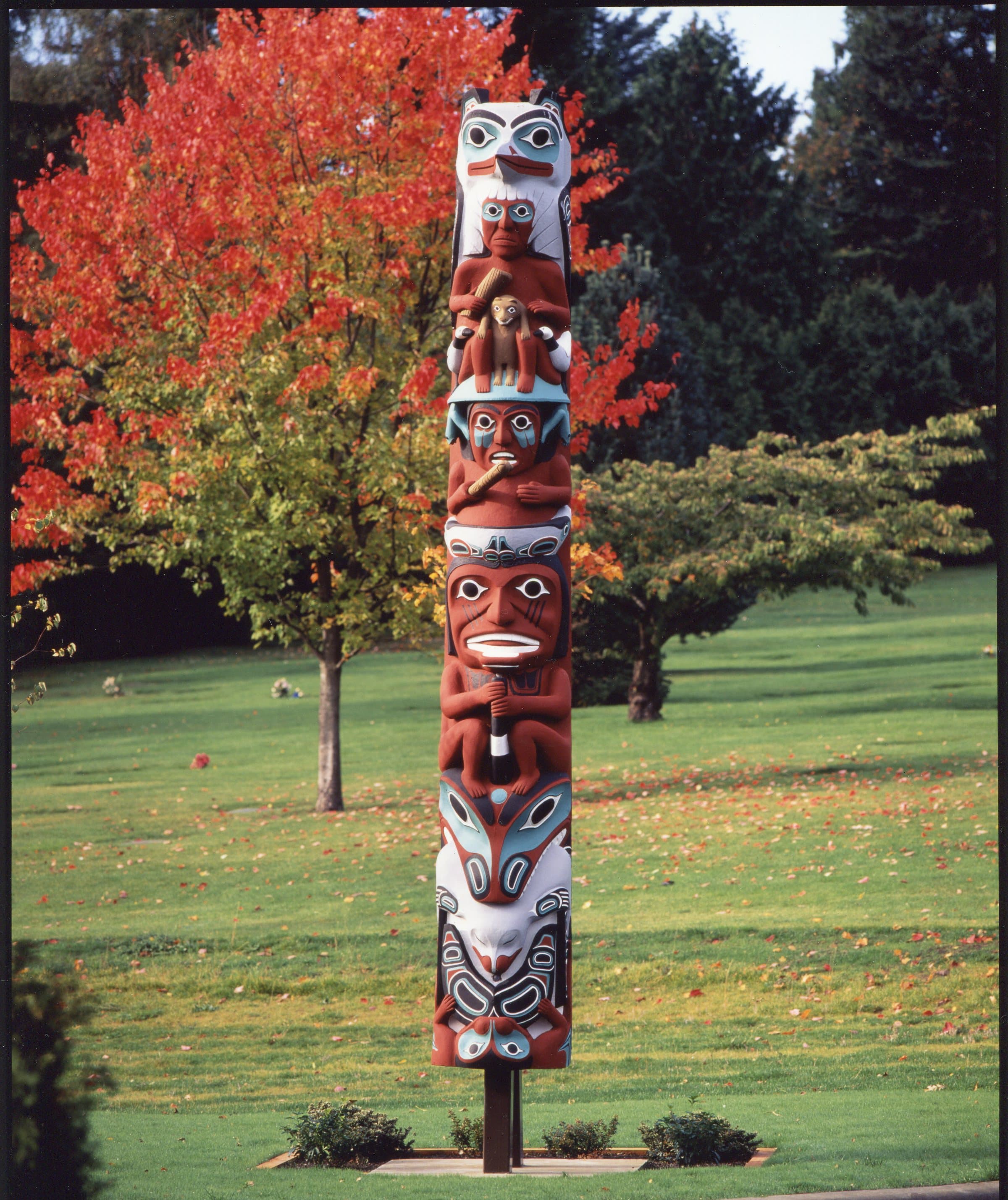
File:Raven Totem Pole.jpg - Wikipedia View original
Is this image relevant?
File:Native Alaskan Totem Pole.JPG - Wikipedia View original
Is this image relevant?
Fichier:Ketchican totem pole 2.jpg — Wikipédia View original
Is this image relevant?
File:Raven Totem Pole.jpg - Wikipedia View original
Is this image relevant?
Cultural significance
Totem poles are far more than decorative art. They embody ancestral connections and spiritual beliefs, functioning as three-dimensional records that preserve tribal legends and family lineages across generations. A single pole might communicate a clan's origin story, mark territorial boundaries, or publicly demonstrate the social standing and wealth of a family. They also serve as territorial markers, indicating clan ownership of specific lands and resources.
Tribal distribution
Totem pole traditions are primarily associated with coastal peoples of the Pacific Northwest, including the Haida, Tlingit, and Tsimshian. Their geographic range extends from southeastern Alaska through British Columbia and into Washington state. Styles and meanings vary significantly between tribal groups. The Haida, for instance, are known for bold, deeply carved forms, while Tlingit poles tend to feature more shallow relief carving. Inland peoples such as the Gitxsan and Wet'suwet'en also developed their own distinct totem pole traditions.
Historical development
The origins of totem pole carving likely reach back to at least 1000 CE, though the organic nature of wood means few ancient examples survive. The tradition proliferated dramatically in the 18th and 19th centuries, partly because increased trade brought metal tools (iron adzes and knives) that allowed far more intricate carving than stone tools had permitted.
During the late 19th and early 20th centuries, totem pole carving experienced a steep decline. Colonial governments and missionaries actively suppressed Indigenous cultural practices, including the potlatch ceremonies closely tied to pole raising. A significant revival began in the mid-20th century as Indigenous communities undertook cultural reclamation efforts, and institutions began recognizing the artistic and historical value of these works.
Symbolism and meanings
Every carved figure and design element on a totem pole carries specific meaning within its tribal context. Interpreting a pole accurately requires understanding the cultural, historical, and familial background of the community that created it. There is no single universal "code" for reading totem poles.
Animal representations
Animals depicted on totem poles hold deep significance in Native American cosmology and mythology. Some of the most common include:
- Eagle: represents strength, wisdom, and spiritual power; often appears at the top of poles
- Raven: symbolizes creation, transformation, and trickster qualities; central to many Northwest Coast origin stories
- Bear: signifies strength, motherhood, and healing; frequently associated with family lineage
- Killer Whale (Orca): represents power, family bonds, and the undersea world
- Wolf: associated with loyalty, intelligence, and hunting prowess
An animal's position on the pole can indicate its relative importance in the narrative being told, though the common belief that the "bottom figure is least important" is actually a misconception. The bottom figure is often the most significant, since it's at eye level and bears the weight of the entire pole.
Mythological figures
Totem poles also portray supernatural beings and ancestral spirits central to tribal belief systems. These include characters from creation stories, legendary heroes, and transformative beings capable of shifting between human and animal forms. The Thunderbird, for example, is a powerful supernatural being associated with thunder and lightning, often carved at the very top of a pole to signify its dominance over the natural world.
Family crests
Clan affiliations and family lineages are displayed through specific crest symbols. These crests represent hereditary rights and privileges, and their arrangement on the pole reflects social hierarchy within the community. A family's totemic animals might appear alongside symbols of specific rights they hold, such as the right to perform certain songs, dances, or ceremonies.
Carving techniques
Creating a totem pole requires years of training in both physical craftsmanship and cultural knowledge. Carvers traditionally undergo long apprenticeships with master carvers, learning not only technique but also the cultural protocols governing what can be depicted and how.
Traditional tools
- Adzes: the primary tool for rough shaping and removing large sections of wood
- Curved knives (D-adzes and crooked knives): used for detailed carving and creating intricate designs
- Chisels: employed for precise cuts and fine detail work
- Hammers and wedges: used for splitting cedar logs during initial shaping
After European contact, metal versions of these tools replaced stone and bone originals, which dramatically expanded what carvers could achieve in terms of detail and scale.
Wood selection
Western red cedar is the strongly preferred wood for totem poles. Its straight grain makes it workable, and its natural oils give it exceptional resistance to decay, which matters for carvings that stand outdoors for decades. Trees are selected based on size, age, straightness, and (in many traditions) spiritual qualities. Felling and preparing a log often involves specific rituals and ceremonies acknowledging the tree's spirit. Proper seasoning of the wood is critical to prevent cracking over time.
Painting and finishing
Traditional pigments come from natural sources:
- Red (from ochre): associated with blood, war, and courage
- Black (from charcoal or lignite): represents night, the unknown, and ancestral spirits
- Blue-green (from copper oxide): symbolizes sky, sea, and tranquility
Paint application follows specific cultural protocols. Not all totem poles are painted; some rely entirely on the sculptural forms themselves. Finishing techniques may include burnishing with smooth stones or applying fish oil to protect the wood from moisture.
Types of totem poles
Different types of totem poles serve distinct purposes, and recognizing these differences reveals the complexity of the tradition.
House posts
These are structural elements that support the main beams of longhouses or communal buildings. They're carved with family crests or important mythological figures, serving both a functional and symbolic role. Their design reflects the social status of the household.

Mortuary poles
Created to honor deceased chiefs or other prominent community members, mortuary poles may incorporate a carved cavity or box at the top containing the ashes or belongings of the deceased. They often feature spirit animals or mythological beings associated with the individual and are typically erected during potlatch ceremonies commemorating the person's life.
Welcome poles
Placed at village entrances or important gathering places, welcome poles greet visitors and demonstrate the community's hospitality. They often feature outstretched arms or welcoming figures and may include symbols representing the village's history and achievements.
Other types include memorial poles (raised to honor a living or recently deceased person), shame poles (erected to publicly ridicule someone who has wronged the community or failed to pay a debt), and legend poles (depicting specific stories from oral tradition).
Social and ceremonial roles
Totem poles are deeply woven into the social and ceremonial life of Pacific Northwest communities. They aren't simply art objects but active participants in cultural practices.
Potlatch ceremonies
The potlatch is an elaborate gift-giving feast central to Northwest Coast cultures, and totem poles are often raised or dedicated during these events. A chief who commissions a pole for a potlatch demonstrates wealth and status. Pole raisings mark significant life events such as births, marriages, deaths, or the transfer of titles. The ceremonies involve specific protocols for unveiling and blessing new poles, often accompanied by feasting, dancing, and the distribution of gifts.
Clan identification
Totem poles serve as public declarations of clan affiliation and lineage. By displaying clan crests and totemic animals, they help maintain social order by making kinship relationships visible to the entire community. They also establish territorial rights and resource access among different clans.
Storytelling function
Totem poles act as mnemonic devices for preserving and transmitting oral histories. Each figure and symbol on the pole corresponds to a specific story or event. Master storytellers use totem poles as visual aids during narrative performances, pointing to each figure as they recount the associated tale. This makes the poles essential tools for intergenerational transfer of cultural knowledge.
Preservation and restoration
Preserving totem poles presents unique challenges because they are made of organic materials and traditionally stand outdoors. Conservation efforts must balance physical preservation needs with cultural values, since many Indigenous communities view the natural decay of a pole as part of its intended life cycle.
Environmental challenges
- Rain, wind, and temperature fluctuations accelerate wood decay
- Fungal growth and insect infestations (particularly carpenter ants and beetles) threaten structural integrity
- Acid rain and air pollution erode carved details
- Climate change introduces new variables into long-term preservation planning
Conservation efforts
Specialized techniques have been developed for stabilizing and treating wooden artifacts, including protective coatings that shield poles from moisture and UV radiation. Some fragile poles are moved to climate-controlled indoor environments. Documentation through 3D scanning and high-resolution photography creates detailed digital records, ensuring that even if a physical pole deteriorates, its design is preserved.
Modern replicas
Exact copies of deteriorating poles are sometimes created to preserve original designs. These replicas are typically produced using traditional materials and techniques, often through collaboration between master carvers and conservation specialists. The replicas can be displayed outdoors while originals are preserved indoors, though some communities prefer to let original poles return to the earth naturally and commission new poles instead.
Cultural appropriation issues
The widespread popularity of totem pole imagery has led to significant concerns about misuse and misrepresentation. Indigenous communities continue to advocate for respectful engagement with their cultural heritage.
Misuse in popular culture
Totem pole imagery appears on mass-produced souvenirs, in inaccurate media depictions, and as decorative elements stripped of cultural context. Miniature "totem poles" sold in gift shops often bear little resemblance to actual Indigenous designs and may combine symbols from unrelated cultures. Sacred symbols are sometimes appropriated for non-Indigenous spiritual practices, which many communities find deeply disrespectful.
Repatriation efforts
Legal and ethical initiatives aim to return totem poles to their original communities. In the United States, the Native American Graves Protection and Repatriation Act (NAGPRA), passed in 1990, provides a framework for returning cultural items held by federally funded institutions. Negotiations between museums, private collectors, and Indigenous groups continue, though determining rightful ownership and ensuring appropriate care for repatriated poles remains challenging. In Canada, similar efforts proceed under different legal frameworks.

Indigenous rights
Indigenous communities increasingly assert intellectual property rights over traditional designs and symbols. This includes developing protocols for respectful use of totem pole imagery, advocating for Indigenous control over how their cultural heritage is represented and interpreted, and promoting Indigenous-led tourism and educational initiatives.
Contemporary totem pole art
Totem pole carving today represents a vibrant, living tradition rather than a relic of the past. Contemporary artists carry the tradition forward while responding to modern realities.
Modern carvers
Today's carvers are often trained through both traditional apprenticeships and formal art education programs. Notable figures include Robert Davidson (Haida), Dempsey Bob (Tlingit-Tahltan), and Susan Point (Musqueam), all of whom have gained international recognition. Carving schools and workshops have been established specifically to pass skills to younger generations, ensuring the tradition's continuity.
Evolving designs
Contemporary carvers sometimes integrate modern social and political themes into traditional formats. Some experiment with new materials like glass and metal alongside traditional wood. Others create works that reflect cultural exchange and globalization while remaining grounded in ancestral design principles. Miniature totem poles are also produced for wider accessibility, though the distinction between authentic artist-made pieces and mass-produced imitations remains an important issue.
Cultural revitalization
For many communities, totem pole carving serves as a powerful means of reconnecting with ancestral traditions. Pole-raising ceremonies strengthen community bonds and cultural pride. Some programs integrate totem pole art into Indigenous language revitalization efforts, using the carving process as a context for teaching traditional vocabulary and concepts. Collaborations between elders and youth in the design and creation process help bridge generational gaps created by decades of cultural suppression.
Wood carving beyond totem poles
Totem poles are the most visible expression of Northwest Coast wood carving, but the tradition encompasses a wide range of objects central to daily life, ceremony, and cultural practice.
Masks and regalia
Carved wooden masks are used in ceremonial dances and spiritual rituals. Transformation masks are particularly striking: they feature movable parts that open to reveal a different face or animal form beneath, dramatizing the shape-shifting beings of Northwest Coast mythology. Other carved regalia includes headdresses, ceremonial staffs, chest plates, and dance rattles.
Canoes and paddles
Dugout canoes carved from single cedar logs were essential for transportation, fishing, and trade along the coast. Decorative carving on canoe prows and gunwales indicates clan affiliations. Paddles are often intricately carved with family crests and spiritual symbols. Miniature model canoes are also created as art pieces and educational tools.
Household items
Wood carving extends into everyday objects, many of which are works of art in their own right:
- Bentwood boxes: steamed and bent from a single plank, used for storing valuables and regalia
- Feast dishes and serving utensils: adorned with clan symbols and mythological figures for use during potlatches
- House posts and interior screens: featuring narrative carvings that decorated the interiors of longhouses
- Functional tools: items like halibut hooks and berry pickers often include decorative carved elements
Totem poles in tourism
Totem poles have become iconic symbols of the Pacific Northwest, and the tourism industry has capitalized on their visual appeal. Balancing economic opportunity with cultural respect remains an ongoing challenge.
Cultural centers
Indigenous-run cultural centers featuring totem pole displays have become important institutions. These centers offer educational programs explaining totem pole meanings and creation processes, hands-on workshops where visitors can learn about carving techniques, and sales of authentic, artist-made works. They allow communities to control their own narrative and benefit economically from cultural tourism.
National parks displays
Historic totem poles are preserved and displayed in protected park environments such as Sitka National Historical Park in Alaska and Stanley Park in Vancouver. Interpretive trails and exhibits explain the significance of the poles. Park services increasingly collaborate with Indigenous communities to ensure accurate representation, though maintaining outdoor poles while ensuring public access remains a practical challenge.
Economic impact
Totem pole-related tourism contributes significantly to local economies through jobs in carving, tour guiding, and cultural interpretation. Indigenous-owned businesses catering to cultural tourism have grown in number and visibility. The tension between economic exploitation and cultural preservation is real, and many communities are working to ensure that tourism benefits flow back to the people whose heritage is being shared.
See Fiveable more often in Google
Mark Fiveable as a preferred source and Google is more likely to show you our guides in Top Stories, with a "preferred" badge in AI Mode and AI Overviews.