6.2 The Viral Life Cycle

🦠Microbiology Unit 6 Review
6.2 The Viral Life Cycle
🦠 Microbiology
Viral Life Cycles and Replication
Viruses can't reproduce on their own. They depend entirely on host cells to copy their genomes and build new viral particles. Understanding how viruses replicate, persist, and transfer genetic material is central to microbiology, and it's also the foundation for how antiviral drugs and vaccines are designed.

Top images from around the web for Lytic vs lysogenic cycles
The Viral Life Cycle | Microbiology View original
Is this image relevant?
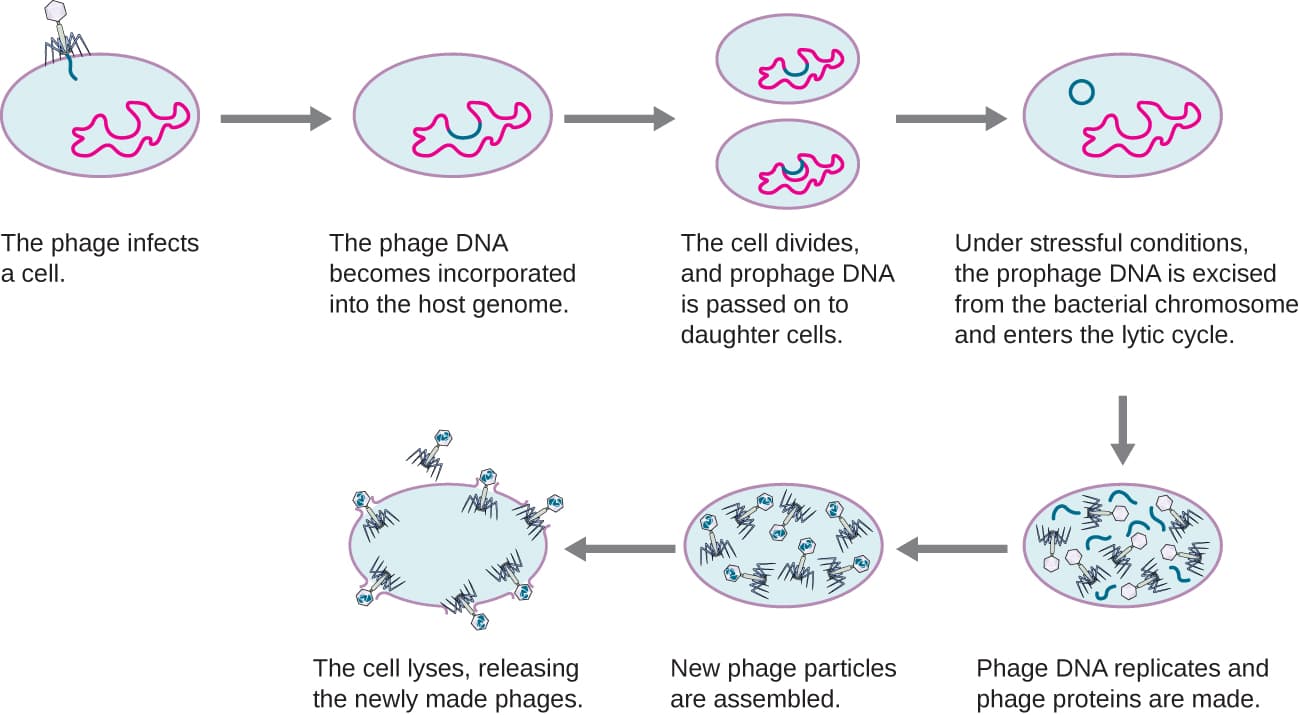
The Viral Life Cycle · Microbiology View original
Is this image relevant?
Lytic cycle - wikidoc View original
Is this image relevant?
The Viral Life Cycle | Microbiology View original
Is this image relevant?
The Viral Life Cycle · Microbiology View original
Is this image relevant?
Lytic vs. Lysogenic Cycles
These are the two main replication strategies used by bacteriophages (and, by extension, conceptual models for understanding animal virus replication).
Lytic cycle: The virus enters a host cell, commandeers its machinery, replicates rapidly, and then lyses (bursts) the cell to release new virions. This is the strategy of virulent phages like T4 phage, and it's also how most acute animal viruses (e.g., influenza) behave.
Lysogenic cycle: Instead of immediately replicating, the viral genome integrates into the host chromosome as a prophage. The host cell replicates normally, copying the prophage along with its own DNA and passing it to daughter cells. The prophage can persist silently for many generations.
- Temperate phages like lambda phage can switch between lysogenic and lytic cycles.
- The prophage can be induced to excise and enter the lytic cycle by environmental stressors such as UV light or chemical damage.
- Some animal viruses follow a similar pattern. Herpes simplex virus, for example, can establish a latent state and later reactivate.
The key distinction: lytic = immediate destruction of the host cell; lysogenic = viral genome hides within the host genome and replicates passively until triggered.
Key Steps in Virus Replication
Regardless of the specific virus, replication follows the same general sequence:
-
Attachment: The virus binds to specific receptors on the host cell surface. This interaction determines which cells a virus can infect. For example, influenza hemagglutinin binds sialic acid residues on respiratory epithelial cells.
-
Penetration: The virus or its genome enters the cell. This can happen via endocytosis (the cell engulfs the virus) or membrane fusion (the viral envelope merges directly with the host membrane, as HIV does).
-
Uncoating: The capsid is removed and the viral genome is released. Depending on the virus, this occurs in the cytoplasm or the nucleus (adenovirus uncoats at the nuclear pore).
-
Replication and gene expression: The viral genome is copied and viral proteins are synthesized using host cell machinery.
- DNA viruses typically replicate in the nucleus (e.g., herpes simplex virus), where they can access host DNA polymerase.
- RNA viruses typically replicate in the cytoplasm (e.g., poliovirus), since they bring or encode their own RNA-dependent RNA polymerase.
-
Assembly: Newly synthesized genomes and structural proteins are assembled into complete virions. This can occur in the cytoplasm (hepatitis B) or the nucleus, depending on the virus.
-
Release: New virions exit the cell by lysis (destroying the cell) or budding (pinching off through the host membrane, acquiring an envelope in the process). Influenza, for instance, buds from the cell membrane. Viral shedding during this stage is what allows transmission to new hosts.

Viral Structure and Host Interactions
A few structural features directly shape how viruses interact with hosts:
- Capsid: The protein shell encasing the viral genome. It protects the nucleic acid and, in non-enveloped viruses, contains the attachment proteins that bind host receptors. Adenovirus is a classic example of a non-enveloped, icosahedral capsid virus.
- Viral envelope: A lipid bilayer derived from the host cell membrane that surrounds some viruses (e.g., influenza, HIV). Envelope glycoproteins mediate attachment and entry. Because the envelope is fragile, enveloped viruses are generally more susceptible to detergents and desiccation than non-enveloped viruses.
- Viral genome: Can be DNA or RNA, single- or double-stranded, linear or circular. Hepatitis B virus, for instance, has a partially double-stranded DNA genome.
- Host cell receptors: The specific surface molecules a virus binds to determine its tropism, meaning which cell types and tissues it can infect. SARS-CoV-2 binds the ACE2 receptor, which is why it primarily targets respiratory and vascular endothelial cells.
Retroviruses vs. Latent Viruses
These two concepts are often confused, but they describe different things.
Retroviruses are RNA viruses that carry the enzyme reverse transcriptase, which converts their RNA genome into DNA. That DNA then integrates into the host chromosome as a provirus. The provirus is transcribed by host machinery to produce new viral RNA and proteins. HIV is the most well-known retrovirus. The integration step is what makes HIV so difficult to cure: the provirus becomes a permanent part of the host cell's genome.
Latent viruses establish infections where the viral genome persists in the host cell without actively producing new virions. The virus is essentially dormant. Reactivation can occur when the host is stressed or immunosuppressed. Varicella-zoster virus is a textbook example: it causes chickenpox during primary infection, then remains latent in dorsal root ganglia and can reactivate years later as shingles.
- A retrovirus can also be latent (HIV can establish latent reservoirs in memory T cells), but not all latent viruses are retroviruses.
- Viral persistence is the broader term for viruses that remain in the host long-term, whether through true latency or chronic active infection (e.g., hepatitis B).

Human Virus-Host Cell Interactions
Viruses don't just passively use host cells. They actively manipulate them.
Exploiting host machinery:
- Viruses bind specific host receptors for entry. HIV, for example, requires both CD4 and a coreceptor (CCR5 or CXCR4) on T helper cells.
- Once inside, viruses use host ribosomes, tRNAs, and energy systems to synthesize viral proteins.
- Some viruses shut down host protein synthesis to give their own mRNAs priority. Poliovirus cleaves a host translation factor (eIF4G), effectively silencing host mRNA translation while viral mRNA (which uses an internal ribosome entry site) continues to be translated.
Evading the immune response:
- Antigenic drift: Gradual mutations in surface proteins (e.g., influenza hemagglutinin) that allow the virus to escape existing antibodies.
- Antigenic shift: Reassortment of genome segments between different viral strains, producing a dramatically new surface protein combination. This is how pandemic influenza strains emerge.
- Interferon interference: Some viruses block interferon production or signaling. Ebola virus proteins actively suppress the interferon pathway, delaying the innate immune response.
- MHC downregulation: Cytomegalovirus reduces MHC class I expression on infected cells, making them less visible to cytotoxic T cells.
Cytopathic effects and disease consequences:
- Cell lysis: Direct destruction of the host cell (adenovirus).
- Syncytia formation: Viral fusion proteins cause neighboring cells to merge into multinucleated giant cells (measles virus). This helps the virus spread while avoiding extracellular immune defenses.
- Inclusion bodies: Aggregates of viral components visible under microscopy, useful as diagnostic markers (Negri bodies in rabies).
- Viruses can trigger apoptosis (programmed cell death) or necrosis in host cells.
- Persistent infections can cause chronic inflammation and progressive tissue damage (hepatitis C leading to liver fibrosis).
- Some viral infections trigger autoimmune responses, where the immune system attacks the body's own tissues. Epstein-Barr virus has been linked to multiple sclerosis.
Oncogenic viruses: Certain viruses can transform normal cells into cancerous ones by disrupting cell cycle controls or activating growth-promoting pathways:
- Human papillomavirus (HPV) → cervical cancer
- Hepatitis B and C viruses → hepatocellular carcinoma (liver cancer)
- Epstein-Barr virus → Burkitt's lymphoma, nasopharyngeal carcinoma
Transduction in Gene Transfer
Transduction is the transfer of bacterial DNA from one bacterium to another via a bacteriophage. It's one of the three main mechanisms of horizontal gene transfer in bacteria (along with transformation and conjugation).
Generalized transduction: During lytic replication, the phage accidentally packages a random fragment of host bacterial DNA into a new phage capsid instead of phage DNA. When this defective phage infects another bacterium, it injects that bacterial DNA, which can recombine into the new host's chromosome. Any gene can potentially be transferred this way. P1 phage is a classic example.
Specialized transduction: This occurs when a prophage excises imprecisely from the host chromosome during induction, taking adjacent bacterial genes with it. Only genes flanking the prophage integration site are transferred. Lambda phage, which integrates near the gal and bio operons in E. coli, is the standard example.
Transduction has real clinical significance because it can spread:
- Antibiotic resistance genes (e.g., beta-lactamase genes, methicillin resistance in Staphylococcus aureus)
- Virulence factors (e.g., Shiga toxin genes in E. coli)
- New metabolic capabilities (e.g., lactose fermentation genes)
This makes transduction a major driver of bacterial evolution and adaptation.
Plant Virus Replication Cycle
Plant viruses face a unique challenge: plant cells are surrounded by rigid cell walls, so viruses can't attach and penetrate the way animal viruses do.
- Entry: Plant viruses typically enter through mechanical wounds or are introduced by insect vectors such as aphids and whiteflies. There is no receptor-mediated attachment step like in animal viruses.
- Cell-to-cell movement: Once inside a cell, viruses spread to neighboring cells through plasmodesmata, the cytoplasmic channels that connect plant cells. Tobacco mosaic virus (TMV) encodes movement proteins that widen plasmodesmata to allow viral passage.
- Replication: Most plant viruses are RNA viruses and replicate in the cytoplasm (e.g., potato virus Y). Some DNA plant viruses, like cauliflower mosaic virus, replicate in the nucleus.
- Assembly: New virions are assembled in the cytoplasm.
- Systemic spread: Viruses can enter the plant's vascular system (phloem) to spread throughout the entire organism.
- Release and transmission: Virions spread to new plants primarily through insect vectors, mechanical contact, or infected seeds. Cell-to-cell release within a plant occurs through plasmodesmata or cell lysis.
Plant viruses do not typically establish lysogenic or latent infections. Most cause persistent, active infections that progressively damage the plant.
See Fiveable more often in Google
Mark Fiveable as a preferred source and Google is more likely to show you our guides in Top Stories, with a "preferred" badge in AI Mode and AI Overviews.