5.5 Cadences and Predominant Function

🎶AP Music Theory Unit 5 Review
5.5 Cadences and Predominant Function
🎶 AP Music Theory
TLDR
A cadence is the chord progression that ends a phrase, and the ones that use predominant function include the plagal cadence (IV-I or iv-i), the Phrygian half cadence (iv⁶-V, minor only), and the deceptive cadence (V moving to a non-tonic chord, usually vi or VI). For AP Music Theory, you need to identify these cadence types both by ear and in a score, along with the authentic and half cadences they get compared to.
Why This Matters for the AP Music Theory Exam
Cadences tell you where phrases end and how strong that ending feels, so naming them quickly helps across the exam. You use cadence recognition when you listen and label what you hear, when you analyze a printed score, and when you check that a part-writing progression actually closes the way it should. Knowing how predominant chords (IV, iv, ii, ii⁶) lead into the dominant also supports harmonic dictation and Roman-numeral analysis, since cadences follow predictable tonic-predominant-dominant-tonic patterns.
Key Takeaways
- A cadence is the harmonic ending of a phrase; some give full closure, some give partial closure, and some avoid it on purpose.
- Plagal cadence: IV-I in major or iv-i in minor, a predominant chord moving straight to tonic.
- Phrygian half cadence: iv⁶-V, minor keys only, with the bass falling a half step into the dominant.
- Deceptive cadence: V moves to a non-tonic chord (usually vi or VI) instead of resolving to I.
- A perfect authentic cadence (PAC) needs root-position V to root-position I with scale degree 1 in the soprano.
- Half cadences end on V and give a sense of pause, not closure.
Cadence Types at a Glance
| Cadence | Progression | Closure |
|---|---|---|
| Perfect Authentic (PAC) | V-I, both root position, soprano ends on tonic | Strongest |
| Imperfect Authentic (IAC) | V-I or vii°-I, but missing a PAC condition | Strong but weaker |
| Plagal (PC) | IV-I or iv-i | Moderate, predominant to tonic |
| Half (HC) | ends on V | Pause, no closure |
| Phrygian Half (PHC) | iv⁶-V, minor only | Pause, no closure |
| Deceptive (DC) | V to non-tonic, usually vi/VI | Avoids expected closure |
Authentic Cadences


An authentic cadence moves a dominant-function chord (V or vii°) to tonic. That dominant-to-tonic motion is what gives the strong sense of arrival. A perfect authentic cadence (PAC) is the strongest version and usually ends a piece or a major section.
To count as a PAC, the cadence must meet all of these:
- It uses a V chord as the dominant (not vii°).
- Both chords are in root position.
- The soprano ends on scale degree 1 (the tonic).
At a PAC, the soprano arrives on tonic, and the leading tone often resolves up by step into scale degree 1. If the soprano leads down to tonic from scale degree 2, that also works. The key requirements are root-position V to root-position I with tonic in the top voice.
If a cadence has dominant-to-tonic motion but misses one of those conditions, it is an imperfect authentic cadence (IAC). Common reasons a cadence is "imperfect": the soprano ends on something other than tonic, one of the chords is inverted, or vii° is used instead of V. IACs still resolve, just not as strongly, and they are very common at the ends of inner phrases and sections.
In minor keys, you can have V-i perfect and imperfect authentic cadences. You may also see V-I (a major tonic) at the end of a minor-key piece, called a Picardy third. It shows up at final cadences, almost never in the middle of a piece.
Plagal Cadences
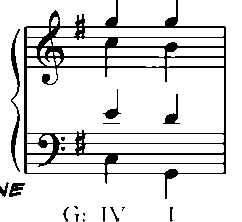

A plagal cadence uses a predominant chord moving straight to tonic: IV-I in major or iv-i in minor. If a ii chord is used, it is usually in first inversion (ii⁶) so scale degree 4 sits in the bass. Doubling the third of that chord gives a fuller subdominant sound.
The name comes from the "Amen" ending in many hymns, which uses IV-I. You also hear this motion all over popular music, often inside the common I-V-vi-IV loop, so do not assume plagal motion only belongs to sacred music.
A strong plagal cadence usually has:
- A IV chord (not ii) moving into tonic.
- Both chords in root position, with the root doubled.
- The soprano ending on tonic.
- The common tone kept, so the fifth of IV (which is scale degree 1) stays in the soprano into the I chord.
When a plagal cadence is inverted or built on ii instead of IV, it sounds weaker. Keeping common tones is just good voice leading, so hold them when you can regardless of cadence type.
Half Cadences


A half cadence ends on V. It creates a feeling of pause, like a comma rather than a period. In major you often hear I-V, and IV-V is also common since the subdominant resolves into the dominant. The phrase pauses on the dominant without returning home to tonic.
In minor, you can use the Phrygian half cadence, which uses predominant function to reach V. It must meet all of these:
- It occurs only in minor keys.
- It uses iv⁶ moving to V, with the iv chord in first inversion.
- The soprano and bass move in contrary motion: the bass falls a half step while the soprano rises a step.
- Both outer voices end on the dominant scale degree.
The bass falling by a half step into V is the easiest way to spot a Phrygian half cadence by ear. Two voice-leading cautions: do not let a doubled third in iv⁶ create an augmented second moving into the V chord, and remember to raise the leading tone in the V chord.
Phrygian half cadences were common at the ends of slow movements leading into faster ones, especially in Baroque music, so they carry an older, more formal sound.
Deceptive Cadences

A deceptive cadence happens when V resolves to a non-tonic chord instead of I, almost always the submediant (vi in major or VI in minor). The ear expects tonic and gets something else, which is why it feels "deceptive." You usually find it inside a section, not at the very end of a piece, because it delays closure rather than providing it.
There are degrees of surprise here. A V-vi (or V-VI) deceptive cadence is the most common and least jarring. A V-IV or V-iv resolution is more unexpected and unsettling.
How to Use This on the AP Music Theory Exam
Aural Recognition
- Listen for where the phrase lands. Resolution to tonic means authentic or plagal; a pause on V means a half cadence; a surprise non-tonic landing after V means deceptive.
- The half-step bass drop into V is your clue for a Phrygian half cadence, and it only happens in minor.
- IV-I and V-I both end on tonic, so listen for whether the chord before tonic feels like a leading-tone pull (V) or a softer subdominant (IV).
Score Analysis
- Label the last two chords with Roman numerals, then match the pattern: V-I is authentic, IV-I (iv-i) is plagal, V to vi/VI is deceptive, anything ending on V is a half cadence.
- Check inversions and the soprano note before you call something a PAC. Root-position V to root-position I with scale degree 1 on top is the test.
Part Writing
- When you want a strong ending, set up V-I in root position with tonic in the soprano.
- For a Phrygian half cadence, write iv⁶ to V in minor, keep contrary motion in the outer voices, raise the leading tone, and avoid an augmented second.
Common Trap
- Do not call a cadence a PAC just because it is V-I. If a chord is inverted or the soprano does not end on tonic, it is an IAC.
Common Misconceptions
- A PAC does not require the soprano to move by step. It requires root-position V to root-position I with scale degree 1 in the soprano. The leading tone often rises into tonic, but stepwise soprano motion is not a separate rule.
- An authentic cadence is not only V-I. A vii° resolving to tonic is also authentic-function, but it cannot be a PAC since PAC needs a root-position V.
- A plagal cadence is not just "church music." The same IV-I motion is everywhere in popular songs.
- A deceptive cadence does not always go V-vi. It can move to other non-tonic chords; vi (or VI) is just the most common target.
- A half cadence is not a weak authentic cadence. It deliberately ends on V and is not supposed to resolve to tonic.
- A Phrygian half cadence is minor-key only and uses iv⁶-V, not a major-key progression.
Related AP Music Theory Guides
Vocabulary
The following words are mentioned explicitly in the AP® course framework for this topic.Term | Definition |
|---|---|
authentic cadence | A cadence that moves from a dominant chord (V) to a tonic chord (I or i), creating a sense of strong harmonic resolution. |
cadence | A harmonic progression that marks the end of a phrase and provides punctuation in musical flow. |
deceptive cadence | A cadence that avoids the expected V-I resolution of an authentic cadence by substituting a non-tonic chord for the tonic. |
dominant | The fifth scale degree and its associated chord (V), which creates tension and typically resolves to the tonic. |
Phrygian half cadence | A cadence that moves from a subdominant chord in first inversion (iv⁶) to a dominant chord (V), used in minor keys only. |
plagal cadence | A cadence that moves from a subdominant chord (IV or iv) to a tonic chord (I or i), also known as an 'Amen cadence.' |
predominant function | A harmonic function that typically occurs between the tonic and dominant, preparing the resolution to the tonic through subdominant chords. |
subdominant | The fourth scale degree and its associated chord (IV or iv), which functions as a predominant harmony leading toward the dominant or tonic. |
tonic | The first scale degree and the primary harmonic center of a key, providing the sense of resolution and stability. |
Frequently Asked Questions
What is a cadence in AP Music Theory?
A cadence is a harmonic ending to a phrase. It signals closure, a pause, or delayed resolution depending on the chord progression and how strongly it returns to tonic.
What is a plagal cadence?
A plagal cadence moves from IV to I in major or iv to i in minor. It uses predominant or subdominant function to move directly to tonic and often sounds softer than an authentic cadence.
What is a Phrygian half cadence?
A Phrygian half cadence is iv6 to V in a minor key. The bass falls by half step into the dominant while the phrase ends on V, so it creates a strong half-cadence pause.
What is a deceptive cadence?
A deceptive cadence happens when V moves to a non-tonic chord instead of resolving to I or i. The most common version is V to vi in major or V to VI in minor.
What makes a cadence a perfect authentic cadence?
A perfect authentic cadence uses root-position V to root-position I and has scale degree 1 in the soprano on the final chord. If one of those conditions is missing, it is not a PAC.
How are cadences tested on the AP Music Theory exam?
Cadences are tested in aural recognition, score analysis, Roman-numeral analysis, and part writing. You need to identify the final chord pattern, inversion, soprano note, and whether the phrase closes or pauses.