8.1 American Romantic Movement

🧁English 12 Unit 8 Review
8.1 American Romantic Movement
🧁 English 12
American Romanticism celebrated emotion, nature, and the individual.
Writers like Poe, Thoreau, and Whitman explored the human psyche, glorified the natural world, and elevated the common person as a hero. This wasn't just a literary trend; it was a cultural reaction to rapid industrialization and a young nation trying to define its own identity apart from Europe.
American Romanticism shared roots with European Romanticism but developed its own distinct flavor. Where European Romantics looked back to medieval history and ancient myths, American Romantics looked outward to the frontier wilderness and the democratic ideals born from the Revolution. Historical forces like westward expansion and the Industrial Revolution shaped the movement's themes and styles.

Top images from around the web for Characteristics of American Romanticism
Romantic and Gothic Literature Remain Popular | Space Mythos: Science Fiction View original
Is this image relevant?
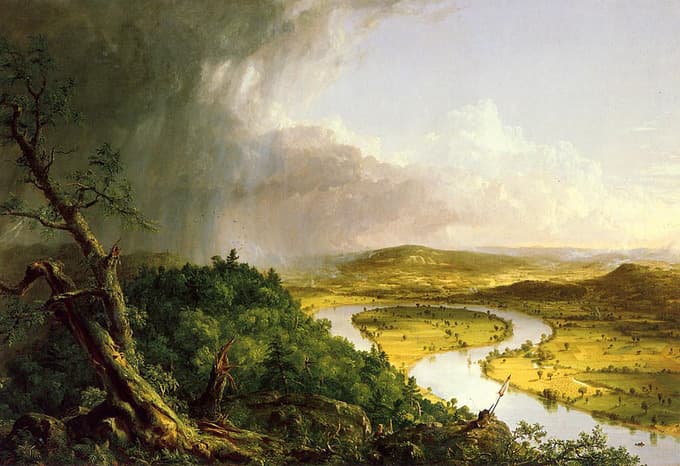
Romanticism – Introduction To Art View original
Is this image relevant?
File:Cole Thomas Romantic Landscape with Ruined Tower 1832-36.jpg - Wikipedia View original
Is this image relevant?
Romantic and Gothic Literature Remain Popular | Space Mythos: Science Fiction View original
Is this image relevant?
Romanticism – Introduction To Art View original
Is this image relevant?
Characteristics and Themes of American Romanticism
Characteristics of American Romanticism
Emotion and individualism took center stage. Writers explored human psychology and the inner world of their characters rather than focusing on social manners or rational argument. Poe's "The Tell-Tale Heart," for example, plunges you directly into the mind of an unreliable, guilt-ridden narrator.
Nature as spiritual truth. Romantic writers treated the natural world as more than scenery. It symbolized freedom, purity, and divine presence. Thoreau's Walden is the clearest example: he moved to the woods specifically to strip life down to its essentials and find meaning through direct contact with nature.
The common person as hero. Unlike earlier literary traditions that focused on aristocrats or mythological figures, American Romantics celebrated ordinary people and folk culture. Whitman's "Song of Myself" treats the everyday experiences of working Americans as worthy of epic poetry.
Imagination and intuition over reason. Romantic writers rejected the Enlightenment's emphasis on logic and classicism, instead embracing spontaneity and personal vision. Emerson's "Self-Reliance" argues that trusting your own instincts matters more than conforming to tradition.
Nostalgia for the past. Many Romantics idealized simpler times and incorporated medieval or Gothic elements into their work. Hawthorne's The Scarlet Letter is set in Puritan New England, using that historical distance to explore timeless moral questions.
The exotic and supernatural. Romantic literature was drawn to mystical elements, dreams, and altered states of consciousness. Irving's "Rip Van Winkle" blends folklore with the supernatural as its main character sleeps through twenty years of American history.

Nature and Individualism in Romantic Literature
Nature wasn't just a backdrop; writers personified natural elements and used them to mirror human emotions. In Bryant's "Thanatopsis," nature literally speaks to comfort humanity about death, treating the earth itself as a source of wisdom.
Individualism drove character development. Romantic protagonists tend to be defined by unique personal experiences and inner conflicts, often clashing with the expectations of society around them. Captain Ahab in Melville's Moby-Dick is a powerful example: his obsessive individual will drives the entire novel toward its tragic conclusion.
Writers also pursued emotional intensity through vivid imagery, sensory detail, and passionate language. Dickinson's poetry packs enormous feeling into compressed lines, using dashes and unexpected metaphors to jolt the reader into new ways of seeing.
The concept of the sublime runs through much of this literature and art. The sublime is the feeling of awe, even terror, that comes from encountering something overwhelmingly vast or powerful in nature. Thomas Cole and the Hudson River School painters captured this visually, depicting towering mountains and dramatic skies that make human figures look small by comparison.
Historical Context and Comparisons

American vs. European Romanticism
Both movements shared a core emphasis on emotion and imagination over reason, but they diverged in significant ways:
- Cultural focus: American Romantics explored frontier life, democracy, and national identity. European Romantics drew on medieval history, aristocratic traditions, and ancient myths.
- Natural settings: American literature featured untamed wilderness and vast, uncharted landscapes. European Romanticism more often depicted cultivated gardens and pastoral countryside.
- Political influences: American writers were shaped by democratic ideals and individualism. European Romantics were often reacting against monarchies and the upheaval of revolutions like the French Revolution.
- Literary forms: Americans developed homegrown genres like the tall tale, reflecting the oral storytelling traditions of frontier life. European Romantics tended to revive traditional forms like ballads and sonnets.
Historical Context of American Romanticism
The American Revolution planted the seeds for this movement. Its emphasis on individual liberty and self-reliance gave writers a philosophical foundation and a reason to reject European aristocratic literary traditions.
Westward expansion romanticized pioneer life and fueled stories about humans confronting raw nature. Cooper's Leatherstocking Tales, featuring the frontiersman Natty Bumppo, became some of the most popular novels of the era by dramatizing life on the edge of civilization.
The Industrial Revolution created a counter-reaction. As factories and cities grew, writers felt nostalgia for pre-industrial simplicity and critiqued the materialism and dehumanization that came with urbanization. Much of Romantic literature can be read as pushing back against this rapid change.
Transcendentalism, led by Emerson and Thoreau, grew directly out of American Romanticism. It pushed the movement's ideas further, arguing that individuals could access spiritual truth through intuition and direct experience with nature, without needing organized religion as an intermediary.
Romantic writers also engaged with the social tensions of their time. Native American cultures were often romanticized, as in Longfellow's "The Song of Hiawatha," though these portrayals frequently oversimplified or idealized Indigenous peoples rather than representing them accurately. The slavery crisis and reform movements also shaped the literature; Stowe's Uncle Tom's Cabin used Romantic emotional appeal to make a powerful abolitionist argument, becoming one of the most influential novels in American history.
See Fiveable more often in Google
Mark Fiveable as a preferred source and Google is more likely to show you our guides in Top Stories, with a "preferred" badge in AI Mode and AI Overviews.