12.2 Historical Development of the Novel

🧁English 12 Unit 12 Review
12.2 Historical Development of the Novel
🧁 English 12
Origins and Evolution of the Novel
The novel is one of the most influential literary forms ever developed, but it didn't appear overnight. It evolved over centuries, shaped by changes in technology, society, and ideas about what stories could do. Understanding that history helps you see why novels look and feel the way they do today.

Top images from around the web for Origins to present of novels
Gender in Novels, 1770–1922 View original
Is this image relevant?
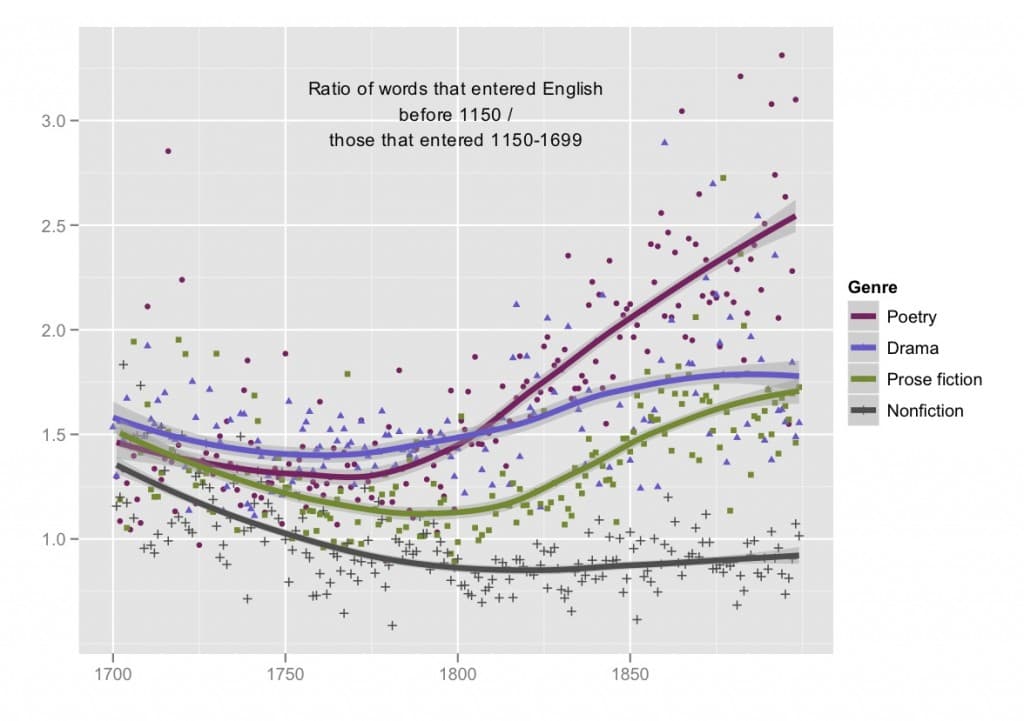
» The Emergence of Literary Diction Journal of Digital Humanities View original
Is this image relevant?
Why To Teach Students to Not-Read Novels | Scholars' Lab View original
Is this image relevant?
Gender in Novels, 1770–1922 View original
Is this image relevant?
» The Emergence of Literary Diction Journal of Digital Humanities View original
Is this image relevant?
From Ancient Roots to the Early Modern Period
Long before anyone used the word "novel," writers were experimenting with long prose narratives. Ancient Greek and Roman works like Petronius's Satyricon (1st century CE) told fictional stories in prose rather than verse. During the medieval period, romances like Thomas Malory's Le Morte d'Arthur (1485) wove together adventure, chivalry, and myth into extended narratives.
The real shift toward the modern novel began in 16th-century Spain with picaresque fiction, stories following a roguish lower-class hero through a corrupt society. Lazarillo de Tormes (1554) is a key early example. Then came Miguel de Cervantes's Don Quixote (1605), often called the first modern novel. Cervantes did something new: he created a psychologically complex character whose delusions clashed with the real world, blending comedy with genuine insight into human nature.
The Rise of the Modern Novel (18th Century)
The 1700s are when the novel truly took shape as a distinct genre. A few landmark developments:
- Daniel Defoe's Robinson Crusoe (1719) introduced a new level of realism, presenting a fictional story as though it were a true account, with detailed descriptions of everyday survival.
- Samuel Richardson's Pamela (1740) used the epistolary form (a novel told through letters) to explore a character's inner psychology in ways earlier fiction hadn't attempted.
- Henry Fielding's Tom Jones (1749) brought a more comic, panoramic style, following a character across social classes and settings.
These writers established core expectations readers still have for novels: believable characters, realistic settings, and sustained attention to how people think and feel.
The 19th-Century Golden Age
The 1800s were a period of extraordinary growth for the novel. Several forces drove this expansion:
- Serialized publication made novels accessible to a much wider audience. Charles Dickens published works like Oliver Twist and Bleak House in monthly installments, building suspense and reaching readers who couldn't afford full books.
- Realism became the dominant mode. Writers like George Eliot (Middlemarch) and Gustave Flaubert (Madame Bovary) aimed to portray life as it actually was, with careful attention to social detail and psychological truth.
- Social commentary became central to the novel's purpose. Dickens exposed poverty and institutional cruelty; the Brontë sisters explored the constraints placed on women; Leo Tolstoy tackled war, faith, and class in sweeping works like War and Peace.
By the end of the century, the novel was the dominant literary form in Europe and North America.

20th-Century Experimentation
The two World Wars, rapid industrialization, and new ideas in psychology (especially Freud's work on the unconscious) pushed novelists to rethink how stories could be told.
- Modernist writers broke with linear, straightforward narration. Virginia Woolf (Mrs. Dalloway, To the Lighthouse) and James Joyce (Ulysses) used stream of consciousness, a technique that tries to capture the flow of a character's thoughts in real time, jumping between memories, sensations, and observations.
- Postmodern writers went further, questioning whether fiction could represent reality at all. Metafiction (fiction that draws attention to its own status as fiction) became a hallmark of this movement. Kurt Vonnegut's Slaughterhouse-Five uses nonlinear time and self-aware narration to convey the absurdity of war.
- Lost Generation writers like Ernest Hemingway and F. Scott Fitzgerald captured the disillusionment that followed World War I, while later decades saw Holocaust literature and postcolonial fiction grapple with trauma, identity, and recovery.
The 21st Century and the Digital Age
The novel continues to evolve. E-books and online publishing platforms have lowered barriers to entry, bringing a wider range of voices into print. Global authors writing in or translated from many languages reach broader audiences than ever before. Interactive and transmedia storytelling (narratives that span books, apps, and other platforms) have begun to reshape what a "novel" can even be.
What Drove the Novel's Evolution
The novel didn't develop in a vacuum. Several major forces shaped its growth at every stage:
- Rising literacy and a growing middle class created demand for stories about ordinary people's lives, not just aristocrats and heroes.
- Printing technology was crucial. The Gutenberg press (mid-1400s) made books possible at scale; 19th-century innovations like steam-powered printing and cheaper paper made them affordable.
- Industrialization and urbanization gave novelists new subjects: factory life, crowded cities, class conflict, social mobility.
- Intellectual movements directly shaped themes. Enlightenment rationalism influenced satirical novels like Voltaire's Candide. Romanticism elevated emotion and individual experience, visible in Goethe's The Sorrows of Young Werther.
- Colonialism introduced new settings and perspectives into European fiction (Kipling's Kim), though often through a lens that later postcolonial writers would challenge and rewrite.
- The women's rights movement elevated female authors and made women's inner lives a serious literary subject. The Brontë sisters, George Eliot, and later Virginia Woolf all expanded what the novel could explore.
- Scientific advances reshaped how novelists understood human behavior. Darwin's theory of evolution influenced the naturalism of Émile Zola, who depicted characters shaped by heredity and environment. Advances in psychology informed the deep character portrayals in Dostoevsky's Crime and Punishment.

Adaptation and Impact of the Novel
How the Novel Adapted Over Time
As the novel matured, it branched out in form, voice, and subject matter. Here are the key dimensions of that adaptation:
Genre diversification. The novel splintered into specialized genres, each with its own conventions. Mary Shelley's Frankenstein (1818) helped launch the Gothic novel. Arthur Conan Doyle's Sherlock Holmes stories established detective fiction. Science fiction and fantasy opened up entirely new imaginative territories.
Narrative technique. Writers kept finding new ways to tell stories:
- Stream of consciousness (Woolf's Mrs. Dalloway) immerses the reader in a character's unfiltered thoughts.
- Nonlinear storytelling (Vonnegut's Slaughterhouse-Five) disrupts chronological order to reflect how memory and trauma actually work.
- Unreliable narrators (Agatha Christie's The Murder of Roger Ackroyd) force readers to question what they're being told.
Representation. The novel gradually expanded to include voices that had been excluded. Chinua Achebe's Things Fall Apart (1958) told the story of colonialism from an African perspective, challenging the dominance of Western viewpoints in literary fiction.
Language. Early novels tended toward formal, elevated prose. Over time, writers embraced colloquial speech and dialect. Mark Twain's Adventures of Huckleberry Finn (1884) was groundbreaking in its use of vernacular English, making the narrator's voice feel authentic to his background.
Structure. William Faulkner's The Sound and the Fury fragmented narrative across multiple perspectives and time periods. Truman Capote's In Cold Blood (1966) created a hybrid form blending novelistic techniques with journalism, often called the "nonfiction novel."
Themes. Early novels often carried explicit moral lessons. Over time, the focus shifted toward social critique, psychological exploration, and questions of identity. J.D. Salinger's The Catcher in the Rye (1951) is a clear example of this shift, centering on adolescent alienation rather than moral instruction.
Impact of Key Novels and Authors
Certain writers didn't just participate in the novel's development; they changed its direction. Here are some of the most significant:
- Jane Austen perfected social comedy and free indirect discourse (narrating through a character's perspective without using first person). Pride and Prejudice (1813) remains a model for how irony and sharp observation can reveal the dynamics of class and gender.
- Charles Dickens popularized the serial publication model and proved that novels could be both wildly entertaining and vehicles for social reform. Characters like Oliver Twist became symbols of institutional neglect.
- Gustave Flaubert raised the standard for prose craftsmanship. Madame Bovary (1857) pursued an almost scientific objectivity in narration, influencing generations of realist writers.
- Leo Tolstoy demonstrated that a novel could operate on an epic scale while maintaining psychological intimacy. War and Peace weaves together personal stories and sweeping historical events.
- Virginia Woolf advanced stream of consciousness as a narrative method and brought feminist perspectives into the literary mainstream. To the Lighthouse (1927) explores time, memory, and gender with remarkable subtlety.
- James Joyce pushed the boundaries of language and structure further than almost anyone. Ulysses (1922) reimagines a single day in Dublin through radically experimental prose, influencing virtually every modernist writer who followed.
- Gabriel García Márquez brought magical realism to a global audience with One Hundred Years of Solitude (1967), blending myth, history, and the supernatural in a way that felt both fantastical and deeply true to Latin American experience.
- Toni Morrison illuminated the African American experience through poetic, nonlinear narratives. Beloved (1987) confronts the legacy of slavery with a power that reshaped American literary fiction.
- Haruki Murakami blends Western and Eastern literary traditions, weaving surrealist elements into otherwise quiet, contemporary settings. The Wind-Up Bird Chronicle (1994) exemplifies his distinctive fusion of the mundane and the strange.
See Fiveable more often in Google
Mark Fiveable as a preferred source and Google is more likely to show you our guides in Top Stories, with a "preferred" badge in AI Mode and AI Overviews.