5.2 Victorian Poetry

🧁English 12 Unit 5 Review
5.2 Victorian Poetry
🧁 English 12
Victorian poetry captured the spirit of an era defined by rapid change and deep social tension. Poets like Tennyson, Browning, and Arnold wrestled with questions about faith, love, duty, and identity, often using innovative forms to probe the inner lives of their characters. Their work reflects both the confidence and the anxiety of a society transformed by industrialization, scientific discovery, and shifting moral certainties.
Victorian Poets and Their Works

Top images from around the web for Major Victorian poets
Poems (Tennyson, 1842) - Wikipedia View original
Is this image relevant?
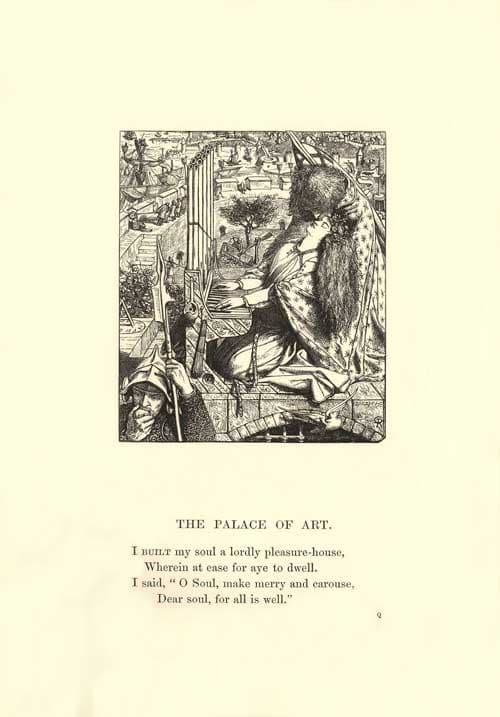
Lorraine Janzen Kooistra, “The Moxon Tennyson as Textual Event: 1857, Wood Engraving, and Visual ... View original
Is this image relevant?
Biography: Christina Rossetti | English Literature: Victorians and Moderns View original
Is this image relevant?
Poems (Tennyson, 1842) - Wikipedia View original
Is this image relevant?
Lorraine Janzen Kooistra, “The Moxon Tennyson as Textual Event: 1857, Wood Engraving, and Visual ... View original
Is this image relevant?
Major Victorian poets
Alfred, Lord Tennyson served as Poet Laureate for over 40 years, making him the public voice of Victorian poetry. He crafted narrative poems and dramatic monologues that explore loss, duty, and the pull of the past. His "In Memoriam A.H.H." is a long elegy mourning the death of his close friend Arthur Hallam, and it became one of the era's most important meditations on grief and religious doubt. "The Lady of Shalott" uses Arthurian legend and vivid imagery to explore themes of isolation and artistic creation.
Robert Browning is best known for pioneering the dramatic monologue, a form where a single speaker reveals their psychology (often unintentionally) to a silent listener. "My Last Duchess" is the classic example: a duke casually describes a painting of his late wife, and through his words you gradually realize he had her killed. Browning's longer work "The Ring and the Book" tells a murder story from multiple perspectives, pushing the dramatic monologue to epic scale.
Elizabeth Barrett Browning innovated within the sonnet form and tackled social issues head-on. "Sonnets from the Portuguese" is a sequence of 44 love sonnets written to her husband Robert Browning, including the famous "How Do I Love Thee?" Her verse novel Aurora Leigh addressed women's independence, poverty, and the role of the artist, making it one of the most ambitious poems of the period.
Matthew Arnold combined the roles of cultural critic and poet. "Dover Beach" is his most famous poem, using the image of a retreating sea to express the loss of religious faith in the modern world. The poem's closing image of "ignorant armies" clashing by night captures Victorian anxiety about a world without spiritual certainty. His prose work Culture and Anarchy argued that literature and the arts could fill the moral gap left by declining religion.
Christina Rossetti wrote devotional and lyric poetry marked by vivid imagery and emotional directness. "Goblin Market" is a richly symbolic narrative poem about two sisters tempted by goblin fruit, open to readings about temptation, sexuality, and sisterly love. Her shorter poem "Remember" is a sonnet about death and memory that balances grief with quiet acceptance.

Themes and styles in Victorian poetry
Victorian poets returned again and again to a set of concerns shaped by their rapidly changing world.
Common themes:
- Social criticism and reform tackled poverty, class inequality, and the harsh conditions of urban and industrial life
- Industrialization and urbanization explored how technological change reshaped society, labor, and the natural landscape
- Faith and doubt grappled with religious uncertainty as scientific advances (especially Darwin's theory of evolution) challenged traditional belief
- Love and marriage examined the complexities of romantic relationships, often questioning the societal expectations placed on both men and women
- Nature and the pastoral idealized rural life as a counterpoint to the noise and grime of industrial cities
Poetic styles and forms:
- Dramatic monologue reveals a character's psychology through a single speaker's voice, often exposing more than the speaker intends. Browning's "My Last Duchess" is the defining example.
- Narrative poetry tells stories, frequently with moral or social messages woven in. Tennyson's "Idylls of the King" retells the Arthurian legends as a commentary on Victorian ideals.
- Lyric poetry expresses personal emotions and reflections in a musical, compressed form. Christina Rossetti's "When I am dead, my dearest" is a clear example.
- Sonnets and sonnet sequences explored love and philosophical themes across linked poems. Elizabeth Barrett Browning's "Sonnets from the Portuguese" revitalized the form.
Literary techniques:
- Symbolism and allegory used concrete objects and stories to represent abstract ideas. The goblin fruit in Rossetti's "Goblin Market" can symbolize temptation, consumer culture, or sexual desire.
- Imagery and sensory detail created vivid, evocative scenes. Tennyson was especially known for this; "The Lady of Shalott" is packed with color, light, and texture.
- Metrical experimentation pushed the boundaries of rhythm and form. Gerard Manley Hopkins developed sprung rhythm, a system based on stressed syllables rather than regular metrical feet, giving his poetry a compressed, energetic feel.
- Archaic language and medieval settings evoked a romanticized past, as in Tennyson's Arthurian poems, creating distance from the industrial present.
Tone and mood:
- Melancholy and nostalgia reflected societal anxieties and a longing for a simpler, more certain time
- Moral seriousness addressed weighty ethical and social questions without irony
- Introspection and self-analysis delved into the complexities of the human psyche, anticipating the psychological focus of modern literature

Victorian Poetry in Context
Romanticism vs Victorian poetry
Victorian poets inherited a great deal from the Romantics but moved in distinctly new directions. Understanding what they kept and what they changed is key to reading their work well.
Romantic influences that carried over:
- An emphasis on nature and the sublime, celebrating the natural world as a source of inspiration and transcendence
- Interest in medieval themes and settings, romanticizing past ages (Tennyson's Arthurian legends draw directly from this tradition)
- Exploration of individual emotions, focusing on personal experience and feeling
Where Victorian poets departed from Romanticism:
- A shift from idealism to realism, addressing concrete social problems and the texture of everyday life rather than abstract ideals
- A greater focus on social issues and contemporary life, engaging directly with industrialization, poverty, and class conflict
- More complex psychological portrayals, exploring characters with contradictory motivations rather than idealized figures
- Increased skepticism and questioning of faith, reflecting the growing religious doubts that scientific discoveries provoked
Victorian innovations:
- The dramatic monologue as a fully developed form, allowing poets to inhabit voices very different from their own and reveal character psychology indirectly
- Experimentation with form and meter, including Hopkins' sprung rhythm and Barrett Browning's reshaping of the sonnet sequence
- Integration of scientific and philosophical ideas into poetry, treating Darwin, geology, and social theory as legitimate poetic subjects
Poetry's role in Victorian society
Poetry wasn't a niche art form in Victorian England. It was widely read, publicly debated, and expected to engage with the moral and social questions of the day.
Social commentary:
- Poets exposed the harsh conditions of factories and urban slums, giving voice to suffering that polite society often ignored
- Class issues and social mobility were frequent subjects, examining who could rise in Victorian society and at what cost
Gender roles and women's rights:
- The "Angel in the House" ideal (from Coventry Patmore's poem of that name) portrayed women as pure, domestic, and self-sacrificing. Many poems reinforced this image.
- Other poets, especially Elizabeth Barrett Browning and Christina Rossetti, challenged these expectations, questioning the narrow roles available to women
Religious doubt and faith:
- Scientific discoveries, particularly in geology and evolutionary biology, shook the foundations of traditional Christian belief
- Poems like Tennyson's "In Memoriam" and Arnold's "Dover Beach" portray spiritual crises honestly, showing characters struggling to hold onto faith or coming to terms with its loss
Empire and nationalism:
- Victorian poetry reflected both pride and ambivalence about the British Empire and its colonial reach
- Some poems celebrated national identity and achievement, while others hinted at the moral costs of imperialism
Morality and social responsibility:
- Victorian culture placed enormous emphasis on duty, self-improvement, and moral uprightness, and poetry was expected to reinforce these values
- At the same time, the best Victorian poems explored genuine ethical dilemmas rather than offering easy answers
Cultural anxieties:
- Rapid social and technological change produced both excitement and fear about the future
- Poets questioned whether Victorian civilization could sustain itself, a concern that gives much of the era's poetry its underlying tension
See Fiveable more often in Google
Mark Fiveable as a preferred source and Google is more likely to show you our guides in Top Stories, with a "preferred" badge in AI Mode and AI Overviews.