
Vectors are the foundation of multidimensional calculus. They let you describe quantities that have both magnitude and direction, which is essential for modeling motion, forces, and geometry in three-dimensional space. This section covers the core operations you'll perform on vectors and the key properties you'll rely on throughout the course.
Vector Operations
Adding and Multiplying Vectors
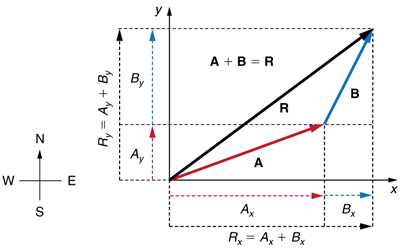
Vector addition combines two or more vectors into a single resultant vector. Graphically, you can visualize this using the parallelogram law or the tip-to-tail (triangle) method. Analytically, you just add corresponding components:
Scalar multiplication scales a vector's magnitude without changing its direction. You multiply each component by the scalar:
If , the vector points in the same direction but is stretched or compressed. If , the vector also reverses direction. And if , you get the zero vector.

Dot Product and Cross Product
The dot product (also called the scalar product) takes two vectors and returns a single number. It's computed component-wise:
There's also a geometric form that connects the dot product to the angle between the two vectors:
This geometric form is extremely useful. It gives you a direct way to find the angle between two vectors, and it immediately tells you whether vectors are perpendicular (dot product equals zero), point in roughly the same direction (positive), or roughly opposite directions (negative). The dot product is commutative: .
The cross product (vector product) takes two vectors and returns a new vector that is perpendicular to both inputs. The formula is:
A reliable way to remember this is to set up a determinant with in the first row, the components of in the second, and the components of in the third, then expand along the first row.
Key properties of the cross product:
- Its magnitude equals , which also gives the area of the parallelogram spanned by the two vectors.
- Its direction is determined by the right-hand rule: point your fingers along , curl them toward , and your thumb points in the direction of .
- It is anti-commutative: . Swapping the order flips the sign.
Vector Properties
Unit Vectors and Magnitude
The magnitude (or length) of a vector is the distance from its initial point to its terminal point, calculated with the Euclidean norm:
A unit vector has magnitude 1 and represents pure direction. You can turn any nonzero vector into a unit vector by dividing it by its magnitude:
The standard unit vectors in are , , and . Any vector can be written as a linear combination of these: .
Vector Relationships and Decomposition
Vector projection finds the component of one vector that lies along the direction of another. The projection of onto is itself a vector:
The scalar projection (sometimes called the component) gives just the signed length of that projection:
A positive scalar projection means has a component in the same direction as ; a negative value means it points partly opposite.
Orthogonal vectors are perpendicular to each other, which you can test with the dot product: if and only if the two vectors are orthogonal (assuming neither is the zero vector).
Vector decomposition breaks a vector into components along specified directions:
- Rectangular decomposition expresses a vector in terms of the standard basis:
- You can also decompose along non-standard directions using vector projection. For example, given any vector and a direction , you can write as the sum of its projection onto and the component orthogonal to : . This decomposition shows up constantly in applications like computing work and resolving forces.