
Partial Derivatives and Multivariable Functions
Partial derivatives let you isolate how a multivariable function changes with respect to one variable while holding everything else constant. They're the foundation for nearly everything else in Calculus IV: tangent planes, optimization, gradient fields, and more.
Definition and Notation of Partial Derivatives
A multivariable function depends on two or more independent variables. For example, takes in two inputs and returns a single output.
A partial derivative measures the rate of change of such a function with respect to one variable, treating all other variables as constants. Think of it this way: if you're standing on a surface and you walk purely in the -direction, the partial derivative tells you how steeply the surface rises or falls along that path.
The symbol (as opposed to ) signals that other variables are being held fixed. Common notations you'll see:
- or for the partial derivative with respect to
- or for the partial derivative with respect to
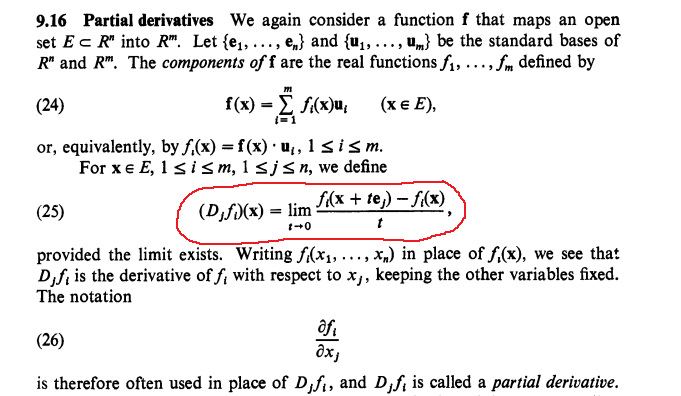
The formal limit definition mirrors single-variable calculus:
Notice only the -input changes; stays at .
Computing Partial Derivatives
The mechanics are straightforward: differentiate with respect to your target variable using all the standard rules (power, product, chain, trig, etc.), and treat every other variable as if it were a constant number.
Step-by-step process:
- Identify which variable you're differentiating with respect to.
- Mentally replace every other variable with a constant (some students find it helpful to literally substitute a letter like for the held-fixed variable while computing).
- Differentiate using the usual single-variable rules.
- Substitute the original variable names back in if you replaced them.
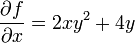
Example 1: Let .
- For : treat as a constant. You're differentiating , which gives .
- For : treat as a constant. You're differentiating , which gives .
Example 2: Let .
- (the term is a constant with respect to , so it vanishes)
- (the term vanishes since it's constant with respect to )
A common early mistake is forgetting to zero out terms that don't involve your target variable. If a term has no in it, its partial derivative with respect to is zero.
Higher-Order Partial Derivatives
Just as in single-variable calculus, you can differentiate again. Second-order partial derivatives come in two flavors:
- Unmixed: differentiate twice with respect to the same variable, e.g.,
- Mixed: differentiate with respect to different variables, e.g.,
Be careful with the notation for mixed partials. In , you differentiate with respect to first, then with respect to (right to left). In subscript notation , you go left to right: first, then . These conventions are opposite, which trips people up.
Clairaut's Theorem and Mixed Partial Derivatives
Clairaut's theorem says: if and are both continuous near a point, then at that point. In practice, this means the order of differentiation doesn't matter for the vast majority of functions you'll encounter in this course.
Example: Let .
- Compute , then .
- Compute , then .
Both mixed partials equal , confirming Clairaut's theorem. If you ever compute them and get different results, check your algebra first.
Geometric Interpretation
Tangent Planes and Directional Derivatives
Partial derivatives have a clean geometric meaning. The partial derivative is the slope of the curve you get by slicing the surface with the plane . Similarly, is the slope of the slice at . Together, these two slopes determine the tangent plane at a point.
The equation of the tangent plane to at the point is:
This is the best linear approximation to the surface near that point, and it generalizes the tangent line from Calc I.
The directional derivative extends partial derivatives beyond just the - and -directions. It measures the rate of change of at in the direction of any unit vector :
Note that must be a unit vector. If you're given a direction that isn't unit length, normalize it first.
The gradient vector packages both partial derivatives into a single vector. Two key facts about the gradient:
- It points in the direction of the greatest rate of increase of .
- It's perpendicular to the level curves of at that point.
Example: For , the gradient at is . The level curves are circles centered at the origin, and points radially outward, perpendicular to those circles, exactly as expected.