
Iterated Integrals
Double integrals over rectangles let you calculate quantities like area and volume by breaking a two-variable problem into two one-variable integrals. You evaluate them one at a time: compute the inner integral first, then feed that result into the outer integral.
Definition and Notation
An iterated integral is written as:
You can also write it with explicit parentheses to make the evaluation order clearer:
Here's how to evaluate one:
- Inner integral first. Integrate with respect to from to , treating as a constant. This produces a function of alone.
- Outer integral second. Integrate that result with respect to from to . This gives you a number.
Quick example: Evaluate .
- Inner integral (with respect to , treating as constant):
- Outer integral (with respect to ):
Types of Limits of Integration
- Constant limits are fixed values that don't depend on the other variable. The example above, , has all constant limits. This is the standard setup for rectangular regions.
- Variable limits depend on the outer variable. For instance, has an upper limit of on the inner integral, meaning the range of changes as changes.
- Variable limits show up when the region of integration is not a rectangle. For this unit (rectangular regions), you'll mostly work with constant limits on both integrals.
Reversing Order of Integration
Swapping the Order of Integration
For rectangular regions with constant limits, Fubini's Theorem guarantees that you can swap the order of integration freely, as long as is continuous on the rectangle:
This is useful when one order leads to a much simpler antiderivative than the other. When you reverse the order:
- The old inner limits become the new outer limits (and vice versa).
- The differentials swap: becomes .
For non-rectangular regions (variable limits), reversing the order requires you to re-derive the limits from the geometry of the region, which is more involved.
Visualizing the Change of Order
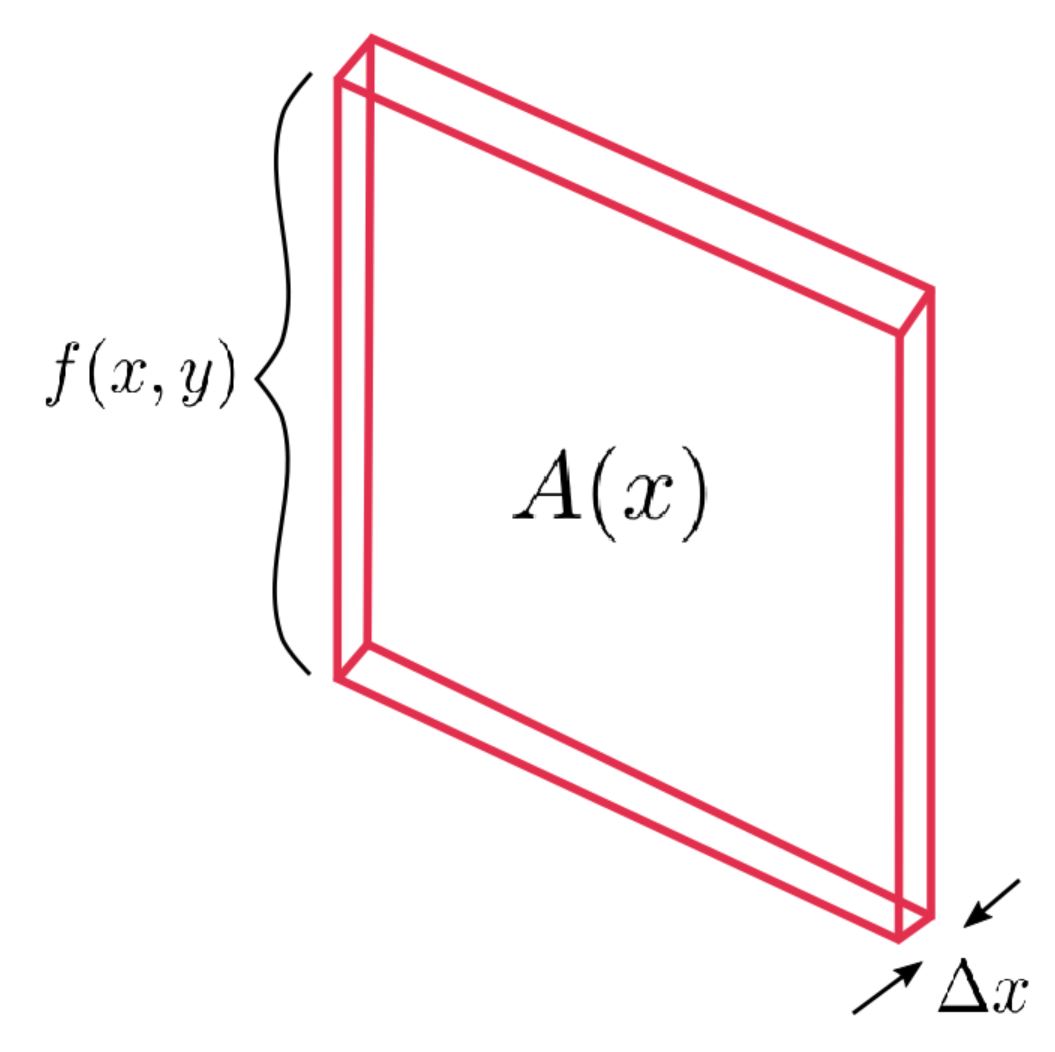
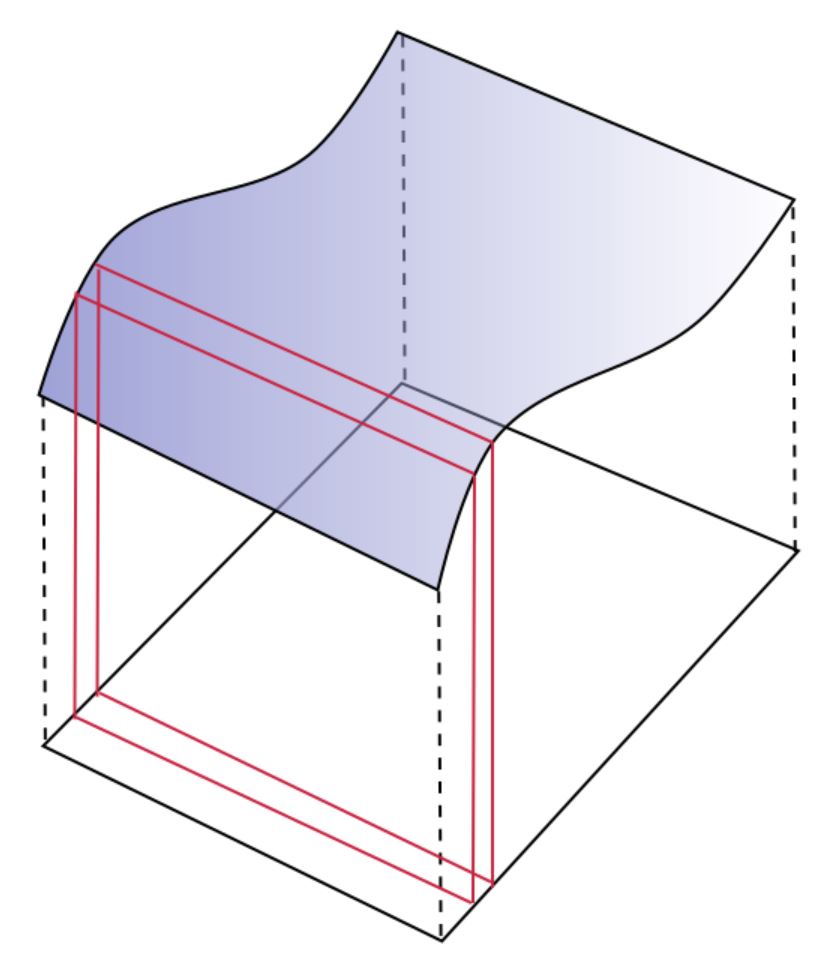
Think of the two orders as slicing the region in different directions:
- order: You slice the region into thin vertical strips. For each fixed , you integrate along (bottom to top), then sweep those strips from left to right.
- order: You slice into thin horizontal strips. For each fixed , you integrate along (left to right), then sweep those strips from bottom to top.
Both approaches cover the same region and yield the same answer. The choice comes down to which integrand is easier to handle in a given order.
Applications of Double Integrals
Area Calculation
To find the area of a planar region , integrate the constant function 1 over that region:
Example: Find the area of the region bounded by and .
The curves intersect where , so and . Using symmetry (or just integrating from to ), set up:
The inner integral gives , and then .
Note: this particular example uses variable limits, so it goes beyond a purely rectangular region. On a rectangle like , the area is simply .
Volume Calculation
The most common application over rectangles is computing volume. If a surface sits above a rectangular base , the volume of the solid between the surface and the -plane is:
Here gives the height of the surface above each point in the base.
Example: Find the volume under over the rectangle .
- Set up the integral:
- Inner integral:
- Outer integral:
The volume is cubic unit. You can verify this by reversing the order of integration and confirming you get the same result.