
Work and Line Integrals
Calculating Work Using Line Integrals
Work measures the energy transferred by a force acting on an object as it moves along a path. In vector calculus, you compute it as the line integral of a force vector field along a curve :
At each point along the path, the dot product captures only the component of force in the direction of motion. Force perpendicular to the path does zero work.
To actually evaluate this integral, you parameterize the path with a vector-valued function for , then compute:
Note the distinction between two types of line integrals you'll encounter:
- Line integral of a vector field (used for work): . This depends on the direction you traverse .
- Line integral of a scalar function (used for mass, arc length, etc.): , where is the arc length element. This does not depend on orientation.
Force fields are vector fields representing the force on an object at each point in space. Gravitational fields, electric fields, and fluid velocity fields are common examples.
Path Independence and Conservative Fields
Path independence means the value of depends only on the endpoints of , not on which route you take between them. If paths and share the same start and end points, then:
A vector field with this property is called conservative. Gravity and electrostatic force are conservative. Friction is not, because the work it does depends on the length and shape of the path (and it always removes energy from the system).
The fundamental theorem for line integrals is what makes conservative fields so convenient. If for some scalar function , then:
You skip the parameterization entirely and just evaluate the potential function at the two endpoints.
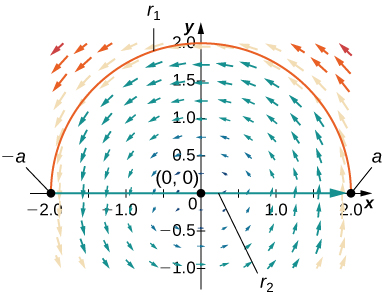
Conservative Forces and Potential Energy
Relationship Between Conservative Forces and Potential Energy
In physics, conservative forces are written with a sign convention: , where is the potential energy function. The negative sign means force points in the direction of decreasing potential energy (objects naturally move toward lower energy states).
The work done by a conservative force then equals the negative change in potential energy:
So if an object moves from high potential to low potential, the force does positive work on it (it speeds up). Familiar examples:
- Gravitational potential energy: . A falling object loses potential energy, and gravity does positive work.
- Electrostatic potential energy: . A charge moving toward an opposite charge loses potential energy as the electric force does positive work.
In both cases, the work depends only on the initial and final positions, never on the path.

Properties of Conservative Force Fields
Three equivalent ways to identify a conservative field (on a simply connected domain):
- Zero curl: everywhere in the domain.
- Path independence: depends only on endpoints.
- Zero circulation on closed loops: for every closed curve .
These three conditions are all equivalent, and any one of them implies the other two. The zero-curl test (condition 1) is usually the fastest way to check whether a given field is conservative.
Conservative forces also conserve mechanical energy. Since and the work-energy theorem gives (change in kinetic energy), you get:
Total mechanical energy is preserved whenever only conservative forces act.
Circulation and Closed Paths
Defining Circulation
Circulation measures how much a vector field "flows along" a closed loop. For a vector field and a closed curve , circulation is:
The sign tells you the rotational tendency relative to your chosen orientation:
- Positive circulation: net flow in the counterclockwise direction (standard orientation).
- Negative circulation: net flow in the clockwise direction.
- Zero circulation: no net rotational tendency around the loop.
Circulation connects directly to curl through Stokes' theorem. If is any oriented surface bounded by , then:
This tells you that circulation around a loop equals the total curl "flux" through any surface spanning that loop. If everywhere, Stokes' theorem immediately gives zero circulation on every closed path, which is consistent with the conservative field properties above.
Properties of Closed Paths and Circulation
A closed path starts and ends at the same point. Circles, ellipses, rectangles, or any simple closed curve all qualify.
The key results connecting circulation to the rest of this unit:
- Conservative fields have zero circulation on every closed path. This follows directly from the fundamental theorem for line integrals: if , then for any closed curve starting and ending at .
- Nonzero circulation implies non-conservative. If you find any closed path where , the field cannot be conservative and has no potential function.
- Circulation detects rotation in physical systems. In fluid dynamics, the circulation of a velocity field around a closed curve measures the net rotational motion of the fluid. A vortex has large circulation around loops enclosing its center, even if the fluid speed is the same at every point on the loop.
This gives you a practical diagnostic: computing circulation on a well-chosen closed path is often the quickest way to confirm that a field is not conservative, without needing to check the curl component by component.