
Function Graphs and Representations
Graphs of Functions in Three Dimensions
The graph of a function is the set of all points in three-dimensional space where . You can think of it as a surface hovering over (or dipping below) the -plane, where the height at each point is determined by the function's output.
This surface gives you a geometric picture of how the function behaves across its entire domain. You can spot features like peaks, valleys, saddle points, and symmetry much more quickly from a graph than from the equation alone.
Implicit Functions and Parametric Representations
Not every surface can be written neatly as . Two other representations handle those cases:
- Implicit form defines a surface through an equation without solving for any single variable. For example, defines a sphere. You can't write the full sphere as one explicit function of and because for most pairs there are two -values (top and bottom hemispheres).
- Parametric form expresses coordinates in terms of one or more free parameters. For example, traces out a helix as varies. For surfaces you'll typically need two parameters (say and ), while curves need just one.
Parametric representations are especially useful for curves and surfaces with complicated geometry, and they show up constantly in applications like computer graphics and physics simulations.
Level Curves and Surfaces
Level Curves and Contour Plots
A level curve (or contour line) of is the set of all points satisfying for some constant . Geometrically, you're slicing the surface with a horizontal plane at height and then projecting that intersection down onto the -plane.
For , the level curve at is the circle (radius 2, centered at the origin). At you get a larger circle of radius 3. The function is a paraboloid, and its level curves are concentric circles that spread out as increases.
A contour plot draws many level curves at evenly spaced -values on a single 2D diagram. Two things to read from a contour plot:
- Closely spaced curves mean the function is changing rapidly (steep slope).
- Widely spaced curves mean the function is changing slowly (gentle slope).
Topographic maps work exactly this way, with each contour line representing a fixed elevation.

Level Surfaces and 3D Contour Plots
When you move to functions of three variables , the analog of a level curve is a level surface: the set of all where .
For , the level surface at is the unit sphere. At it's a sphere of radius 2. Each value of gives a different nested sphere.
A 3D contour plot displays several of these level surfaces simultaneously. This is harder to draw on paper, but software can render transparent or partially cut-away surfaces so you can see how they nest inside each other. These plots help you identify symmetries, locate extrema, and understand the overall structure of a function you can't graph directly (since its full graph would live in 4D).
Visualizing Functions
Cross-Sections and Slices
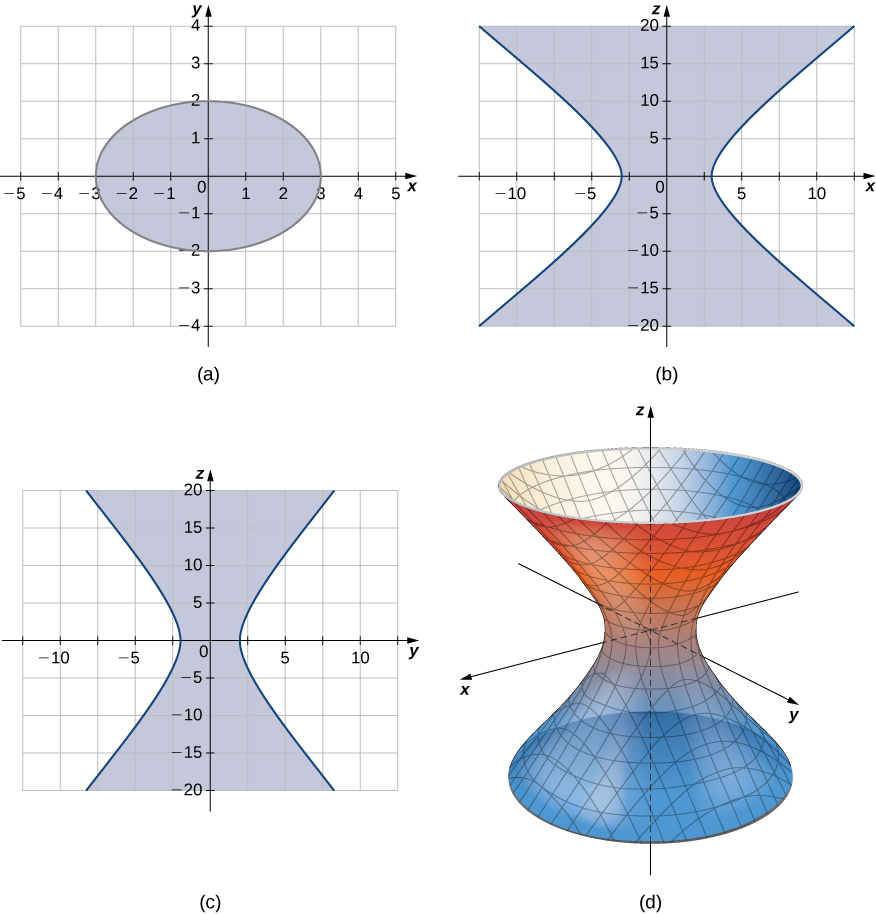
A cross-section (or trace) is what you get when you fix one input variable and look at the resulting curve. This is different from a level curve: here you're cutting the surface with a vertical plane (parallel to a coordinate plane) rather than a horizontal one.
For (a hyperbolic paraboloid, or "saddle"):
- Fix : you get , an upward-opening parabola.
- Fix : you get , a downward-opening parabola.
- Fix : you get , the same upward parabola shifted down by 1.
These two families of cross-sections reveal the saddle shape: curving up in the -direction and down in the -direction.
Slices are just cross-sections taken at regular intervals along one variable. Stacking them together gives you a mental picture of the full 3D surface, much like stacking MRI scans builds up an image of a 3D object. For a function like , taking slices at produces a series of shifted sine curves in , showing how the wave propagates across the surface.
Cross-sections are one of the most practical tools for functions that are hard to visualize all at once. When you're stuck on what a surface looks like, fix one variable and sketch the resulting 2D curve. Do that for a few values and the shape will start to come together.