3.6 Forces that Impact Political Participation

🗳️AP Comparative Government and Politics Unit 3 Review
3.6 Forces that Impact Political Participation
🗳️ AP Comparative Government and Politics
Political participation includes the ways people try to influence politics, but regime type changes how much that participation can actually shape policy. Democratic regimes usually allow broader and more independent participation, while authoritarian regimes often channel, limit, or monitor participation to protect the regime. For AP Comparative Government, compare whether participation is open, competitive, and able to affect government decisions.
Why This Matters for the AP Comparative Government Exam
This topic builds your ability to compare how participation works across democratic and authoritarian regimes, which is exactly the kind of thinking the AP Comparative Government exam rewards. You will see questions that ask you to read data, describe patterns, and then connect those patterns to political concepts like legitimacy, competitiveness, and regime type.
On the exam, you may need to:
- Analyze quantitative data shown in charts or graphs and explain what it suggests about a country's political system.
- Compare how two course countries handle voting, protests, or media criticism.
- Build an argument with specific evidence about why a regime encourages or limits participation.
The strongest responses go past describing a trend. They explain what the trend reveals about a country's institutions, legitimacy, or level of competitiveness.
Key Takeaways
- Democratic and authoritarian regimes support similar forms of participation, like elections, but differ in how open and competitive those elections are.
- In many authoritarian elections, few or no opposition candidates are allowed to run, and the government often intervenes to make sure its preferred candidates win.
- Informal participation, like protests and social media criticism, is treated very differently across regime types. Authoritarian systems tolerate critical viewpoints far less.
- Both regime types regulate participation by restricting voting access and banning violent or disruptive protests, but authoritarian regimes manage participation much more heavily.
- Authoritarian regimes value public order over individual liberties, so they tolerate mass protests and movements less than democratic regimes do.
Comparing Participation Across Regime Types
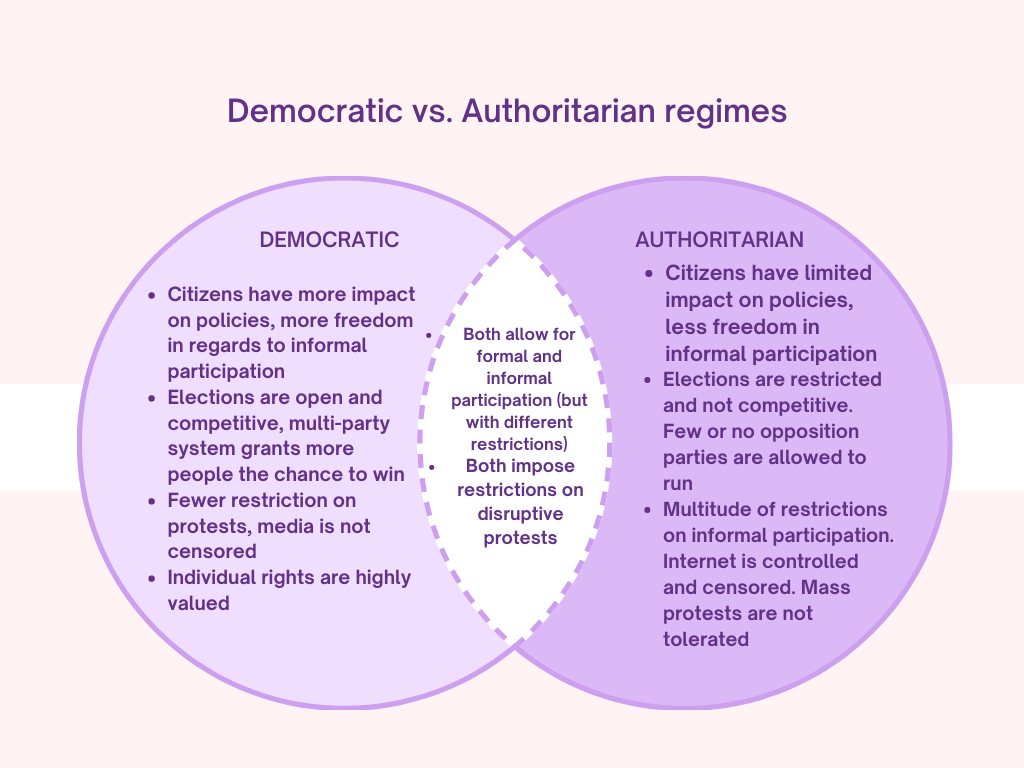
Formal and informal participation both exist in democratic and authoritarian regimes. The key difference is how much impact citizens actually have and how much the government controls the process.
Where they overlap:
- Both hold elections and allow citizens to vote.
- Both place some restrictions on voting access.
- Both disallow disruptive and violent protests.
Where they differ:
- Democratic regimes hold open, competitive elections so citizens can control policy making. Authoritarian regimes often limit or ban opposition candidates and intervene to control outcomes.
- Democratic regimes generally tolerate protests and online criticism. Authoritarian regimes show much less tolerance for viewpoints that challenge them.
- Authoritarian regimes manage and limit participation to a much greater extent, prioritizing public order over civil rights and liberties.
A useful way to frame it: democratic regimes are largely shaped by participation, while authoritarian regimes intentionally shape and control participation to keep power and project a stable image.
Course Country Examples
These examples show how the concepts apply across the six course countries. Treat the specific events as applications of the ideas, not as separate required facts.
| Country | Regime | Example |
|---|---|---|
| UK 🇬🇧 | Democratic | Direct election of Parliament members, use of referenda, a well-established civil service, and protests treated as legitimate forms of participation. |
| Mexico 🇲🇽 | Democratic | Direct election of the president and legislature. Mexico is still consolidating its democracy, and before the 1990s participation that opposed the long-controlling PRI was heavily discouraged. |
| Iran 🇮🇷 | Authoritarian | Voting has age requirements similar to democracies, but elections offer little real choice among parties and candidates and are less competitive. Iran is known for suppressing mass protests and censoring media, and it has shut down internet access to limit information and organizing. |
| China 🇨🇳 | Authoritarian | Little to no opposition to the ruling party, and citizens do not directly select the top leader. Protests are heavily suppressed, as seen in the 1989 Tiananmen Square crackdown against pro-democracy demonstrators. |
| Nigeria 🇳🇬 | Democratic | An emerging democracy with multiple parties competing and winning elections in the 21st century. Common voting requirements like age apply, and the constitution protects the right to protest and assemble peacefully. |
| Russia 🇷🇺 | Authoritarian | Citizens can vote for the president and legislature, but competition is limited. In 2012 Russia passed legislation targeting large gatherings, and protests in Chechnya were met with force and centrally appointed leadership. |
How to Use This on the AP Comparative Government Exam
Multiple Choice
Expect questions that show participation data, like voter turnout or protest figures, and ask what it reveals. Practice moving from "what the data shows" to "what it means" about competitiveness or regime type.
Free Response
When you compare two countries, name the specific difference clearly. For example, contrast open, competitive elections in a democratic regime with managed elections and banned opposition candidates in an authoritarian one. Support each claim with a concrete piece of evidence from a course country.
Using Sources Effectively
If a chart shows declining civil liberties or rising protest crackdowns, connect it to the idea that authoritarian regimes prioritize public order and limit participation more heavily. Always tie the trend back to a political concept.
Common Trap
Saying "authoritarian regimes don't have elections" loses points. They often do hold elections. The real distinction is competitiveness and whether opposition candidates can actually run and win.
Common Misconceptions
- Misconception: Authoritarian regimes have no participation or elections.Actually: They often hold elections and allow voting. The difference is that opposition is limited or banned and outcomes are managed, so citizens have little real impact.
- Misconception: Only authoritarian regimes restrict participation.Actually: Both regime types restrict voting access in some ways and ban violent or disruptive protests. Authoritarian regimes simply control participation far more.
- Misconception: Protests mean a country is democratic.Actually: Protests can happen under authoritarian regimes too, but those regimes tolerate them less and are more likely to suppress them to protect public order.
- Misconception: Voting always means citizen control of policy.Actually: In democratic regimes, competitive elections let citizens shape policy. In authoritarian regimes, voting can be used to intimidate opposition or create an illusion of influence.
- Misconception: Informal participation is the same everywhere.Actually: Social media criticism and protests are tolerated in democracies far more than in authoritarian systems, where critical viewpoints are often censored or punished.
Related AP Comparative Government Guides
Practice Questions for 3.6
1 of 10
From 2005 to 2015 the UK showed 92–96% eligible voter registration while China reported a constant 99.8%. What does this discrepancy most likely reveal about how regime type affects formal political participation?
A.
Lower UK registration does not imply less democratic engagement or interest
B.
Authoritarian regimes may inflate or coerce registration, masking genuine participation
C.
Comparable registration rates do not prove equal political influence or freedom
D.
China's higher registration proves authoritarian regimes generate greater citizen engagement
Vocabulary
The following words are mentioned explicitly in the AP® course framework for this topic.Term | Definition |
|---|---|
authoritarian regime | A system of government characterized by centralized power, limited political freedoms, and restricted citizen participation in decision-making. |
citizen participation | The involvement of citizens in the political process, including voting, activism, and engagement in civic affairs. |
civil rights | Fundamental freedoms and protections from government interference, such as freedom of speech, press, religion, and assembly. |
competitive elections | Elections in which multiple candidates and parties are allowed to run and have a genuine opportunity to win office. |
democratic regime | A system of government in which power is held by the people through elections and representative institutions, with protections for individual rights and freedoms. |
formal political participation | Institutionalized forms of political engagement such as voting in elections and other official channels of citizen involvement. |
individual liberties | Fundamental freedoms and rights protected for individuals, such as freedom of expression and freedom of assembly. |
informal participation | Non-institutionalized forms of political engagement such as protests and political criticism expressed through social media. |
opposition candidates | Candidates who advocate differing views from the controlling party or elite and compete in elections. |
public order | The state of peace and stability maintained by government, prioritized by authoritarian regimes over individual freedoms. |
Frequently Asked Questions
How does regime type affect political participation?
Democratic and authoritarian regimes can both allow participation such as voting, but citizens usually have more real influence in democracies because elections are more open and competitive. Authoritarian regimes manage participation more tightly to protect public order and political control.
Do authoritarian regimes have elections?
Yes. Many authoritarian regimes hold elections, but opposition candidates may be limited, banned, or disadvantaged, and the government may intervene to help preferred candidates or parties win.
What is informal political participation?
Informal political participation includes actions outside official voting and party systems, such as protests, social media criticism, petitions, and public demonstrations. Regimes differ in how much they tolerate these actions.
Why do authoritarian regimes limit protests more than democracies?
Authoritarian regimes tend to value public order and regime stability over individual liberties, so they are less tolerant of mass protests or movements that challenge the government.
How should I compare participation across course countries?
Compare both the form and the real influence of participation. For example, two countries may both hold elections, but the democratic country usually has more competition and a greater chance for voters to affect policy.
What is the common AP Comp Gov mistake for this topic?
The common mistake is saying authoritarian regimes have no participation. A stronger answer explains that participation exists but is more controlled, less competitive, and less likely to affect policy.
See Fiveable more often in Google
Mark Fiveable as a preferred source and Google is more likely to show you our guides in Top Stories, with a "preferred" badge in AI Mode and AI Overviews.