2.1 Early Human Evolution and Migration

🏰World History – Before 1500 Unit 2 Review
2.1 Early Human Evolution and Migration
🏰 World History – Before 1500
Early Human Evolution and Migration
Human evolution spans millions of years, from early hominids walking upright in Africa to modern Homo sapiens spreading across every continent. Understanding this timeline helps you see how physical changes, tool development, and environmental pressures all worked together to shape the species we are today.
Early Human Evolution
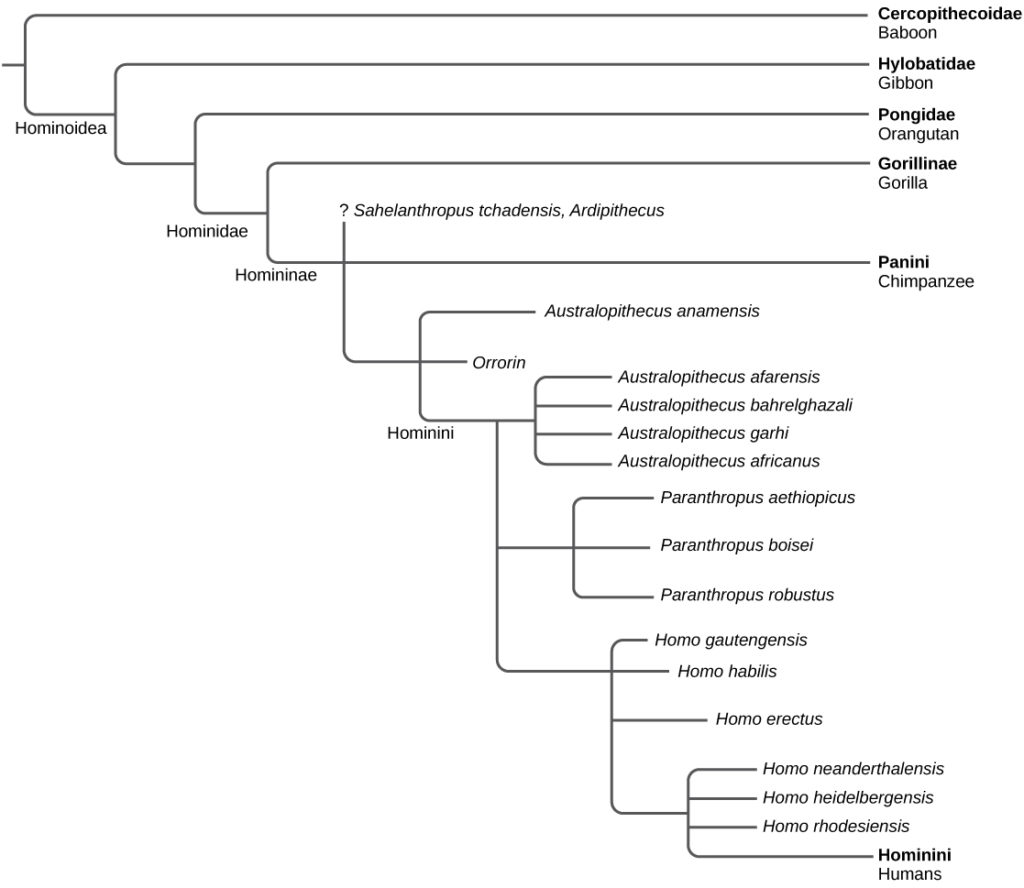
Stages of Human Evolution
Each stage of human evolution built on what came before. New physical traits and cognitive abilities accumulated over millions of years.
- Ardipithecus ramidus (4.4 million years ago)
- One of the earliest known hominid species, discovered in Ethiopia
- Showed signs of bipedal locomotion (walking upright on two legs), though it likely still spent significant time in trees
- Australopithecus afarensis (3.9–2.9 million years ago)
- More committed to bipedalism than Ardipithecus, with skeletal features suited for regular upright walking
- Brain size was still relatively small (about the size of a chimpanzee's), but larger than Ardipithecus
- The famous fossil "Lucy" belongs to this species
- Homo habilis (2.3–1.4 million years ago)
- First species placed in the genus Homo, marking a major evolutionary shift
- Developed simple stone tools known as Oldowan tools, the earliest known stone tool technology
- Brain size increased noticeably compared to Australopithecus
- Homo erectus (1.9 million–110,000 years ago)
- Had a significantly larger brain and body than earlier hominids, with body proportions closer to modern humans
- Created more sophisticated Acheulean tools, including symmetrical handaxes
- First hominid species to migrate out of Africa, reaching parts of Asia and Europe
- Likely the first to use fire in a controlled way
- Homo sapiens (300,000 years ago–present)
- Modern humans, first appearing in Africa
- Developed complex language, symbolic thought, and abstract reasoning
- Produced advanced tools, art (cave paintings, carved figurines), and cultural practices like burial rituals and personal ornamentation

Factors in Paleolithic Migration
Humans didn't leave Africa all at once or for a single reason. Migration happened in waves over tens of thousands of years, driven by overlapping pressures.
- Climate change
- Glacial and interglacial periods shifted temperatures and rainfall patterns dramatically
- Falling sea levels during ice ages exposed land bridges, such as Beringia (connecting Asia to North America), which allowed humans to walk into new continents
- Following animal migrations
- Paleolithic humans depended on hunting large animals like mammoths and bison
- As animal herds moved in response to changing climates and vegetation, human groups followed them into new territories
- Population pressure
- Growing populations meant more competition for food, water, and shelter in a given area
- Migrating to less populated regions reduced that competition
- Technological advancements
- Better tools (sharper spears, eventually bows) and improved hunting techniques made it possible to survive in unfamiliar environments
- Fire allowed groups to move into colder climates they couldn't have survived in otherwise
- The Out of Africa theory
- The dominant scientific model proposes that modern Homo sapiens originated in Africa and then migrated outward in waves, eventually reaching every inhabited continent
- This is supported by both genetic evidence (all non-African populations trace back to a relatively small founding group) and the fossil record
Paleolithic Tools and Fire
Stone Tools
Tool development didn't just make life easier. It changed what humans could eat, how their brains developed, and how they interacted with each other.
- Oldowan tools (starting ~2.6 million years ago)
- Simple stone flakes and choppers, made by striking one rock against another
- Used for scavenging animal carcasses, cracking bones for marrow, and processing plant material
- Gave early hominids access to calorie-dense meat and marrow, which helped fuel brain growth
- Acheulean tools (starting ~1.7 million years ago)
- More carefully shaped handaxes and cleavers with symmetrical edges
- Used for hunting, butchering, and woodworking
- Required more planning and skill to produce, reflecting growing cognitive abilities
Access to richer food sources (especially animal fat and protein) provided the calories needed to support larger brains. The process of making tools also reinforced social learning, since techniques had to be taught and practiced.
Fire
Controlled use of fire, established by at least 1 million years ago (with some evidence pointing earlier), transformed daily life in several ways:
- Warmth and protection from predators, especially at night
- Cooking, which broke down tough plant fibers and made meat easier to digest, increasing the nutrients humans could absorb from the same food
- Extended activity hours, giving groups more time for socializing, planning, and sharing knowledge after dark
- Migration into colder climates, since fire made it possible to survive in regions that would otherwise be uninhabitable
- Tool improvement, including hardening wooden spear tips and creating adhesives to attach stone points to handles
Evolutionary Mechanisms and Early Human Societies
The biological and social changes described above didn't happen randomly. Several key mechanisms drove human evolution and shaped how early people lived.
Natural selection is the process by which traits that improve survival and reproduction become more common over generations. For example, individuals better suited to bipedal walking could travel farther and access more food, giving them a survival advantage.
Bipedalism was one of the most consequential adaptations. Walking upright freed the hands for carrying food and using tools, changed the skeletal structure (pelvis, spine, foot arch), and improved energy efficiency over long distances.
Genetic mutation provides the raw variation that natural selection acts on. Random changes in DNA occasionally produce new traits. Most are neutral or harmful, but some (like changes affecting brain size or hand dexterity) proved advantageous and spread through populations.
Adaptive radiation describes how a single lineage diversifies to fill different ecological niches. Early hominid species spread into forests, savannas, coastlines, and eventually arctic environments, each time adapting to local conditions.
Hunter-gatherer societies were the universal social structure for most of human history. These small, mobile groups organized around foraging and hunting, with flexible divisions of labor. They developed shared cultural practices, oral traditions, and cooperative strategies for survival that laid the groundwork for all later human social organization.
See Fiveable more often in Google
Mark Fiveable as a preferred source and Google is more likely to show you our guides in Top Stories, with a "preferred" badge in AI Mode and AI Overviews.