1.3 Causation and Interpretation in History

🏰World History – Before 1500 Unit 1 Review
1.3 Causation and Interpretation in History
🏰 World History – Before 1500
Causation in History
Historical causation and interpretation are the core skills historians use to make sense of the past. Rather than just listing what happened, historians ask why things happened and how our understanding of those events gets shaped by the people studying them.
Historians' Use of Causation
Causation is about identifying the factors that contributed to a historical event and understanding how those factors connect to each other. Historians rarely point to a single cause. Instead, they look at layers of causes working together.
To build their arguments, historians draw on two types of evidence:
- Primary sources are materials from the time period itself: original documents, artifacts, eyewitness accounts, letters, and official records.
- Secondary sources are works produced later by scholars who analyze, interpret, and synthesize primary sources.
Historians also recognize contingency, the idea that history is not predetermined. Small, unpredictable events can redirect the course of history. A different decision by one leader, a storm on a particular day, or a message that arrived late could have changed outcomes entirely. This means historians have to resist the temptation to treat what did happen as what had to happen.
By studying causation across many events, historians identify patterns and trends that help them develop broader theories about how historical processes work.

Types of Historical Causes
Historians typically sort causes into three categories based on their time scale. Think of these as layers stacked on top of each other:
- Long-term causes develop over decades or centuries. These are deep, structural conditions that create the environment for an event. For example, centuries of nationalism and imperial competition among European powers created the tensions that made a large-scale war possible by the early 1900s.
- Intermediate causes develop over months or years and set the stage more directly. The European arms race and the rigid alliance system of the early 1900s turned those long-standing tensions into a situation where any crisis could spiral out of control.
- Immediate causes are the short-term triggers that set an event in motion. The assassination of Archduke Franz Ferdinand in 1914 was the spark that ignited World War I, but it only had that effect because of the intermediate and long-term causes already in place.
The key insight here is that immediate causes get the most attention, but they rarely explain why something happened on their own. A full explanation requires all three layers.
Some historians place special emphasis on economic factors as drivers of historical change. This approach, called historical materialism, argues that economic systems and class relationships are the primary forces shaping societies and events.
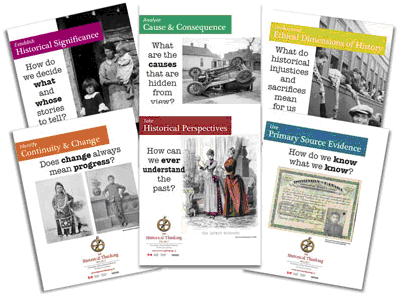
Interpretation in History
Impact of Interpretation on History
Two historians can look at the same evidence and reach different conclusions. That's because interpretation is always shaped by the historian's own perspective, cultural context, and the questions they choose to ask.
This means competing narratives about the same event are normal, not a flaw. For example, traditional accounts of the Crusades written by European historians emphasized religious duty and heroism, while more recent scholarship examines the Crusades through the perspectives of the people in the regions being invaded, producing a very different narrative.
Interpretation also affects what gets preserved and what gets forgotten. The people who write and maintain historical records make choices about what to emphasize and what to leave out. This is why entire groups of people can be underrepresented in the historical record.
Historians address these challenges by:
- Critically evaluating each source's author, purpose, and potential biases
- Corroborating claims across multiple independent sources
- Practicing cultural relativism, which means analyzing past societies within their own cultural contexts rather than judging them solely by modern standards
As new evidence surfaces or new methodologies develop, established narratives get reexamined. What one generation of historians considers settled can be reopened by the next.
Approaches to Historical Interpretation
These are frameworks historians use (and debate) when constructing their interpretations:
- Historical determinism holds that events are the inevitable outcomes of preceding causes. Under this view, large structural forces (economic systems, geography, demographics) drive history more than individual choices do.
- Historical objectivity is the ideal of presenting facts and interpretations without personal bias. Most historians treat this as a goal to strive toward rather than something fully achievable, since all scholars bring some perspective to their work.
- Historical revisionism is the reexamination of accepted narratives based on new evidence, new questions, or previously excluded perspectives. This is a normal and healthy part of how historical knowledge evolves.
- Periodization is the practice of dividing history into distinct eras (e.g., "Classical Antiquity," "the Middle Ages"). These divisions help organize study, but they're constructed by historians, not built into history itself. Different cultures and scholars periodize history differently, which can shape how events are understood.
See Fiveable more often in Google
Mark Fiveable as a preferred source and Google is more likely to show you our guides in Top Stories, with a "preferred" badge in AI Mode and AI Overviews.