5.3 The Exponential Distribution (Optional)

📊Honors Statistics Unit 5 Review
5.3 The Exponential Distribution (Optional)
📊 Honors Statistics
continue practicing 5.3
Multiple choice
Properties and Applications of the Exponential Distribution
Memoryless property of exponential distribution
The memoryless property is what makes the exponential distribution special among continuous distributions. It means the probability of an event occurring in the next time interval doesn't depend on how much time has already passed. The system has no "memory" of waiting.
Mathematically, for an exponential random variable with rate parameter and :
In plain terms: if you've already waited minutes with no event, the probability of waiting at least more minutes is the same as if you'd just started waiting.
When the exponential model fits:
- Time between events in a Poisson process, where events occur continuously and independently at a constant average rate (customer arrivals at a store, calls to a call center, radioactive particle decays)
- Interarrival times in queuing systems
When it does NOT fit:
- Situations where the probability of an event changes with elapsed time. For example, an aging machine becomes more likely to fail the longer it runs. That violates the memoryless property, so the exponential distribution would be a poor model.

Probability calculations with exponential distribution
The probability density function (PDF) for an exponential distribution with rate parameter :
The cumulative distribution function (CDF) gives :
Both are for .
To find the probability of an event occurring within a time interval :
Worked example using the memoryless property:
Suppose time between customer arrivals follows an exponential distribution with per minute. No customer has arrived in the past 2 minutes. What's the probability a customer arrives within the next 3 minutes?
- Because of the memoryless property, the 2 minutes already elapsed are irrelevant. You treat the problem as if the clock just restarted.
- You need , not a conditional calculation over the full 5-minute window.
- Apply the CDF:
So there's about a 77.7% chance a customer arrives in the next 3 minutes, regardless of how long you've already been waiting.
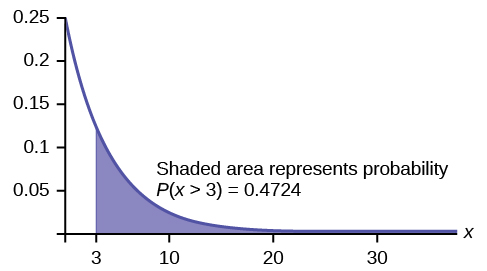
Relationship between Exponential and Poisson Distributions
These two distributions are two sides of the same coin. They both describe a Poisson process but answer different questions about it.
- The Poisson distribution models the count of events in a fixed time interval, given a constant average rate (events per unit time).
- The exponential distribution models the time between consecutive events in that same process, using the same rate parameter .
The formal connection:
- If the number of events in a fixed interval follows a Poisson distribution with rate , then the time between successive events follows an exponential distribution with the same rate .
- Going the other direction: if interarrival times are exponentially distributed with rate , then the number of events in an interval of length follows a Poisson distribution with rate .
Quick example: A help desk receives calls at an average rate of calls per hour. The number of calls in any given hour follows . The time between consecutive calls follows , with a mean wait of hour (15 minutes).
These distributions are frequently used together in queuing systems, reliability analysis, and modeling radioactive decay.
Applications in Reliability and Decay Processes
The exponential distribution shows up often in reliability engineering and physics because many natural processes involve events occurring at a constant rate.
- In reliability engineering, it models the lifetime of components or systems that have a constant failure rate. The hazard rate (instantaneous failure rate) stays the same over time for an exponentially distributed lifetime. This is a direct consequence of the memoryless property: the component is always "as good as new."
- In physics and chemistry, radioactive decay is a classic exponential process. Each atom has a fixed probability of decaying per unit time, independent of how long it has existed.
- The mean time to failure (MTTF) for an exponential distribution with rate is:
This also equals the standard deviation, which is a distinctive feature of the exponential distribution. If a server fails at an average rate of failures per hour, the MTTF is hours.
See Fiveable more often in Google
Mark Fiveable as a preferred source and Google is more likely to show you our guides in Top Stories, with a "preferred" badge in AI Mode and AI Overviews.