3.3 Two Basic Rules of Probability

📊Honors Statistics Unit 3 Review
3.3 Two Basic Rules of Probability
📊 Honors Statistics
continue practicing 3.3
Multiple choice
Probability Rules
Multiplication Rule for Event Probabilities
The multiplication rule tells you how to find the probability of two events both happening. The formula you use depends on whether the events are independent or dependent.
Independent events are events where the outcome of one has no effect on the probability of the other. For independent events:
Rolling a die and flipping a coin at the same time is a classic example. The die doesn't care what the coin does. So the probability of rolling a 6 and flipping heads is .
Dependent events are events where the outcome of the first event changes the probability of the second. For dependent events, you need conditional probability, written , which means "the probability of B given that A already happened."
Drawing cards without replacement is the go-to example here. Say you draw a heart from a standard deck (), then want to draw a king from the remaining cards. Since you already removed a heart, there are only 51 cards left. If the heart you drew was not a king, there are still 4 kings remaining, giving . But if the heart you drew was the king of hearts, only 3 kings remain, giving .
The original guide's example assumes you drew the king of hearts first, which is why it uses . On an exam, read carefully to determine exactly what condition is being set.
Addition Rule for Event Probabilities
The addition rule tells you how to find the probability of at least one of two events occurring (A or B or both).
Mutually exclusive events cannot happen at the same time. If you roll a single die, getting a 2 and getting a 5 are mutually exclusive. For mutually exclusive events:
For example, the probability of rolling a 1 or a 6 on a fair die is .
Watch out: "rolling an even number" and "rolling a prime number" on a fair die are not mutually exclusive, because 2 is both even and prime. If a problem gives you , you'd need the non-mutually exclusive formula below.
Non-mutually exclusive events can occur at the same time, meaning they overlap. You have to subtract the overlap to avoid double-counting:
Drawing a heart or a face card from a standard deck is a good example. There are 13 hearts and 12 face cards, but 3 cards are both (jack, queen, and king of hearts). Without subtracting, you'd count those 3 cards twice:
Complement rule: A related and very useful tool. The probability of an event not occurring is:
This is especially handy when calculating "at least one" probabilities, where it's often easier to find the probability of none and subtract from 1.

Multiple Event Probability Calculations
When a problem involves more than one event, use this approach:
-
Identify the events and their individual probabilities.
-
Determine the relationship between the events:
- Are they independent or dependent? This tells you which multiplication rule to use.
- Are they mutually exclusive or not? This tells you which addition rule to use.
-
Break complex problems into sub-problems. Calculate each piece, then combine using the appropriate rule.
-
Check your work by confirming your final probability is between 0 and 1.
Worked example: What's the probability of drawing 2 aces in a row from a standard deck without replacement?
- (one ace and one card are gone)
Tree diagrams are particularly useful for multi-step problems. Each branch represents a possible outcome, and you multiply along branches to find the probability of a specific path. They help you organize dependent probabilities and make sure you haven't missed any cases.
Probability Foundations and Visualization
- Sample space: The set of all possible outcomes in a probability experiment. For a single die roll, the sample space is {1, 2, 3, 4, 5, 6}.
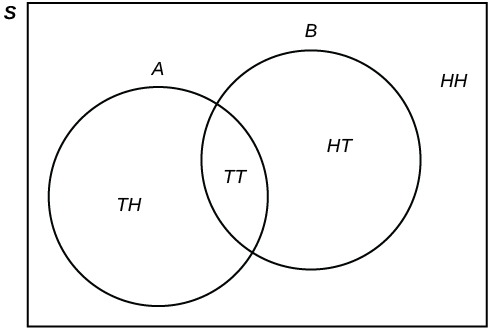
- Venn diagrams: Visual representations of how events overlap. They're especially helpful for addition rule problems because you can literally see the intersection you need to subtract.
- Set theory notation: Probability is built on set theory. The intersection () corresponds to "A and B," while the union () corresponds to "A or B."
- Law of total probability: A rule that lets you calculate by breaking it into pieces based on a partition of the sample space. You'll see this come up alongside Bayes' theorem in more advanced problems.
See Fiveable more often in Google
Mark Fiveable as a preferred source and Google is more likely to show you our guides in Top Stories, with a "preferred" badge in AI Mode and AI Overviews.