
📈College Algebra Unit 2 Review
2.7 Linear Inequalities and Absolute Value Inequalities
2.7 Linear Inequalities and Absolute Value Inequalities
Unit & Topic Study Guides
Prerequisites
Equations and Inequalities
Functions
Linear Functions
Polynomial and Rational Functions
Exponential and Logarithmic Functions
The Unit Circle: Sine and Cosine
Trigonometric Identities and Equations
Further Applications of Trigonometry
Systems of Equations and Inequalities
Analytic Geometry
Sequences, Probability, and Counting
Linear Inequalities
Linear inequalities compare expressions using symbols like , , , or instead of an equals sign. Solving them works a lot like solving equations, with one critical difference: multiplying or dividing by a negative number flips the inequality sign. The solution isn't a single number but a whole range of values, which you'll represent using interval notation and number line graphs.
Properties of Inequality Solutions
Three rules govern how you can manipulate inequalities:
- Addition/Subtraction Property: Adding or subtracting the same value on both sides keeps the inequality direction the same. If , then .
- Multiplication/Division by a Positive: Multiplying or dividing both sides by a positive number keeps the inequality direction the same. If , then .
- Multiplication/Division by a Negative (the tricky one): Multiplying or dividing both sides by a negative number reverses the inequality. If , dividing both sides by gives . The flipped to .
That third rule is where most mistakes happen. Every time you divide or multiply by a negative, flip the sign.
Solving a Linear Inequality Step-by-Step
Solve :
- Add 5 to both sides:
- Divide both sides by 2 (positive, so no flip):
The solution is every real number less than 6.
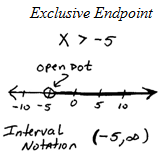
Interval Notation
Interval notation is a compact way to write solution sets. It uses:
- Parentheses for endpoints that are not included (strict inequalities or )
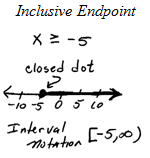
- Brackets for endpoints that are included (non-strict inequalities or )
- and always get parentheses, since infinity isn't a reachable number
| Inequality | Interval Notation |
|---|---|
Notice that last example mixes a parenthesis on the left ( is excluded) with a bracket on the right ( is included).
Graphing on a Number Line
To graph an inequality on a number line:
- Find the boundary value by solving the inequality.
- Draw an open circle (○) for strict inequalities ( or ), or a closed circle (●) for non-strict inequalities ( or ).
- Shade the direction that satisfies the inequality. For , shade to the left of 6. For , shade to the right of .
Absolute Value Inequalities
The absolute value measures distance from zero on the number line. So absolute value inequalities are really asking: how far from zero (or some other point) can this expression be?
The key skill here is rewriting an absolute value inequality as a compound inequality without absolute value signs, then solving it like a regular inequality.
Rewriting Rules
There are two cases, and they work differently:
"Less than" type ( or ): The expression inside is trapped between and . This gives you one connected interval.
becomes
becomes
"Greater than" type ( or ): The expression is outside the range from to . This gives you two separate regions.
becomes or
becomes or
A quick way to remember: less than = "and" (between), greater than = "or" (outside).
Solving an Absolute Value Inequality Step-by-Step
Solve :
-
Identify the type: this is a "less than" inequality, so rewrite as a compound inequality:
-
Add 3 to all three parts:
-
Divide all three parts by 2:
-
Write in interval notation:
Solve :
- Identify the type: this is a "greater than or equal to" inequality, so split into two: or
- Solve each separately: or
- Write in interval notation:
The symbol means "union," combining both separate solution regions.
Special Cases to Watch For
- has no solution, since absolute value can never be negative.
- is true for all real numbers, since absolute value is always zero or positive.
- is also true for all real numbers (same reasoning).
If you get a result that seems too simple, check whether the inequality is comparing absolute value to a negative number. That's usually what's going on.