11.4 Partial Fractions

📈College Algebra Unit 11 Review
11.4 Partial Fractions
📈 College Algebra
11.1
Systems of Linear Equations: Two Variables
11.2
Systems of Linear Equations: Three Variables
11.3
Systems of Nonlinear Equations and Inequalities: Two Variables
11.4
Partial Fractions
11.5
Matrices and Matrix Operations
11.6
Solving Systems with Gaussian Elimination
11.7
Solving Systems with Inverses
11.8
Solving Systems with Cramer's Rule
Partial Fraction Decomposition

Top images from around the web for Decomposition of rational expressions
Multiply and Divide Rational Expressions – Intermediate Algebra View original
Is this image relevant?
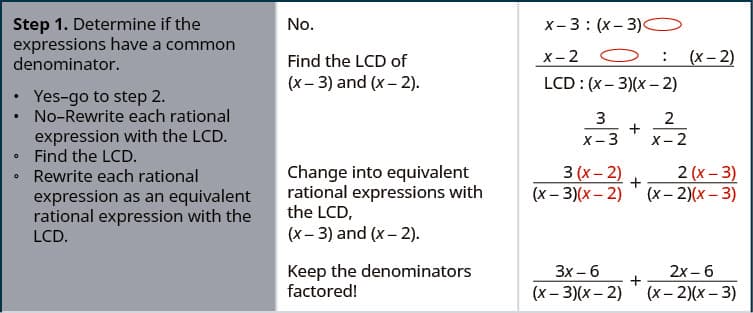
Add and Subtract Rational Expressions – Intermediate Algebra View original
Is this image relevant?
Integrate Rational Functions: Partial Fractions - Wisewire View original
Is this image relevant?
Multiply and Divide Rational Expressions – Intermediate Algebra View original
Is this image relevant?
Add and Subtract Rational Expressions – Intermediate Algebra View original
Is this image relevant?
What Is Partial Fraction Decomposition?
Partial fraction decomposition takes a complex rational expression and breaks it into a sum of simpler fractions. Think of it as "un-adding" fractions. You know how ? Partial fractions works backward: it takes something like and splits it back into the simpler pieces.
This technique shows up constantly in calculus (especially integration), but it's also useful any time you need to simplify a rational expression or solve equations involving them.
Before you start, there's one critical prerequisite: the rational expression must be proper, meaning the degree of the numerator is less than the degree of the denominator. If it's not, you need to do polynomial long division first to get it into proper form.
Setting Up Partial Fractions
The setup depends entirely on what kinds of factors appear in the denominator. Factor the denominator completely, then match each factor to the correct form:
- Non-repeated linear factors like and : each gets a constant numerator.
- Repeated linear factors like : you need one fraction for every power from 1 up to .
- Irreducible quadratic factors (quadratics that don't factor over the reals, like ): the numerator is linear, not just a constant.
If an irreducible quadratic is repeated, you follow the same "increasing powers" rule as with repeated linear factors, and each term gets a linear numerator.

Step-by-Step Process
Here's the full method from start to finish:
- Check that the fraction is proper. If the numerator's degree is greater than or equal to the denominator's degree, perform polynomial long division first. Use the remainder as your new numerator.
- Factor the denominator completely. Identify every linear and irreducible quadratic factor, including any repeated factors.
- Write the partial fraction setup. Assign the correct form (constant or linear numerator) to each factor, using unknown constants ().
- Clear the fractions. Multiply both sides of the equation by the fully factored denominator (the LCD). This eliminates all denominators.
- Solve for the constants. You can use either method below (or a combination of both).
- Write the final decomposition as the sum of the partial fractions with the solved constants plugged in.
Two Methods for Solving the Constants
Substitution method: Plug in values of that make individual factors equal zero. For example, if the denominator has factors and , substituting and will each eliminate terms and let you solve for constants directly. This is usually the fastest approach for linear factors.
Equating coefficients method: After multiplying both sides by the LCD, expand everything and collect like terms. Then match the coefficients of each power of on both sides. This creates a system of equations you can solve using substitution, elimination, or matrices. This method is especially useful when you have irreducible quadratic factors, where strategic substitution alone may not give you enough equations.
You can mix both methods in a single problem. Use substitution to find the easy constants first, then equate coefficients for the rest.

Example
Decompose .
- The fraction is already proper (degree 1 over degree 2), and the denominator is fully factored with non-repeated linear factors.
- Set up:
- Multiply both sides by :
- Substitute : , so
- Substitute : , so
- Final answer:
Preparatory Steps
Sometimes you need to do some work before you can even begin the decomposition:
- Polynomial long division is required when the degree of the numerator is greater than or equal to the degree of the denominator. The result will be a polynomial plus a proper fraction, and you decompose only the proper fraction part.
- Factoring techniques are essential for breaking the denominator into linear and irreducible quadratic factors. Review factoring by grouping, difference of squares, and the quadratic formula.
- The quadratic formula or the discriminant () helps you confirm when a quadratic factor is truly irreducible over the reals and needs the form.
Applications
- Simplifying rational expressions into forms that are easier to integrate (you'll use this heavily in Calculus II)
- Breaking apart complex fractions to solve equations that would be difficult to handle in their original form
- Solving systems of equations that involve rational expressions, where decomposition can reduce the problem to a more manageable system
See Fiveable more often in Google
Mark Fiveable as a preferred source and Google is more likely to show you our guides in Top Stories, with a "preferred" badge in AI Mode and AI Overviews.