5.5 Zeros of Polynomial Functions

📈College Algebra Unit 5 Review
5.5 Zeros of Polynomial Functions
📈 College Algebra
Polynomial Division and the Remainder Theorem

Top images from around the web for Remainder theorem for polynomial evaluation
Zeros of Polynomial Functions · Algebra and Trigonometry View original
Is this image relevant?
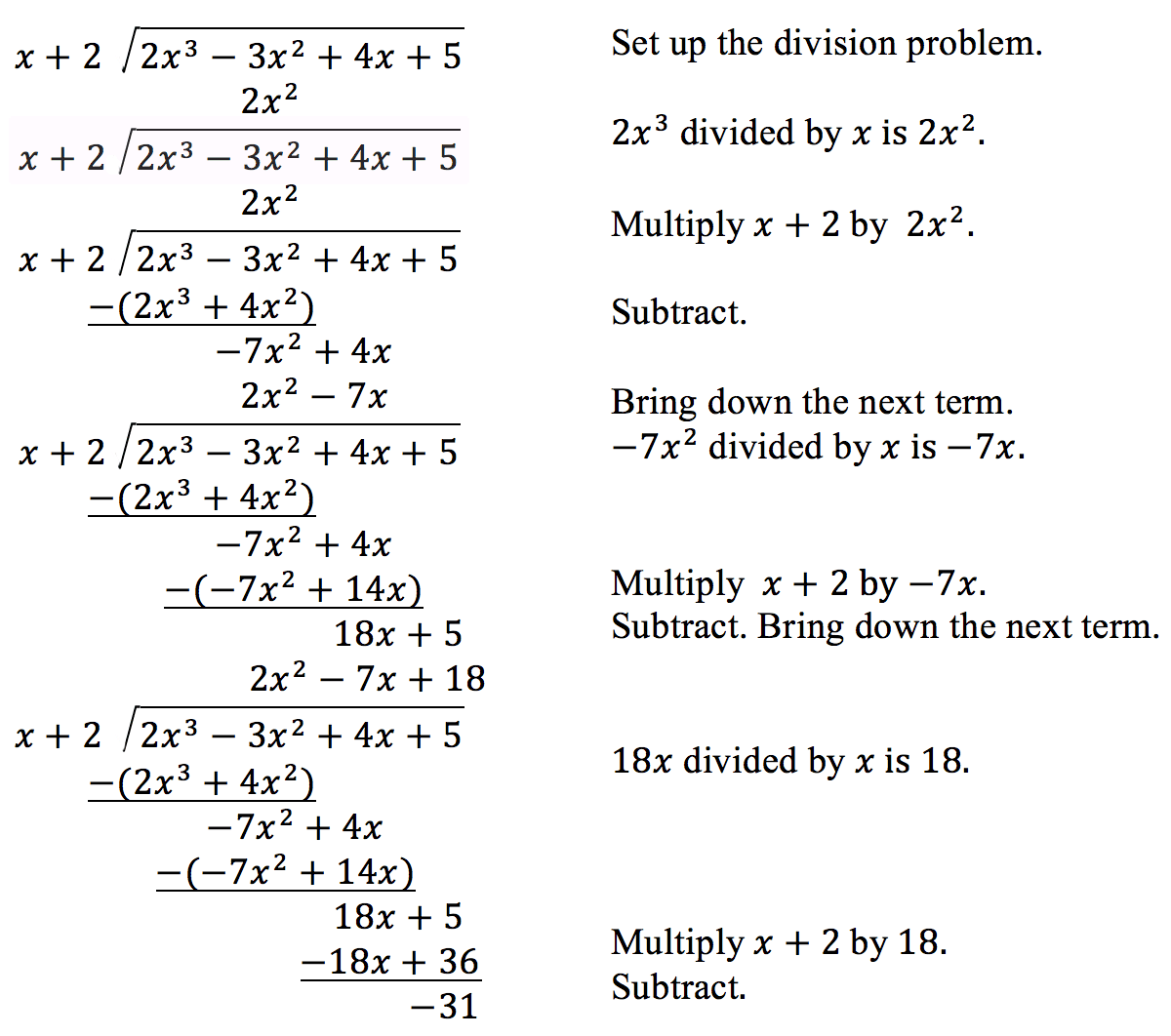
Use long division to divide polynomials | College Algebra View original
Is this image relevant?
Dividing Polynomials · Algebra and Trigonometry View original
Is this image relevant?
Zeros of Polynomial Functions · Algebra and Trigonometry View original
Is this image relevant?
Use long division to divide polynomials | College Algebra View original
Is this image relevant?
Remainder theorem for polynomial evaluation
The Remainder Theorem gives you a shortcut for evaluating polynomials. Instead of plugging a value into a long expression, you can use division to get the same answer.
The theorem states: when a polynomial is divided by , the remainder equals . So if you want to know what is, you can divide by , and the remainder you get is .
- Polynomial long division works like regular long division: you divide the polynomial by a linear factor and get a quotient (one degree lower) plus a remainder.
- The remainder's degree is always less than the divisor's degree. Since the divisor is degree 1, the remainder is just a constant.
Example: If , then dividing by gives a remainder of .
Zeros and Factors of Polynomial Functions
Factor theorem for polynomial zeros
The Factor Theorem is the flip side of the Remainder Theorem. It says: is a factor of if and only if .
Think about what that means. If you plug into the polynomial and get zero, then divides evenly into with no remainder. And it works the other way too: if is a factor, then must be a zero.
- Each zero of the polynomial corresponds to a linear factor .
- For polynomials with real coefficients, complex zeros always come in conjugate pairs. If is a zero, then is also a zero.

Rational zero theorem applications
When you're hunting for zeros of a polynomial with integer coefficients, the Rational Zero Theorem narrows down your search. It says any rational zero must have the form , where:
- is a factor of the constant term (the term with no )
- is a factor of the leading coefficient
Here's how to use it step by step:
- List all factors of the constant term (these are your possible values).
- List all factors of the leading coefficient (these are your possible values).
- Form all possible fractions and simplify to remove duplicates.
- Test each candidate by plugging it into the polynomial (or using synthetic division). If , you've found a zero.
Example: For , the constant term is 3 (factors: 1, 3) and the leading coefficient is 2 (factors: 1, 2). The possible rational zeros are .
Methods for finding polynomial zeros
You'll often need to combine several techniques to find all zeros of a polynomial:
- Factoring: If the polynomial factors nicely, set each factor equal to zero and solve. This is always the fastest route when it works.
- Quadratic Formula: Once you've reduced a polynomial down to a quadratic (degree 2), apply to find the remaining zeros.
- Rational Zero Theorem: Use the method above to identify and test candidate rational zeros.
- Polynomial Long Division (or Synthetic Division): Once you find one zero, divide it out to reduce the polynomial's degree by one. Then repeat the process on the simpler quotient.
A typical strategy for a cubic or higher polynomial: use the Rational Zero Theorem to find one zero, divide it out, then solve the remaining quadratic with factoring or the quadratic formula.
Linear factorization theorem usage
The Linear Factorization Theorem guarantees that every polynomial of degree can be written as a product of exactly linear factors:
Here is the leading coefficient and are the zeros (which may include complex numbers or repeated values).
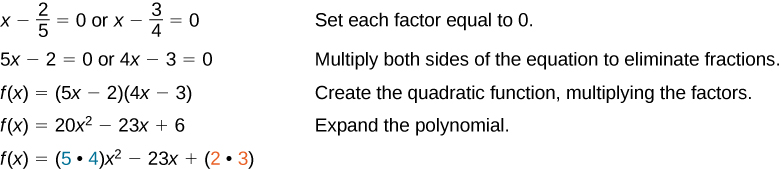
To build a polynomial from given zeros, multiply the corresponding linear factors together. For example, if the zeros are 2, -1, and 5 with leading coefficient 1, the polynomial is , which you then expand.
Analyzing Polynomial Functions
Characteristics of polynomial functions
A polynomial function uses only addition, subtraction, multiplication, and whole-number exponents on the variable. The degree is the highest exponent that appears.
Two key facts tie the degree to the function's behavior:
- The total number of zeros (counting both real and complex, and counting repeated zeros by their multiplicity) equals the degree.
- End behavior depends on the degree and the sign of the leading coefficient. For instance, an odd-degree polynomial with a positive leading coefficient falls to the left and rises to the right.
Descartes' rule of signs
Descartes' Rule of Signs helps you predict how many positive and negative real zeros a polynomial has before you start solving.
For positive real zeros:
- Write in standard form (descending powers).
- Count the number of sign changes between consecutive nonzero coefficients.
- The number of positive real zeros is either that count, or less than it by an even number.
For negative real zeros:
- Substitute for to get , and simplify.
- Count the sign changes in .
- The number of negative real zeros is either that count, or less than it by an even number.
Example: If , the signs are , giving 1 sign change. So there's exactly 1 positive real zero. For , the signs are , giving 2 sign changes. So there are either 2 or 0 negative real zeros.
Real-world polynomial problem solving
Many applied problems lead to polynomial equations (volume optimization, projectile motion, revenue models, etc.). A general approach:
- Identify variables: Assign a variable to each unknown quantity.
- Build the equation: Translate the problem's relationships into a polynomial equation.
- Solve: Use the techniques from this section (factoring, Rational Zero Theorem, division, quadratic formula).
- Interpret: Check your solutions against the problem's context. Discard answers that don't make physical sense (negative lengths, for example).
See Fiveable more often in Google
Mark Fiveable as a preferred source and Google is more likely to show you our guides in Top Stories, with a "preferred" badge in AI Mode and AI Overviews.