11.7 Solving Systems with Inverses

📈College Algebra Unit 11 Review
11.7 Solving Systems with Inverses
📈 College Algebra
11.1
Systems of Linear Equations: Two Variables
11.2
Systems of Linear Equations: Three Variables
11.3
Systems of Nonlinear Equations and Inequalities: Two Variables
11.4
Partial Fractions
11.5
Matrices and Matrix Operations
11.6
Solving Systems with Gaussian Elimination
11.7
Solving Systems with Inverses
11.8
Solving Systems with Cramer's Rule
Matrix Inverses and Solving Systems
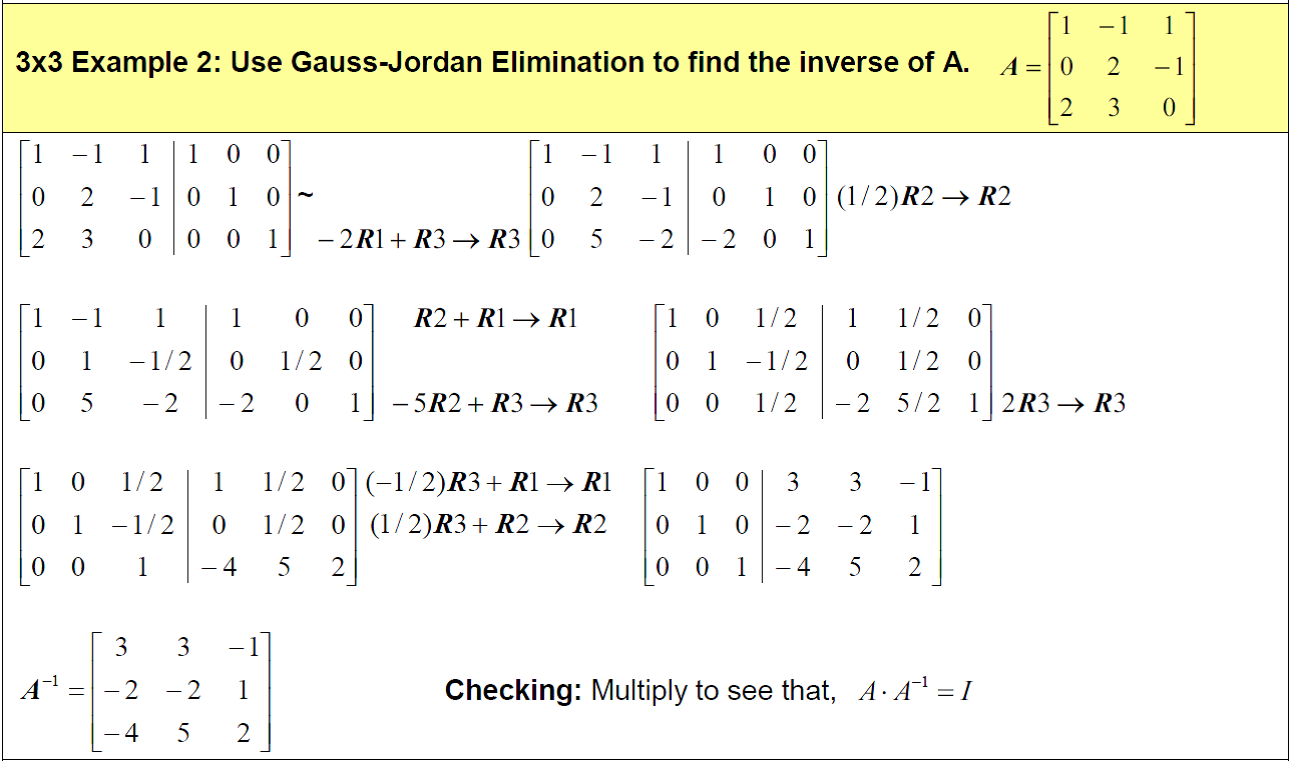
Top images from around the web for Calculation of matrix inverses
3.6b. Examples – Inverses of Matrices | Finite Math View original
Is this image relevant?
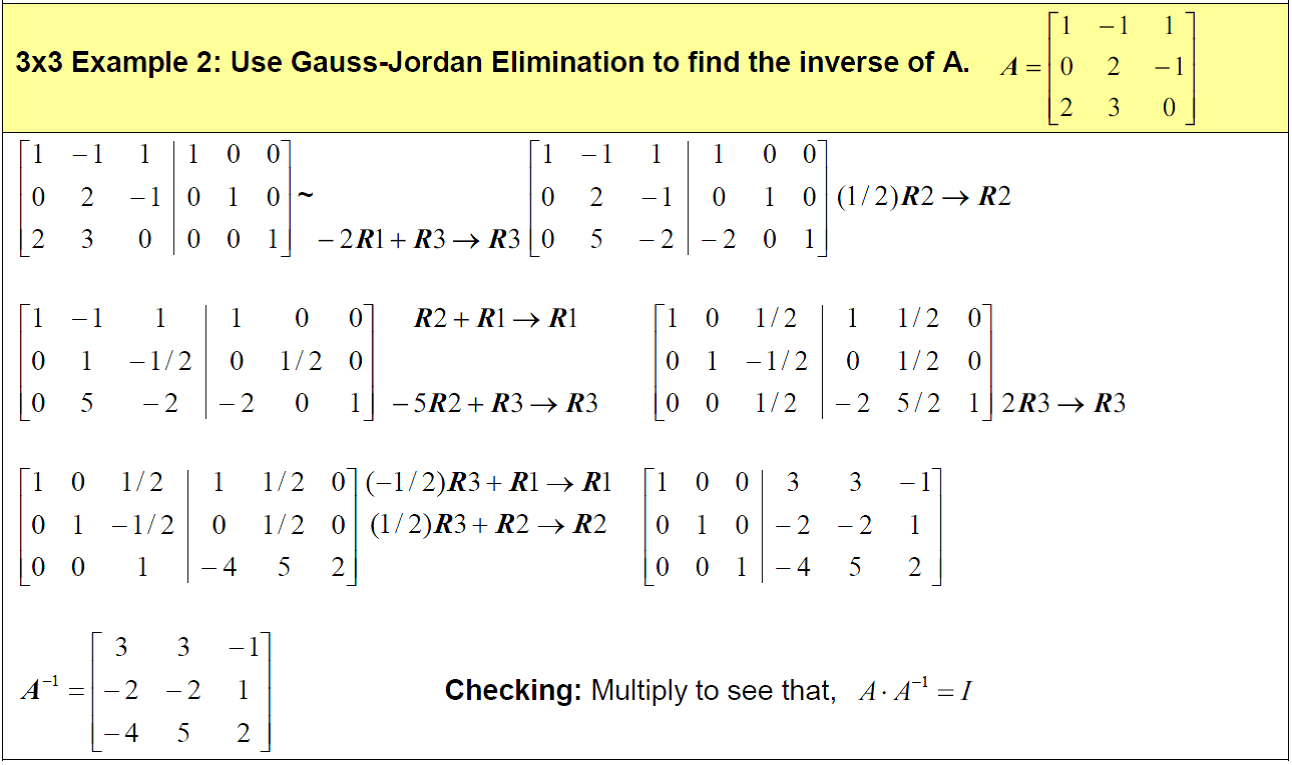
3.6b. Examples – Inverses of Matrices | Finite Math View original
Is this image relevant?
3.6b. Examples – Inverses of Matrices | Finite Math View original
Is this image relevant?
3.6b. Examples – Inverses of Matrices | Finite Math View original
Is this image relevant?
3.6b. Examples – Inverses of Matrices | Finite Math View original
Is this image relevant?
Calculation of Matrix Inverses
A matrix inverse lets you "undo" matrix multiplication, similar to how dividing undoes multiplying with regular numbers. If you can find the inverse of a coefficient matrix, solving a system of equations becomes straightforward.
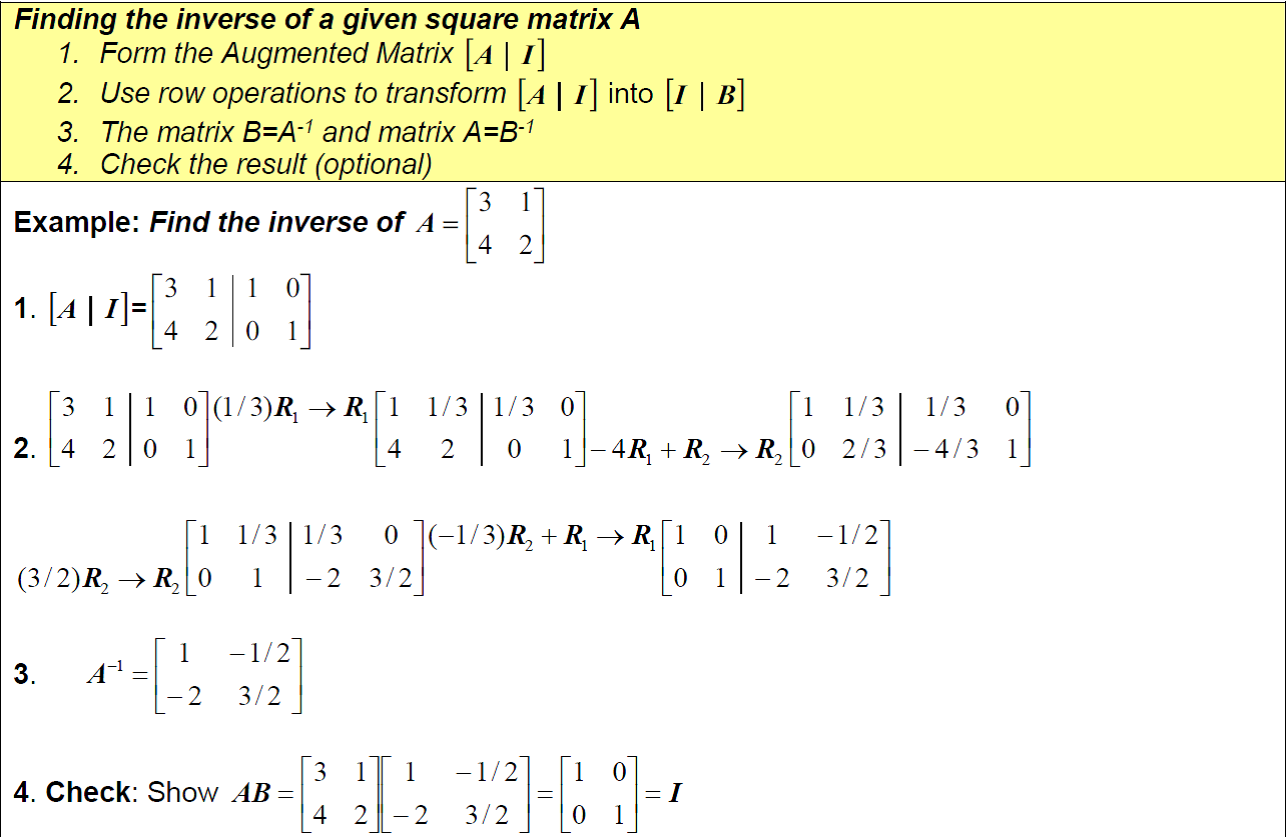
Inverse of a 2×2 Matrix
Given a 2×2 matrix , its inverse is:
The expression is the determinant of the matrix, written . The inverse only exists when . If the determinant equals zero, the matrix is called singular and has no inverse.
For example, if , then , and:
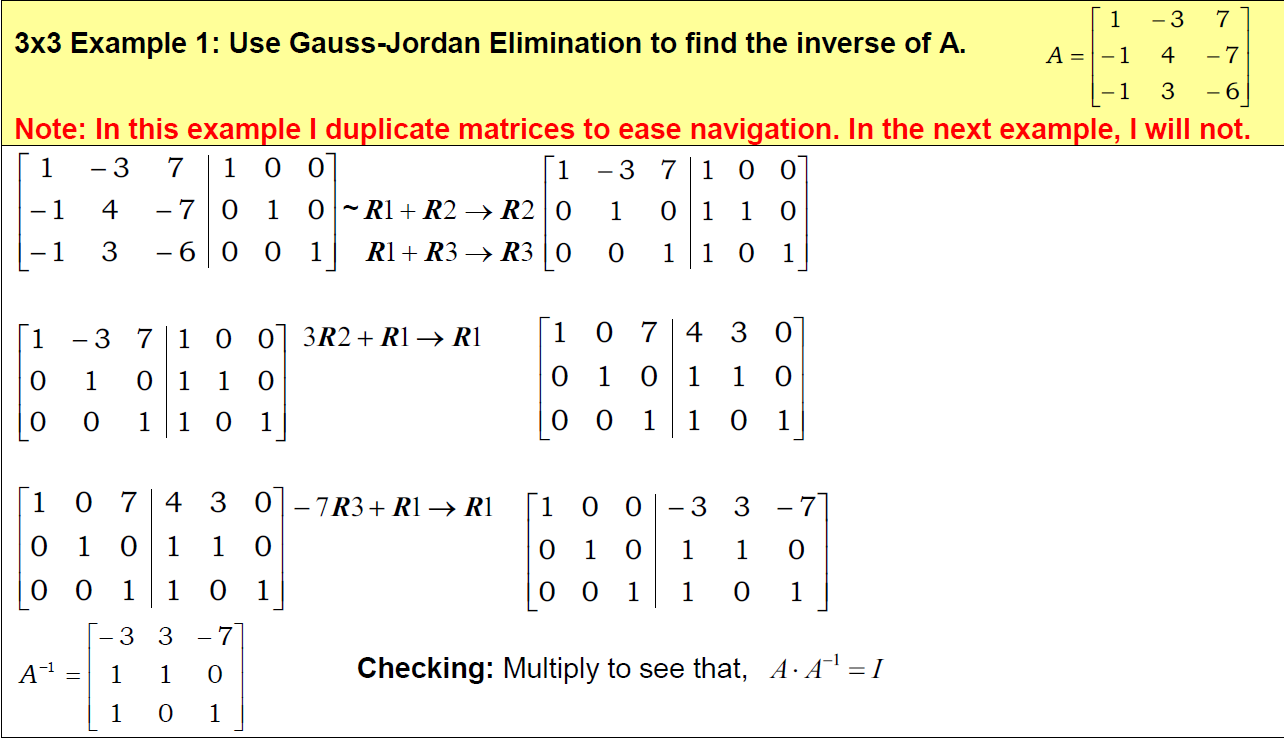
Inverse by Augmentation (for any size matrix)
For matrices larger than 2×2, use row reduction on an augmented matrix:
- Set up the augmented matrix , placing the identity matrix next to
- Perform row operations (row swapping, multiplying a row by a nonzero scalar, adding a multiple of one row to another) to transform the left side into the identity matrix
- Once the left side is , the right side is
If at any point you get a row of all zeros on the left side, the matrix is singular and has no inverse.
Matrix Inverses for Linear Systems
Any system of linear equations can be written as a single matrix equation:
- is the coefficient matrix (the numbers in front of each variable)
- is the variable vector (the unknowns you're solving for)
- is the constant vector (the numbers on the right side of each equation)
Solving with the inverse:
If is invertible, multiply both sides on the left by :
Since and , this simplifies to:
That's the entire solution. You find the inverse once, then multiply it by the constant vector.
When does this work?
- If , the system has exactly one unique solution
- If , you can't use this method. The system is either inconsistent (no solution) or dependent (infinitely many solutions). You'd need a different approach, like row reduction, to figure out which case you're in.
Interpretation of Matrix Solutions
Translating a word problem into a matrix equation follows a consistent process:
- Identify the unknowns and assign them as variables ()
- Write a system of linear equations from the relationships described in the problem
- Build the coefficient matrix , variable vector , and constant vector
- Find and compute
- Interpret each component of the solution vector in context (e.g., might mean "5 units of Product A")
The inverse method is especially useful when you need to solve the same system structure with different constant vectors. Since stays the same, you just multiply by each new . This comes up in applications like analyzing circuits with different voltage sources or modeling economic scenarios with changing inputs.
Matrix Operations and Linear Algebra
The inverse method builds on core matrix operations you've already learned: addition, scalar multiplication, and matrix multiplication. A few things to keep straight:
- Matrix multiplication is not commutative: in general. That's why you must multiply by on the left side of both sides of the equation.
- The identity matrix acts like the number 1: for any square matrix .
- Only square matrices (same number of rows and columns) can have inverses, and only when their determinant is nonzero.
These properties are the foundation for everything in this section, so make sure they feel solid before moving on.
See Fiveable more often in Google
Mark Fiveable as a preferred source and Google is more likely to show you our guides in Top Stories, with a "preferred" badge in AI Mode and AI Overviews.