12.2 The Hyperbola

📈College Algebra Unit 12 Review
12.2 The Hyperbola
📈 College Algebra
Hyperbola Fundamentals
A hyperbola is the set of all points where the difference of the distances to two fixed points (called foci) is constant. Unlike an ellipse, which uses the sum of distances, this difference property produces two separate branches that open away from each other and extend infinitely.

Top images from around the web for Key points of hyperbolas
The Hyperbola | Algebra and Trigonometry View original
Is this image relevant?
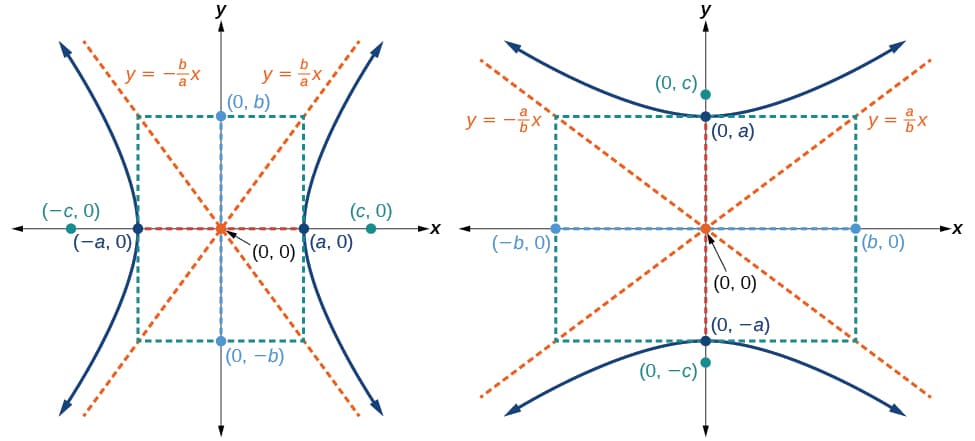
The Hyperbola · Algebra and Trigonometry View original
Is this image relevant?
The Hyperbola · Precalculus View original
Is this image relevant?
The Hyperbola | Algebra and Trigonometry View original
Is this image relevant?
The Hyperbola · Algebra and Trigonometry View original
Is this image relevant?
Key Components
The center is the midpoint between the two foci and serves as the reference point for the entire hyperbola. Every other component is measured from it.
- Foci (singular: focus) are the two fixed points that define the hyperbola. They sit on the transverse axis, each a distance from the center.
- Vertices are where the hyperbola actually crosses the transverse axis. Each vertex is a distance from the center.
- Transverse axis is the segment connecting the two vertices. Its length is , and it runs through both foci.
- Conjugate axis is perpendicular to the transverse axis and passes through the center. Its length is . The hyperbola never crosses this axis, but it helps define the asymptotes.
- Asymptotes are lines the branches approach but never touch. They pass through the center and act as guides for sketching the curve.
Hyperbola Equations and Graphing
Standard Form Equations
Which variable comes first in the equation tells you the orientation of the transverse axis:
- Horizontal transverse axis (branches open left and right):
- Vertical transverse axis (branches open up and down):
The positive term always corresponds to the transverse axis direction. The center is at .
A quick way to remember: is always under the positive fraction. The value gives the distance to each vertex, and gives the distance used to define the conjugate axis endpoints (sometimes called co-vertices).
The relationship connecting all three key distances is:
Notice this is different from ellipses, where . For hyperbolas, always, which makes sense because the foci lie beyond the vertices.

Asymptote Equations
For a hyperbola centered at :
- Horizontal transverse axis:
- Vertical transverse axis:
The asymptotes always pass through the center. A helpful trick: draw a rectangle centered at with dimensions by . The diagonals of that rectangle lie along the asymptotes.
Steps to Graph a Hyperbola
- Rewrite in standard form if needed (complete the square for each variable).
- Identify the center and plot it.
- Determine the orientation. The positive fraction tells you the transverse axis direction.
- Find and by taking the square roots of the denominators. Plot the vertices units from the center along the transverse axis, and the co-vertices units from the center along the conjugate axis.
- Draw the central rectangle through the vertices and co-vertices, then sketch the asymptotes through its diagonals.
- Find the foci using , and plot them on the transverse axis, units from the center.
- Sketch the branches starting at each vertex, curving outward and approaching (but never crossing) the asymptotes.
Example: Given , the center is . Since is positive, the transverse axis is horizontal. Here , , and . Vertices are at , so and . Foci are at , so and . Asymptotes: .
Relationships Between Equation and Graph
Understanding how the constants affect the shape helps you move between equations and graphs:
- Changing translates the hyperbola without altering its shape.
- Increasing pushes the vertices farther from the center, stretching the hyperbola along the transverse axis.
- Increasing makes the asymptotes steeper (for horizontal transverse axis), causing the branches to spread more widely in the perpendicular direction.
- The eccentricity measures how "open" the hyperbola is. Since , eccentricity is always greater than 1. Values close to 1 produce branches that hug the transverse axis tightly; larger values produce wider, more open branches.
The foci and vertices are always symmetric about the center. The distance between foci is , and the distance between vertices is .

Applications and Connections
Real-World Applications
- Navigation (LORAN): LORAN systems locate ships and aircraft by measuring the difference in arrival times of radio signals from two stations. Each constant time difference traces out a hyperbola, and the intersection of two such hyperbolas gives the position.
- Astronomy: Some comets follow hyperbolic orbits around the sun, meaning they pass through the solar system once and never return.
- Acoustics and optics: Hyperbolic mirrors reflect signals from one focus toward the other, a property used in telescope designs (such as the Cassegrain reflector).
Hyperbolas Among the Conic Sections
Hyperbolas are one of the four conic sections (circles, ellipses, parabolas, and hyperbolas). What distinguishes them is eccentricity:
- Circle:
- Ellipse:
- Parabola:
- Hyperbola:
Each conic can also be defined using a focus and a line called a directrix. For a hyperbola, the ratio of the distance from any point on the curve to a focus, divided by the distance to the directrix, equals the eccentricity , and that ratio is always greater than 1.
See Fiveable more often in Google
Mark Fiveable as a preferred source and Google is more likely to show you our guides in Top Stories, with a "preferred" badge in AI Mode and AI Overviews.