1.6 Rational Expressions

📈College Algebra Unit 1 Review
1.6 Rational Expressions
Simplifying and Operating on Rational Expressions
A rational expression is a fraction where both the numerator and denominator are polynomials. Think of it as everything you already know about fractions, but now with polynomials instead of plain numbers. The same rules apply: you can add, subtract, multiply, divide, and simplify. The key difference is that you'll need to factor polynomials before you can cancel anything.
One thing to keep in mind throughout: a rational expression is undefined whenever its denominator equals zero. The set of input values that keep the denominator nonzero is called the domain of the expression. Always watch for values that would make a denominator zero.
Simplification of Rational Expressions
The goal of simplifying is to reduce the expression to its lowest terms, just like reducing to .
Steps to simplify:
-
Factor the numerator and denominator completely. Use whichever factoring techniques fit:
- Greatest common factor (GCF)
- Difference of squares:
- Perfect square trinomials:
- Trinomial factoring or factoring by grouping
-
Cancel factors that appear in both the numerator and denominator. You can only cancel factors (things being multiplied), never individual terms that are being added or subtracted.
-
Write what remains.
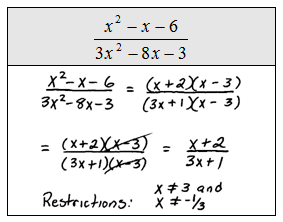
For example, simplify :
- Factor the numerator:
- Factor the denominator:
- Cancel the common factor : the result is , with and
Multiplication and Division
Multiplication works the same way as with numeric fractions:
- Factor all numerators and denominators completely.
- Cancel any factor that appears in both a numerator and a denominator.
- Multiply the remaining numerators together and the remaining denominators together.
Factor before you multiply. It's much easier to cancel at that stage than after you've expanded everything.
Division adds one preliminary step:
- Rewrite the division as multiplication by the reciprocal. The reciprocal of is .
- Then follow the multiplication steps above.
Addition and Subtraction
Adding and subtracting rational expressions requires a common denominator, just like numeric fractions.
With like denominators:
- Keep the common denominator.
- Add or subtract the numerators.
- Factor and simplify the result.
With unlike denominators:
- Find the least common denominator (LCD). Factor each denominator, then build the LCD by taking each distinct factor raised to its highest power that appears in any denominator.
- Rewrite each fraction with the LCD as its denominator. Multiply each fraction's numerator and denominator by whatever factor(s) it's missing.
- Add or subtract the numerators over the common denominator.
- Factor and simplify the result.
For example, to add and : the LCD is . Rewrite as .
Solving Equations and Analyzing Complex Rational Expressions

Equations with Rational Expressions
When you have an equation (not just an expression) containing rational expressions, you can clear the fractions entirely.
-
Identify the LCD of every rational expression in the equation.
-
Multiply both sides of the equation by the LCD. This eliminates all denominators.
-
Solve the resulting polynomial equation using standard techniques (distributing, combining like terms, factoring, or the quadratic formula ).
-
Check every solution in the original equation. Any value that makes a denominator equal to zero is extraneous and must be rejected.
That last step is not optional. Clearing denominators can introduce false solutions, so you must verify each one.
Complex Rational Expressions
A complex rational expression (or compound fraction) has fractions within its numerator, its denominator, or both. There are two common methods to simplify them:
Method 1: Simplify top and bottom separately
- Combine any fractions in the numerator into a single fraction.
- Combine any fractions in the denominator into a single fraction.
- Rewrite the overall expression as the numerator fraction divided by the denominator fraction.
- Flip and multiply (multiply by the reciprocal of the denominator fraction), then simplify.
Method 2: Multiply by the LCD
- Find the LCD of all the smaller fractions in the expression.
- Multiply both the overall numerator and overall denominator by that LCD.
- Simplify what remains.
Method 2 is often faster, especially when the expression has several small fractions.
Key Terms to Know
- Rational expression: A fraction where both numerator and denominator are polynomials.
- Domain: The set of all input values for which the expression is defined (denominator ≠ 0).
- Extraneous solution: A value that emerges from solving but makes a denominator zero in the original equation.
- LCD (Least Common Denominator): The smallest expression that each denominator divides into evenly.
See Fiveable more often in Google
Mark Fiveable as a preferred source and Google is more likely to show you our guides in Top Stories, with a "preferred" badge in AI Mode and AI Overviews.