2.6 Other Types of Equations

📈College Algebra Unit 2 Review
2.6 Other Types of Equations
Solving Equations with Special Properties

Top images from around the web for Rational exponents and radicals
OpenAlgebra.com: Free Algebra Study Guide & Video Tutorials: Solving Radical Equations View original
Is this image relevant?
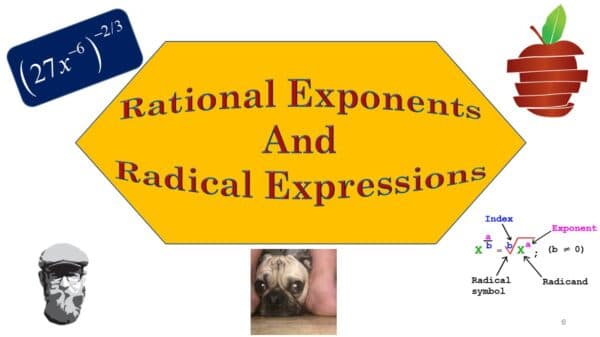
Rational Exponents - The Bearded Math Man View original
Is this image relevant?
OpenAlgebra.com: Free Algebra Study Guide & Video Tutorials: Solving Radical Equations View original
Is this image relevant?
OpenAlgebra.com: Free Algebra Study Guide & Video Tutorials: Solving Radical Equations View original
Is this image relevant?
Rational Exponents - The Bearded Math Man View original
Is this image relevant?
Rational exponents and radicals
A rational exponent expresses roots and powers in a single notation: . The denominator of the exponent is the root, and the numerator is the power.
To solve an equation involving a rational exponent, raise both sides to the reciprocal exponent to isolate the variable. For example, if , raise both sides to the power: .
For radical equations, follow these steps:
- Isolate the radical term on one side of the equation (e.g., )
- Raise both sides to the power of the radical's index to eliminate it:
- Simplify and solve the resulting equation: , so
- Check your answer in the original equation. Squaring (or raising to any even power) can introduce extraneous solutions that don't actually work. Also consider domain restrictions; for instance, the expression under an even root must be non-negative.
Factoring for polynomial equations
To solve a polynomial equation by factoring, you rewrite it as a product of simpler expressions, then use the zero-product property: if , then or .
Here are the main factoring patterns to know:
- Greatest common factor (GCF): Pull out the largest factor shared by all terms.
- Difference of squares: . For example,
- Sum or difference of cubes: . For example,
- Trinomials: factors into two binomials. For example,
After factoring, set each factor equal to zero and solve. Those values are the roots of the polynomial.

Absolute value equation solutions
The absolute value gives the distance of from zero, so it's always non-negative. That fact drives the entire solving process.
-
Isolate the absolute value expression on one side (e.g., )
-
Split into two cases, since the expression inside could be positive or negative:
- →
- →
-
Check for impossible setups. If the absolute value equals a negative number (like ), there is no solution, because absolute value can never be negative.
-
Combine your solutions. For , the solution set is or .
Solving Equations with Logarithms and Exponentials

Logarithmic and exponential equations
Logarithmic equations often require you to combine or simplify log terms before solving. The three key properties are:
- Product property:
- Quotient property:
- Power property:
Once you've condensed the equation to a single logarithm, convert to exponential form to solve. For example:
→ →
Then solve the resulting equation and check that your solutions keep the arguments of every logarithm positive (since you can't take the log of zero or a negative number).
Exponential equations are solved by applying logarithms:
- Isolate the exponential expression: →
- Take the natural log of both sides:
- Solve for the variable:
If the equation has different bases (like ), take a logarithm of both sides and use the change of base formula: .
Multiple solution methods
Many equations can be solved in more than one way. Picking the most efficient method saves time:
- Factorable quadratics (like ) → factor directly
- Non-factorable quadratics (like ) → quadratic formula or completing the square
- Exponential equations (like ) → logarithms
- Absolute value equations → split into two cases as described above
Regardless of which method you use, always verify your solutions in the original equation. This catches extraneous solutions and arithmetic errors.
Advanced Equation Solving Techniques
Equation types and solution strategies
Beyond the specific methods above, a few general strategies come up repeatedly:
- Algebraic manipulation: Rearranging terms and applying operations to isolate the variable. This is the foundation of every solving technique.
- Substitution: Replacing a complicated expression with a single variable to simplify the equation. For example, if you have , let to get , which is a standard quadratic. Solve for , then back-substitute to find .
- Graphical solutions: Graphing both sides of an equation as separate functions and finding where they intersect. This is especially useful for equations that are difficult to solve algebraically.
- Inverse functions: Applying the inverse operation to "undo" what's been done to the variable. Logarithms undo exponentials, squaring undoes square roots, and so on.
See Fiveable more often in Google
Mark Fiveable as a preferred source and Google is more likely to show you our guides in Top Stories, with a "preferred" badge in AI Mode and AI Overviews.