13.6 Binomial Theorem

📈College Algebra Unit 13 Review
13.6 Binomial Theorem
📈 College Algebra
The Binomial Theorem gives you a formula for expanding expressions like without multiplying the binomial by itself over and over. This matters most when the exponent is large, where manual expansion would take forever and invite errors.
Binomial Theorem and Its Applications

Top images from around the web for Application of Binomial Theorem
Use the Binomial Theorem | College Algebra View original
Is this image relevant?
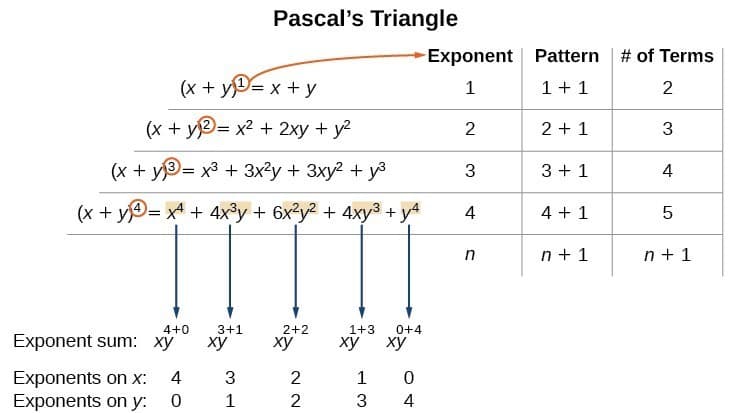
Using the Binomial Theorem | College Algebra View original
Is this image relevant?
Binomial theorem - Wikipedia View original
Is this image relevant?
Use the Binomial Theorem | College Algebra View original
Is this image relevant?
Using the Binomial Theorem | College Algebra View original
Is this image relevant?
The Binomial Theorem Formula
The theorem expands any binomial , where is a non-negative integer, into a sum of terms:
Each term in the expansion has three pieces:
- A binomial coefficient , which tells you the numerical multiplier
- A power of that decreases from down to
- A power of that increases from up to
The binomial coefficient is calculated with factorials:
Recall that (read "n factorial") means the product of all positive integers from to . For example, . By definition, .
Expanding step by step:
-
Identify , , and . Notice that the subtraction is handled by making negative.
-
Write the expansion using the formula:
-
Compute each term by plugging in :
- :
- :
- :
- :
- :
-
Combine:
Notice how the signs alternate. That always happens when is negative, because odd powers of a negative number stay negative while even powers become positive.

Finding a Specific Term
You don't always need the full expansion. To find just one term, use the fact that the th term is:
The trick is figuring out which value of gives you the term you want. Since has exponent , you solve for based on the power you're looking for.
Example: Find the coefficient of in .
- You need the power of to be . Since and its exponent is , set , giving .
- Calculate the binomial coefficient:
- Build the full term:
So the coefficient of is .

Pascal's Triangle for Binomial Expansion
Pascal's Triangle is a shortcut for finding binomial coefficients without computing factorials. It's a triangular array where each number is the sum of the two numbers directly above it:
</>CodeRow 0: 1 Row 1: 1 1 Row 2: 1 2 1 Row 3: 1 3 3 1 Row 4: 1 4 6 4 1
The entries in row give you the binomial coefficients for . For instance, row 3 contains 1, 3, 3, 1, so:
To use Pascal's Triangle for expansion:
- Find the row that matches your exponent
- Write each coefficient from that row
- Attach decreasing powers of (from down to ) and increasing powers of (from up to )
Pascal's Triangle works well for small exponents. For larger values of , the factorial formula is more practical since building the triangle row by row gets tedious.
Related Concepts in Algebraic Expansion
- Factorial (): The product of all positive integers up to . Factorials are the building blocks of binomial coefficients.
- Permutation: An arrangement of objects in a specific order. Permutations use the same factorial calculations that appear in binomial coefficients.
- Polynomial: A more general expression with multiple terms (binomials are polynomials with exactly two terms). The Binomial Theorem produces a polynomial as its output.
- Algebraic expansion: The process of multiplying out grouped expressions to remove parentheses. The Binomial Theorem is a shortcut that handles this for any .
See Fiveable more often in Google
Mark Fiveable as a preferred source and Google is more likely to show you our guides in Top Stories, with a "preferred" badge in AI Mode and AI Overviews.