2.7 Linear Inequalities and Absolute Value Inequalities

📈College Algebra Unit 2 Review
2.7 Linear Inequalities and Absolute Value Inequalities
Linear Inequalities
Linear inequalities compare expressions using symbols like , , , or instead of an equals sign. Solving them works a lot like solving equations, with one critical difference: multiplying or dividing by a negative number flips the inequality sign. The solution isn't a single number but a whole range of values, which you'll represent using interval notation and number line graphs.

Top images from around the web for Interval notation for inequalities
OpenAlgebra.com: Free Algebra Study Guide & Video Tutorials: Introduction to Inequalities and ... View original
Is this image relevant?
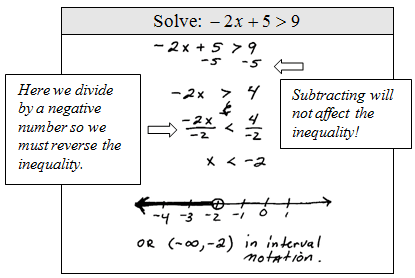
OpenAlgebra.com: Free Algebra Study Guide & Video Tutorials: Introduction to Inequalities and ... View original
Is this image relevant?
OpenAlgebra.com: Free Algebra Study Guide & Video Tutorials: Introduction to Inequalities and ... View original
Is this image relevant?
OpenAlgebra.com: Free Algebra Study Guide & Video Tutorials: Introduction to Inequalities and ... View original
Is this image relevant?
OpenAlgebra.com: Free Algebra Study Guide & Video Tutorials: Introduction to Inequalities and ... View original
Is this image relevant?
Properties of Inequality Solutions
Three rules govern how you can manipulate inequalities:
- Addition/Subtraction Property: Adding or subtracting the same value on both sides keeps the inequality direction the same. If , then .
- Multiplication/Division by a Positive: Multiplying or dividing both sides by a positive number keeps the inequality direction the same. If , then .
- Multiplication/Division by a Negative (the tricky one): Multiplying or dividing both sides by a negative number reverses the inequality. If , dividing both sides by gives . The flipped to .
That third rule is where most mistakes happen. Every time you divide or multiply by a negative, flip the sign.
Solving a Linear Inequality Step-by-Step
Solve :
- Add 5 to both sides:
- Divide both sides by 2 (positive, so no flip):
The solution is every real number less than 6.
Interval Notation
Interval notation is a compact way to write solution sets. It uses:
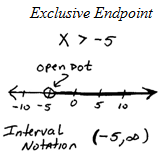
- Parentheses for endpoints that are not included (strict inequalities or )
- Brackets for endpoints that are included (non-strict inequalities or )
- and always get parentheses, since infinity isn't a reachable number
| Inequality | Interval Notation |
|---|---|
Notice that last example mixes a parenthesis on the left ( is excluded) with a bracket on the right ( is included).
Graphing on a Number Line
To graph an inequality on a number line:
- Find the boundary value by solving the inequality.
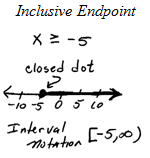
- Draw an open circle (○) for strict inequalities ( or ), or a closed circle (●) for non-strict inequalities ( or ).
- Shade the direction that satisfies the inequality. For , shade to the left of 6. For , shade to the right of .
Absolute Value Inequalities
The absolute value measures distance from zero on the number line. So absolute value inequalities are really asking: how far from zero (or some other point) can this expression be?
The key skill here is rewriting an absolute value inequality as a compound inequality without absolute value signs, then solving it like a regular inequality.
Rewriting Rules
There are two cases, and they work differently:
"Less than" type ( or ): The expression inside is trapped between and . This gives you one connected interval.
becomes
becomes
"Greater than" type ( or ): The expression is outside the range from to . This gives you two separate regions.
becomes or
becomes or
A quick way to remember: less than = "and" (between), greater than = "or" (outside).
Solving an Absolute Value Inequality Step-by-Step
Solve :
- Identify the type: this is a "less than" inequality, so rewrite as a compound inequality:
- Add 3 to all three parts:
- Divide all three parts by 2:
- Write in interval notation:
Solve :
- Identify the type: this is a "greater than or equal to" inequality, so split into two: or
- Solve each separately: or
- Write in interval notation:
The symbol means "union," combining both separate solution regions.
Special Cases to Watch For
- has no solution, since absolute value can never be negative.
- is true for all real numbers, since absolute value is always zero or positive.
- is also true for all real numbers (same reasoning).
If you get a result that seems too simple, check whether the inequality is comparing absolute value to a negative number. That's usually what's going on.
See Fiveable more often in Google
Mark Fiveable as a preferred source and Google is more likely to show you our guides in Top Stories, with a "preferred" badge in AI Mode and AI Overviews.