11.1 Systems of Linear Equations: Two Variables

📈College Algebra Unit 11 Review
11.1 Systems of Linear Equations: Two Variables
📈 College Algebra
11.1
Systems of Linear Equations: Two Variables
11.2
Systems of Linear Equations: Three Variables
11.3
Systems of Nonlinear Equations and Inequalities: Two Variables
11.4
Partial Fractions
11.5
Matrices and Matrix Operations
11.6
Solving Systems with Gaussian Elimination
11.7
Solving Systems with Inverses
11.8
Solving Systems with Cramer's Rule
Solving Systems of Linear Equations
A system of linear equations is two or more equations that share the same variables. Solving the system means finding the values that make all the equations true at the same time. This comes up constantly in real-world problems where you have multiple conditions to satisfy at once.

Top images from around the web for Graphing solutions of linear systems
Solve Systems of Linear Equations with Two Variables – Intermediate Algebra View original
Is this image relevant?
Solving Systems of Equations by Graphing | College Algebra View original
Is this image relevant?
Solve a system of linear equations | College Algebra View original
Is this image relevant?
Solve Systems of Linear Equations with Two Variables – Intermediate Algebra View original
Is this image relevant?
Solving Systems of Equations by Graphing | College Algebra View original
Is this image relevant?
Graphing Solutions of Linear Systems
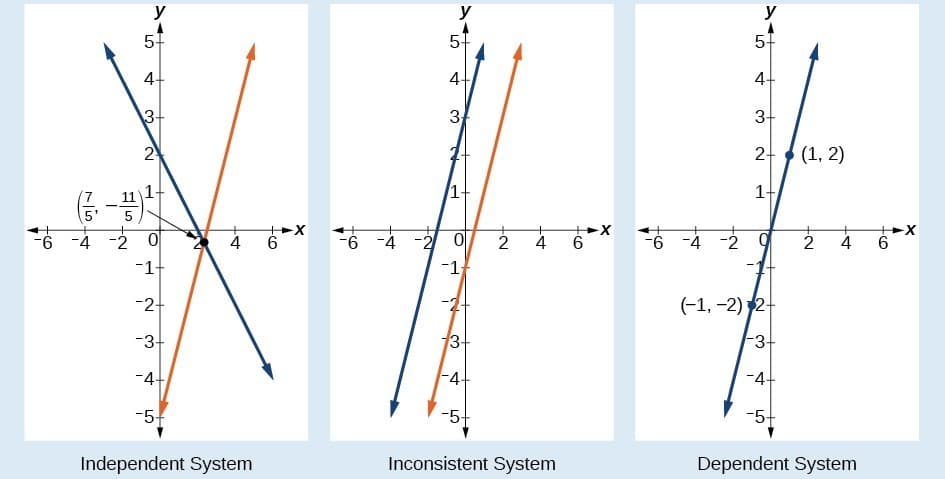
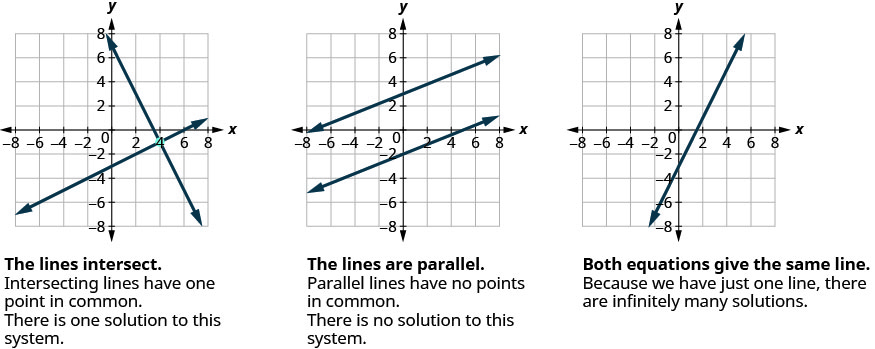
Since each linear equation represents a line on the coordinate plane, a system of two linear equations is really just two lines on the same graph. The solution is the point where those lines intersect, because that's the pair that satisfies both equations simultaneously.
To solve by graphing:
- Rewrite each equation in slope-intercept form () if it isn't already.
- Graph both lines on the same coordinate plane.
- Identify the intersection point and read off its coordinates.
- Check by plugging the coordinates into both original equations.
The number of solutions depends on how the two lines relate to each other:
- One solution: The lines intersect at a single point. The slopes are different (). This is called a consistent and independent system.
- No solution: The lines are parallel. They have the same slope but different y-intercepts ( and ). This is an inconsistent system.
- Infinitely many solutions: The lines are the same line (coincident). Same slope and same y-intercept ( and ). This is a consistent and dependent system.
Graphing gives you a nice visual, but it's not always precise. If the intersection lands at something like , you might not read it accurately off the graph. That's where algebraic methods come in.
Substitution and Elimination Methods
Substitution works best when one equation already has a variable isolated (or can be easily solved for one).
- Solve one equation for one variable. For example, if , rewrite as .
- Substitute that expression into the other equation. This gives you a single equation with one variable.
- Solve for that variable.
- Plug the value back into the expression from Step 1 to find the other variable.
Example: Solve and . From the first equation: . Substitute into the second: , so , giving . Then . Solution: .
Elimination (also called the addition method) works by making the coefficients of one variable opposites so they cancel when you add the equations.
- Multiply one or both equations by constants so that one variable has coefficients that are equal in magnitude but opposite in sign.
- Add the two equations together. One variable drops out.
- Solve for the remaining variable.
- Substitute back into either original equation to find the other variable.
Example: Solve and . The -coefficients are already and . Add the equations: , so . Substitute into the second equation: , giving . Solution: .
A practical tip: use substitution when a variable already has a coefficient of 1 or . Use elimination when both equations have similar structure and neither variable is easy to isolate.

Consistency of Linear Systems
When you solve a system algebraically, the algebra itself tells you what type of system you have:
- If you get a specific value for each variable (like ), the system is consistent and independent with exactly one solution.
- If you reach a contradiction (like ), the system is inconsistent with no solution. The lines are parallel.
- If you reach an identity (like ), the system is dependent with infinitely many solutions. The equations describe the same line.
Solutions for Dependent Systems
When a system is dependent, every point on the line is a solution. You express this by writing the solution set in terms of a parameter.
Typically, you let (where is any real number) and then express in terms of using one of the equations. For instance, if both equations simplify to , the solution set is for all real numbers .
Real-World Applications of Linear Systems
Word problems with two unknowns are where systems really earn their keep. Here's a reliable approach:
- Identify the unknowns and assign each a variable.
- Write two equations based on the relationships described in the problem.
- Solve the system using whichever method fits best.
- Interpret and check. Make sure the answer makes sense in context (no negative prices, no fractional people, etc.).
Example: A theater sells adult tickets for $8 and child tickets for $5. One night, 200 tickets were sold for a total of $1,300. How many of each type were sold? Let = adult tickets and = child tickets. Equation 1: Equation 2: Solving (substitution or elimination) gives and .
If a real-world system has no solution, it means the given conditions are contradictory. If it has infinitely many solutions, there isn't enough information to pin down a unique answer.
Matrix Methods for Solving Systems
A system of linear equations can be written compactly as an augmented matrix, where each row represents one equation and the columns hold the coefficients and constants.
For the system and , the augmented matrix is:
Gaussian elimination uses row operations (swapping rows, multiplying a row by a nonzero constant, adding a multiple of one row to another) to transform this matrix into row echelon form, where you can read off the solution by back-substitution. This method becomes especially useful for larger systems with three or more variables.
See Fiveable more often in Google
Mark Fiveable as a preferred source and Google is more likely to show you our guides in Top Stories, with a "preferred" badge in AI Mode and AI Overviews.