AMSCO 9.1 Contextualizing Period 9

🇺🇸AP US History Review
AMSCO 9.1 Contextualizing Period 9
🇺🇸 AP US History
AMSCO 1.2:Native American Societies Before European Contact Notes
AMSCO 2.1 Context: European Colonization of North America Notes
AMSCO 2.2 European Colonization Notes
AMSCO 2.3 The Regions of the British Colonies Notes
AMSCO 2.4 Transatlantic Trade Notes
AMSCO 2.5 Interactions between American Indians and Europeans Notes
AMSCO 2.6 Slavery in the British Colonies Notes
AMSCO 2.7 Colonial Society and Culture Notes
AMSCO 2.8 Comparison in Period 2 (1607-1754) Notes
AMSCO 3.1 Contextualizing Period 3
AMSCO 3.2 The Seven Year's War
AMSCO 3.3 Taxation Without Representation
AMSCO 3.4 Philosophical Foundations of the American Revolution
AMSCO 3.5 The American Revolution
AMSCO 3.6 The Influence of Revolutionary Ideals
AMSCO 3.7 The Articles of Confederation
AMSCO 3.8 The Constitutional Convention and Debates Over Ratification
AMSCO 3.9 The Constitution
AMSCO 3.10 Shaping a New Republic
AMSCO 3.11 Developing an American Identity
AMSCO 3.12 Movements in the Early Republic
AMSCO 3.13 Continuity and Change in Period 3
AMSCO 4.1 Contextualizing Period 4
AMSCO 4.2 The Rise of Political Parties and the Era of Jefferson
AMSCO 4.3 Politics and Regional Interests
AMSCO 4.4 America on the World Stage
AMSCO 4.5 Market Revolution
AMSCO 4.6 Effects of the Market Revolution on Society and Culture
AMSCO 4.7 Expanding Democracy
AMSCO 4.8 Jackson and Federal Power
AMSCO 4.9 The Development of an American Culture
AMSCO 4.10 The Second Great Awakening
AMSCO 4.11 An Age of Reform
AMSCO 4.12 African Americans in the Early Republic
AMSCO 4.13 Southern Society in the Early Republic
AMSCO 4.14 Causation in Period 4
AMSCO 5.1 Contextualizing Period 5
AMSCO 5.2 The Idea of Manfiest Destiny
AMSCO 5.3 Manifest Destiny and the Mexican-American War
AMSCO 5.4 The Compromise of 1850
AMSCO 5.5 Sectional Conflict: Regional Differences
AMSCO 5.6 Failure of Compromise
AMSCO 5.7 Election of 1860 and Secession
AMSCO 5.8 Military Conflict in the Civil War
AMSCO 5.9 Government Policies During the Civil War
AMSCO 5.10 Reconstruction
AMSCO 5.11 Failure of Reconstruction
AMSCO 5.12 Comparion in Period 5
AMSCO 6.1 Contextualizing Period 6
AMSCO 6.2 Westward Expansion: Economic Development
AMSCO 6.3 Westward Expansion: Social and Cultural Development
AMSCO 6.4 The "New South"
AMSCO 6.5 Technological Innovation
AMSCO 6.6 The Rise of Industrial Capitalism
AMSCO 6.7 Labor in the Gilded Age
AMSCO 6.8 Immigration and Migration in the Gilded Age
AMSCO 6.9 Responses to Immigration in the Gilded Age
AMSCO 6.10 Development of the Middle Class
AMSCO 6.11 Reform in the Gilded Age
AMSCO 6.12 Role of Government in the Gilded Age
AMSCO 6.13 Politics in the Gilded Age
AMSCO 6.14 Continuity and Change Period 6
AMSCO 7.1 Contextualizing Period 7
AMSCO 7.2 Imperialism: Debates
AMSCO 7.3 The Spanish-American War and U.S. Foreign Policy to 1917
AMSCO 7.4 The Progressives
AMSCO 7.5 World War I: Military and Diplomacy
AMSCO 7.6 World War I: Home Front
AMSCO 7.7 1920s: Innovations in Communication and Technology
AMSCO 7.8 1920s: Cultural and Political Controversies
AMSCO 7.9 The Great Depression
AMSCO 7.10 The New Deal
AMSCO 7.11 Inerwar Foreign Policy
AMSCO 7.12 World War II Mobilization
AMSCO 7.13 World War II Military
AMSCO 7.14 World War II and Postwar Diplomacy
AMSCO 7.15 Comparison in Period 7
AMSCO 8.1 Contextualizing Period 8
AMSCO 8.2 The Cold War from 1945 to 1980
AMSCO 8.3 The Red Scare
AMSCO 8.4 Economy after 1945
AMSCO 8.5 Culture after 1945
AMSCO 8.6 Early Steps in the Civil Rights Movement, 1945-1960
AMSCO 8.7 America as a World Power
AMSCO 8.8 The Vietnam War
AMSCO 8.9 The Great Society
AMSCO 8.10 The African American Civil Rights Movement in the 1960s
AMSCO 8.11 The Civil Rights Movement Expands
AMSCO 8.12 Youth Culture of the 1960s
AMSCO 8.13 The Environment and Natural Resources from 1968 to 1980
AMSCO 8.14 Society in Transition
AMSCO 8.15 Continuity and Change in Period 8
AMSCO 9.1 Contextualizing Period 9
AMSCO 9.2 Reagan and Conservatism
AMSCO 9.3 The End of the Cold War
AMSCO 9.4 A Changing Economy
AMSCO 9.5 Migration and Immgiration in the 1990s and 2000s
AMSCO 9.6 Challenges of the 21st Century
AMSCO 9.7 Causation in Period 9
AMSCO 1.1 Contextualizing Period 1 Notes
AMSCO 1.3 European Exploration in the Americas Notes
AMSCO 1.4 Columbian Exchange, Spanish Exploration, and Conquest Notes
AMSCO 1.5 Labor, Slavery, and Caste in the Spanish Colonial System Notes
AMSCO 1.6 Cultural Interactions in the Americas Notes
AMSCO 1.7 Causation in Period 1 Notes
Overview
AMSCO Topic 9.1, "Contextualizing Period 9," sets the stage for the final period of APUSH, covering the United States from 1980 to the present. The chapter argues that Ronald Reagan's election in 1980 closed the postwar era and opened a more conservative political period, then previews the big stories of the unit: the rise of conservatism, the end of the Cold War, the September 11 attacks, globalization's economic squeeze, and deepening political and demographic divides. There's no new deep content here. Instead, this topic gives you the framework you'll need for context points on essays about modern America.
The big question Period 9 asks: how did the United States face international and domestic challenges after 1980? Keep that question in mind as you read; every topic in Unit 9 is an answer to it.
Key Takeaways
- Reagan's 1980 victory marked a conservative turn, strengthened by declining trust in federal government, Sun Belt growth, and Southern White conservative voters joining the Republican Party.
- Reagan paired an aggressive anti-Communist policy with arms-reduction talks; after the Soviet Union collapsed in 1991, conflicts long suppressed by the Cold War broke into violence.
- The September 11 attacks led to U.S. wars in the Middle East and made terrorism and homeland security dominant foreign policy priorities.
- Globalization and financial mismanagement challenged the economy after 1980, while lower- and middle-class incomes stalled and the Great Recession of 2008 left many Americans in or near poverty.
- Rural areas grew older, Whiter, and more conservative while urban areas grew younger and more multicultural; police killings of African Americans sparked Black Lives Matter marches beginning in 2014.
The Conservative Turn After 1980
Reagan's 1980 victory signaled a national shift to the right, and conservatism stayed influential in American politics for decades afterward. AMSCO points to several forces that gave conservatism new life:
- Declining faith in the federal government. After the 1960s and 1970s, many Americans doubted that Washington could solve social and economic problems. Conservative ideas about a reduced role for government gained traction in both the Republican AND Democratic Parties, not just one.
- Corporate support for unregulated markets. American corporations championed deregulation and free-market policies.
- Evangelical Christians in politics. Religious conservatives became increasingly active political players, pushing for traditional social values.
- Sun Belt growth. The demographic boom in the South and West shifted electoral power toward more conservative regions.
- Southern realignment. Southern White conservative voters moved into the Republican Party, completing a transformation of the party map.
One warning sign the chapter flags: the era's economic problems also "opened the door to populist and autocratic movements." Conservatism wasn't the only response to declining trust in institutions.
You'll get the full story of Reagan's presidency and policies in AMSCO 9.2 on Reagan and conservatism.
Foreign Policy: From the Cold War to the War on Terror
Period 9 foreign policy breaks into two acts: the dramatic end of the Cold War, then the scramble to define America's role in a world without it.
Reagan and the Soviet collapse
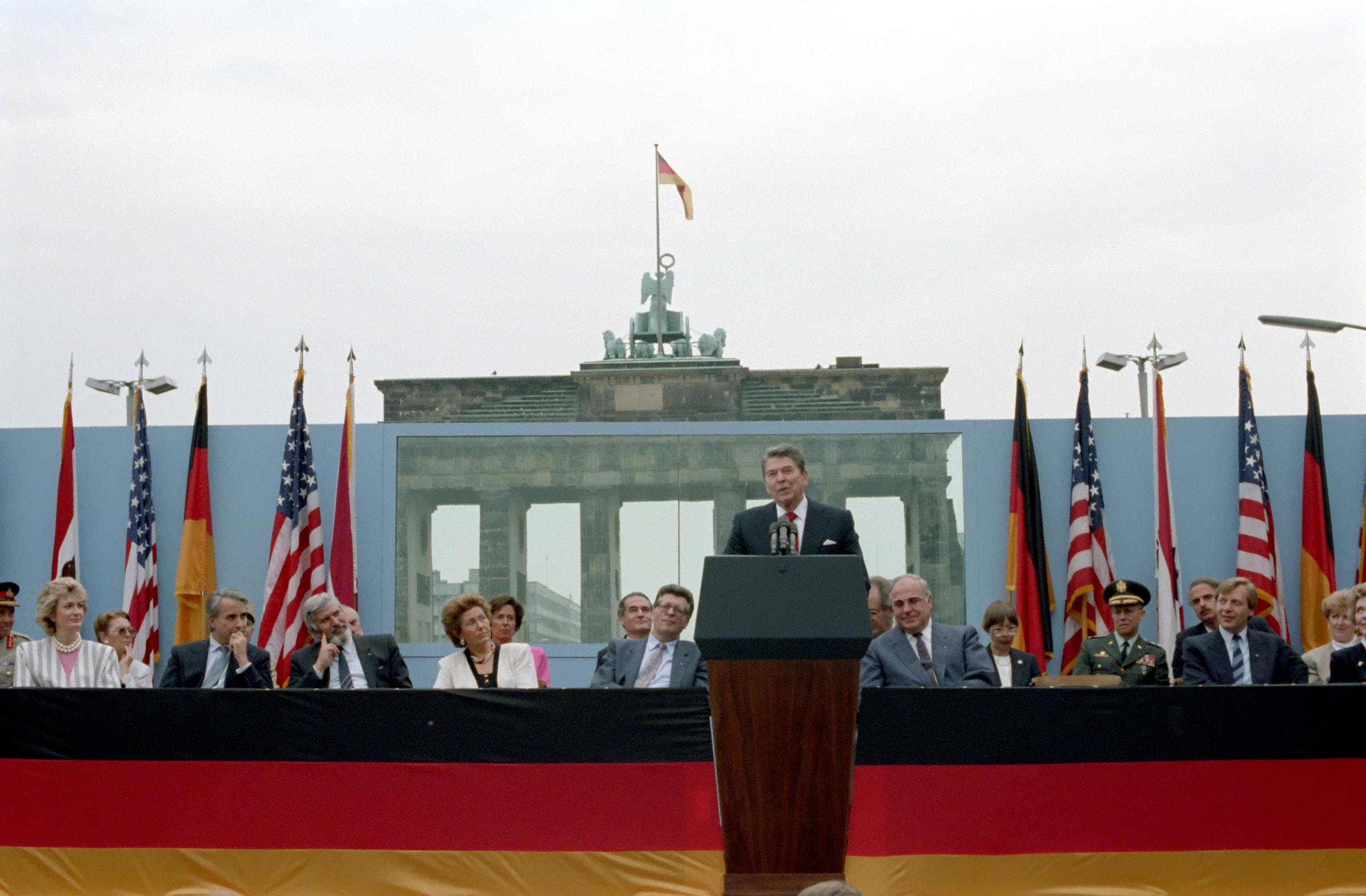
Reagan ran a two-track Soviet policy. He combined an aggressive anti-Communist foreign policy with a willingness to negotiate arms-reduction treaties with the Soviet Union. The symbolic high point came in 1987, when Reagan stood at the Brandenburg Gate of the Berlin Wall and challenged the Soviets to "tear down this wall." The Soviet Union collapsed in 1991, ending a 45-year confrontation.
A world without the Cold War
Here's the twist AMSCO wants you to catch: winning the Cold War created a new problem. For 45 years, anti-communism had been the organizing focus of U.S. foreign policy. With that gone, the political, ethnic, and religious conflicts that the Cold War had long suppressed in many countries exploded into violence in the following decades. The interventionist approach Reagan promoted continued under later administrations even after the Soviet threat disappeared.
September 11 and its aftermath
The terrorist attacks of September 11, 2001 redefined American priorities. The United States quickly became involved in seemingly endless wars in the Middle East, and fighting terrorism and protecting homeland security came to dominate U.S. foreign policy. If a Period 9 prompt asks about foreign policy after 1980, the Cold War's end and 9/11 are your two anchor events.
The details are in AMSCO 9.3 on the end of the Cold War.
Economic Challenges: Globalization and Inequality
After 1980, two forces challenged American economic success: increased competition from globalization and financial mismanagement at home. The results were uneven, and that unevenness drives a lot of Period 9 politics.
- Gains flowed to the top. Corporate capitalism and tax cuts seemed to mainly benefit the top 5 percent of earners.
- Wages stagnated. Income for the lower and middle classes flatlined even as the economy grew.
- Industry declined. Manufacturing shrank in many parts of the country, hollowing out industrial regions.
- Downturns hit hard. Economic shocks like the Great Recession of 2008 left many Americans living in or on the edge of poverty.
The human costs were severe. Depression and drug use increased, and the average American life span declined for the first time in many decades. That life-expectancy statistic is a striking piece of evidence for any essay on the social effects of economic change.
At the same time, new developments in science and technology enhanced the economy and transformed society, even as manufacturing decreased. The tech boom and the industrial decline are two sides of the same Period 9 economy. AMSCO 9.4 on the changing economy covers both.
A Divided and Changing Society
The political divide between rural and urban America widened sharply in this period, and the two regions grew apart demographically:
- Rural regions became older, Whiter, and more conservative.
- Urban regions became younger, multicultural, and more open to changing ideas about gender and ethnicity.
This divide showed up in concrete political fights: bitterly contested presidential elections, contentious federal court nominations, and government shutdowns. When you see modern political gridlock in a prompt, this rural-urban split is the underlying context.
Demographic shifts kept reshaping the population through immigration and migration, with major cultural and political consequences. And racial justice returned to the center of national debate: killings of African Americans by police sparked marches around the country beginning in 2014, a movement known as Black Lives Matter.
These threads continue in AMSCO 9.5 on migration and immigration and AMSCO 9.6 on 21st-century challenges.
Key Terms to Know
| Term | Why it matters |
|---|---|
| Election of 1980 | Reagan's victory signaled the close of the postwar era and the start of a more conservative political period. |
| Conservatism | The dominant political movement of Period 9, favoring traditional social values and a reduced role for government. |
| Ronald Reagan | President whose anti-Communist policy plus arms-reduction negotiations defined the final Cold War years. |
| "Tear down this wall" (1987) | Reagan's challenge to the Soviets at the Brandenburg Gate of the Berlin Wall, a symbol of Cold War endgame pressure. |
| Collapse of the Soviet Union (1991) | Ended the Cold War and removed the 45-year focus of U.S. foreign policy. |
| Arms-reduction treaties | Reagan's negotiations with the Soviets, showing his foreign policy was pressure plus diplomacy, not just confrontation. |
| September 11, 2001 | Terrorist attacks that pushed the U.S. into Middle East wars and made terrorism and homeland security the top priorities. |
| Evangelical Christians | Their growing political involvement strengthened the Republican Party and the push for traditional values. |
| Sun Belt | The growing South and West; its demographic rise boosted conservative political power. |
| Southern realignment | The shift of Southern White conservative voters into the Republican Party. |
| Globalization | Increased international economic competition that challenged American manufacturing and jobs after 1980. |
| Great Recession (2008) | Major economic downturn that left many Americans in or near poverty. |
| Income stagnation | Lower- and middle-class incomes flatlined while gains went mainly to the top 5 percent. |
| Rural-urban divide | Rural areas grew older, Whiter, and more conservative; urban areas grew younger and more multicultural, fueling political polarization. |
| Government shutdowns | A visible symptom of the era's bitter partisan divides, along with contested elections and court nominations. |
| Black Lives Matter | Movement beginning in 2014 protesting police killings of African Americans through nationwide marches for racial justice. |
Practice and Next Steps
Topic 9.1 is your context toolkit for the whole unit, so make sure the framework sticks before you dive into details.
- Review the matching course guide, 9.1 Context: Present Day America, for the College Board framing of the same material.
- Continue to AMSCO 9.2 Reagan and Conservatism, or browse all chapters on the AMSCO notes hub.
- Test yourself with APUSH guided practice questions, then try FRQ practice with instant scoring to work on using Period 9 context in essays.
- Build a quick review sheet from the APUSH key terms glossary.
Frequently Asked Questions
What is APUSH Period 9 about?
Period 9 covers the United States from 1980 to the present. Its major themes are the rise of conservatism starting with Reagan's 1980 election, the end of the Cold War in 1991, the September 11 attacks and the wars that followed, globalization's economic effects, and demographic shifts like Sun Belt growth and the rural-urban divide.
Why does AMSCO 9.1 say Reagan's election in 1980 was a turning point?
Reagan's 1980 victory signaled the close of the postwar era and the start of a more conservative political period. Declining faith in the federal government, corporate support for unregulated markets, politically active evangelical Christians, Sun Belt growth, and the shift of Southern White conservatives into the Republican Party all powered the conservative movement after 1980.
Did the end of the Cold War make US foreign policy simpler?
No, and that's a key point in AMSCO 9.1. The Soviet collapse in 1991 removed the 45-year focus of US foreign policy, and the political, ethnic, and religious conflicts the Cold War had suppressed exploded into violence in following decades. After September 11, 2001, fighting terrorism and homeland security became the new organizing priorities.
How do I use Topic 9.1 for the contextualization point on the DBQ or LEQ?
Contextualizing topics like 9.1 are built for exactly this. For a Period 9 prompt, set the stage with the conservative shift after 1980, the end of the Cold War, or globalization and income stagnation, depending on the question. Practice writing context paragraphs with Fiveable's FRQ practice tool to get instant feedback.
What caused the rural-urban divide in modern America?
After 1980, rural regions became older, Whiter, and more conservative while urban regions became younger, more multicultural, and more open to changing ideas about gender and ethnicity. This divide fueled bitterly fought presidential elections, contentious federal court nominations, and government shutdowns.
See Fiveable more often in Google
Mark Fiveable as a preferred source and Google is more likely to show you our guides in Top Stories, with a "preferred" badge in AI Mode and AI Overviews.