AMSCO 7.2 Imperialism: Debates

🇺🇸AP US History Review
AMSCO 7.2 Imperialism: Debates
🇺🇸 AP US History
AMSCO 1.2:Native American Societies Before European Contact Notes
AMSCO 2.1 Context: European Colonization of North America Notes
AMSCO 2.2 European Colonization Notes
AMSCO 2.3 The Regions of the British Colonies Notes
AMSCO 2.4 Transatlantic Trade Notes
AMSCO 2.5 Interactions between American Indians and Europeans Notes
AMSCO 2.6 Slavery in the British Colonies Notes
AMSCO 2.7 Colonial Society and Culture Notes
AMSCO 2.8 Comparison in Period 2 (1607-1754) Notes
AMSCO 3.1 Contextualizing Period 3
AMSCO 3.2 The Seven Year's War
AMSCO 3.3 Taxation Without Representation
AMSCO 3.4 Philosophical Foundations of the American Revolution
AMSCO 3.5 The American Revolution
AMSCO 3.6 The Influence of Revolutionary Ideals
AMSCO 3.7 The Articles of Confederation
AMSCO 3.8 The Constitutional Convention and Debates Over Ratification
AMSCO 3.9 The Constitution
AMSCO 3.10 Shaping a New Republic
AMSCO 3.11 Developing an American Identity
AMSCO 3.12 Movements in the Early Republic
AMSCO 3.13 Continuity and Change in Period 3
AMSCO 4.1 Contextualizing Period 4
AMSCO 4.2 The Rise of Political Parties and the Era of Jefferson
AMSCO 4.3 Politics and Regional Interests
AMSCO 4.4 America on the World Stage
AMSCO 4.5 Market Revolution
AMSCO 4.6 Effects of the Market Revolution on Society and Culture
AMSCO 4.7 Expanding Democracy
AMSCO 4.8 Jackson and Federal Power
AMSCO 4.9 The Development of an American Culture
AMSCO 4.10 The Second Great Awakening
AMSCO 4.11 An Age of Reform
AMSCO 4.12 African Americans in the Early Republic
AMSCO 4.13 Southern Society in the Early Republic
AMSCO 4.14 Causation in Period 4
AMSCO 5.1 Contextualizing Period 5
AMSCO 5.2 The Idea of Manfiest Destiny
AMSCO 5.3 Manifest Destiny and the Mexican-American War
AMSCO 5.4 The Compromise of 1850
AMSCO 5.5 Sectional Conflict: Regional Differences
AMSCO 5.6 Failure of Compromise
AMSCO 5.7 Election of 1860 and Secession
AMSCO 5.8 Military Conflict in the Civil War
AMSCO 5.9 Government Policies During the Civil War
AMSCO 5.10 Reconstruction
AMSCO 5.11 Failure of Reconstruction
AMSCO 5.12 Comparion in Period 5
AMSCO 6.1 Contextualizing Period 6
AMSCO 6.2 Westward Expansion: Economic Development
AMSCO 6.3 Westward Expansion: Social and Cultural Development
AMSCO 6.4 The "New South"
AMSCO 6.5 Technological Innovation
AMSCO 6.6 The Rise of Industrial Capitalism
AMSCO 6.7 Labor in the Gilded Age
AMSCO 6.8 Immigration and Migration in the Gilded Age
AMSCO 6.9 Responses to Immigration in the Gilded Age
AMSCO 6.10 Development of the Middle Class
AMSCO 6.11 Reform in the Gilded Age
AMSCO 6.12 Role of Government in the Gilded Age
AMSCO 6.13 Politics in the Gilded Age
AMSCO 6.14 Continuity and Change Period 6
AMSCO 7.1 Contextualizing Period 7
AMSCO 7.2 Imperialism: Debates
AMSCO 7.3 The Spanish-American War and U.S. Foreign Policy to 1917
AMSCO 7.4 The Progressives
AMSCO 7.5 World War I: Military and Diplomacy
AMSCO 7.6 World War I: Home Front
AMSCO 7.7 1920s: Innovations in Communication and Technology
AMSCO 7.8 1920s: Cultural and Political Controversies
AMSCO 7.9 The Great Depression
AMSCO 7.10 The New Deal
AMSCO 7.11 Inerwar Foreign Policy
AMSCO 7.12 World War II Mobilization
AMSCO 7.13 World War II Military
AMSCO 7.14 World War II and Postwar Diplomacy
AMSCO 7.15 Comparison in Period 7
AMSCO 8.1 Contextualizing Period 8
AMSCO 8.2 The Cold War from 1945 to 1980
AMSCO 8.3 The Red Scare
AMSCO 8.4 Economy after 1945
AMSCO 8.5 Culture after 1945
AMSCO 8.6 Early Steps in the Civil Rights Movement, 1945-1960
AMSCO 8.7 America as a World Power
AMSCO 8.8 The Vietnam War
AMSCO 8.9 The Great Society
AMSCO 8.10 The African American Civil Rights Movement in the 1960s
AMSCO 8.11 The Civil Rights Movement Expands
AMSCO 8.12 Youth Culture of the 1960s
AMSCO 8.13 The Environment and Natural Resources from 1968 to 1980
AMSCO 8.14 Society in Transition
AMSCO 8.15 Continuity and Change in Period 8
AMSCO 9.1 Contextualizing Period 9
AMSCO 9.2 Reagan and Conservatism
AMSCO 9.3 The End of the Cold War
AMSCO 9.4 A Changing Economy
AMSCO 9.5 Migration and Immgiration in the 1990s and 2000s
AMSCO 9.6 Challenges of the 21st Century
AMSCO 9.7 Causation in Period 9
AMSCO 1.1 Contextualizing Period 1 Notes
AMSCO 1.3 European Exploration in the Americas Notes
AMSCO 1.4 Columbian Exchange, Spanish Exploration, and Conquest Notes
AMSCO 1.5 Labor, Slavery, and Caste in the Spanish Colonial System Notes
AMSCO 1.6 Cultural Interactions in the Americas Notes
AMSCO 1.7 Causation in Period 1 Notes
Overview
AMSCO Topic 7.2, "Imperialism: Debates," covers the argument Americans had in the late 1800s and early 1900s about whether the United States should expand beyond its borders and become a world power. This topic sits in Period 7 (1890-1945), and it sets up the foreign-policy story that runs through the Spanish-American War and into World War I. The big question: should the U.S. build an overseas empire the way European nations were doing, or stay out of it? Two camps formed, the imperialists and the anti-imperialists, and this chapter is about what each side believed and why.
This is a debate-focused topic, so the most useful thing you can do is learn the two positions clearly and be able to compare them. That comparison is exactly what the College Board wants you to be able to explain: the similarities and differences in how Americans thought about the country's proper role in the world.
Key Takeaways
- Belief in a closed western frontier, surplus goods, and competition with European empires pushed Americans to debate overseas expansion.
- Imperialists wanted foreign markets and raw materials, plus ports and a strong navy to protect trade and project American power.
- Some imperialists used racial theories to claim Anglo-Saxon Americans had a duty to spread their culture, government, and religion.
- Anti-imperialists argued that ruling people without their consent violated American democratic principles and that overseas colonies broke with isolationism.
- Racial theories appeared on both sides: imperialists used them to justify spreading American culture, while some anti-imperialists used them to oppose absorbing other peoples.
Why the Imperialism Debate Happened in the 1890s
By the 1890s, several pressures pushed the United States to look outward for the first time in a serious way. Up to this point, American expansion had mostly meant moving west across the continent. Now that energy started pointing overseas.
Forces driving the conversation:
- The "closed frontier." By the 1890s, many Americans believed the western frontier was settled and "closed." If continental expansion was finished, where would the country's restless energy, growing population, and ambition go next? For a lot of people, the answer was overseas.
- Industrial overproduction. American factories and farms were producing more than the home market could buy. Business leaders wanted new foreign markets to sell goods and new places to invest money and get raw materials.
- Competition with European empires. Britain, France, Germany, and others were grabbing colonies across Africa and Asia. To many Americans, falling behind in this race felt like falling behind as a great power.
These pressures didn't automatically mean everyone wanted an empire. They just made the question impossible to avoid, which is what kicked off the debate.
The Imperialist Argument
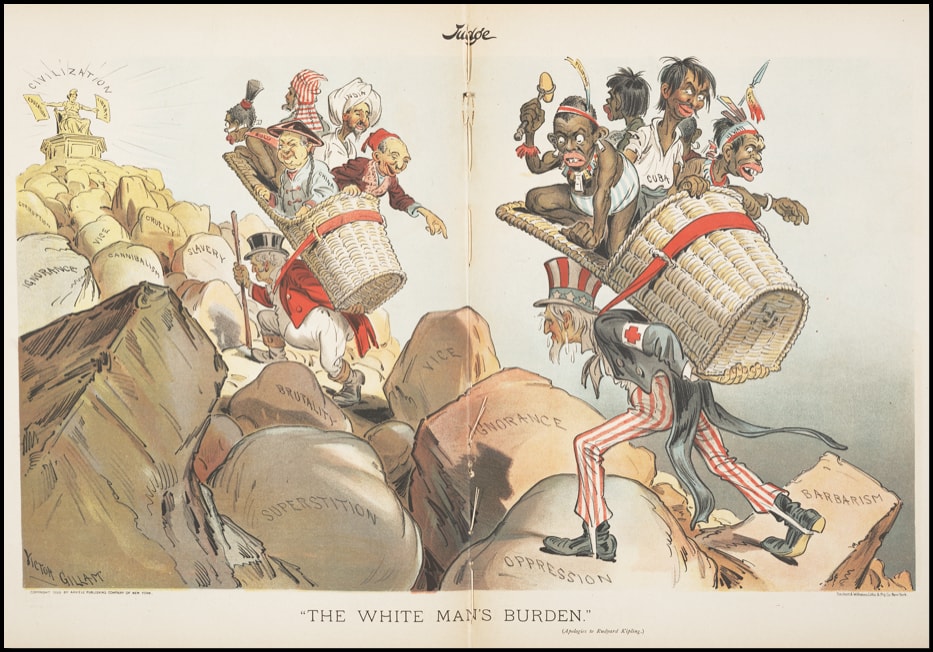
Imperialists argued that the United States was destined to expand its culture, institutions, and influence to peoples around the globe. They leaned on a mix of economic, strategic, and racial reasoning.
Economic reasons
- New overseas markets would absorb surplus American goods.
- Foreign territory offered raw materials and places to invest capital.
- Growing trade required coaling stations, ports, and a strong navy to protect shipping.
Competition and national greatness
- Expansion would let the U.S. keep pace with European empires.
- Naval bases and territory abroad would project American power and strengthen national security.
- With the frontier "closed," overseas expansion was framed as the natural next chapter of American growth.
Racial and cultural theories
- Some imperialists used racial theories to claim that Anglo-Saxon Americans had a duty to spread their culture, government, and religion to other peoples.
- This argument cast expansion as a mission to "uplift" or "civilize," which assumed American institutions were superior and that other peoples needed American guidance.
That last point is uncomfortable but central. A big chunk of the imperialist case rested on the belief that Americans were destined and obligated to extend their way of life to others, an idea built on racial hierarchy.
The Anti-Imperialist Argument
Anti-imperialists argued that the United States should NOT extend its territory overseas. They thought taking colonies betrayed America's own founding principles. Their reasoning pulled from several directions, and (notably) some of it overlapped with the imperialists.
Self-determination and democratic principles
- Ruling over people who didn't consent to be ruled contradicted the American ideal that government rests on the consent of the governed.
- Holding colonies without giving those people full rights or citizenship looked like hypocrisy for a nation founded on liberty and self-government.
The isolationist tradition
- Anti-imperialists pointed to the long U.S. foreign-policy tradition of isolationism, the idea that America should avoid entanglements abroad.
- Staying out of overseas empire-building fit that tradition; building one broke from it.
Racial theories (used the other way)
- Here's the twist students often miss: some anti-imperialists also used racial theories, but to argue AGAINST expansion. They didn't want to absorb the populations of distant territories into the United States.
- So racial thinking showed up on BOTH sides of the debate, just pointed in opposite directions.
Comparing the Two Sides
The key skill for this topic is comparison, so line the two positions up directly.
| Issue | Imperialists | Anti-Imperialists |
|---|---|---|
| Overseas territory | Yes, the U.S. should expand abroad | No, the U.S. should not extend its territory overseas |
| Economics | New markets, raw materials, investment | Less central to their argument |
| European empires | Compete and keep up with them | Avoid imitating Europe; stay independent |
| The frontier | "Closed," so look overseas next | Not a reason to take colonies |
| Self-determination | Spreading U.S. institutions is a benefit | Ruling people without consent is wrong |
| Foreign-policy tradition | Time for America to be a world power | Stick with isolationism |
| Racial theories | Used to justify expansion ("uplift" others) | Used to oppose absorbing other peoples |
The big similarity
Both sides actually shared one thing: racial theories shaped the arguments on both ends. Imperialists used race to justify spreading American culture; anti-imperialists used race to justify keeping other peoples out. The conclusions were opposite, but the underlying assumptions about racial hierarchy showed up in both camps. That overlap is exactly the kind of nuance that earns points on a comparison question.
The big difference
The core split is simple: imperialists believed the United States was destined to expand its influence across the globe, while anti-imperialists believed expansion overseas violated the principles of self-determination and the tradition of isolationism. Everything else hangs off that one disagreement.
Key Terms to Know
| Term | Why it matters |
|---|---|
| Imperialism | The policy of extending a nation's power and control over other territories, the central subject of the whole debate. |
| Imperialists | The camp that argued the U.S. should expand overseas for economic, strategic, and cultural reasons. |
| Anti-imperialists | The camp that argued the U.S. should not extend its territory abroad. |
| "Closed" frontier | The 1890s perception that western settlement was complete, used to argue America should expand overseas next. |
| Self-determination | The principle that people should govern themselves, a core anti-imperialist objection to ruling colonies. |
| Isolationism | The U.S. tradition of avoiding foreign entanglements, cited by anti-imperialists against expansion. |
| Racial theories | Beliefs about racial hierarchy used by BOTH sides, to justify expansion and to oppose it. |
| Overproduction | The surplus of American goods that pushed business leaders to want new foreign markets. |
| Foreign markets | New places to sell American products, a leading economic argument for expansion. |
| Anglo-Saxonism | The belief that Anglo-Saxon Americans had a duty to spread their culture and institutions to other peoples. |
| Consent of the governed | The democratic ideal anti-imperialists said colonial rule violated. |
| World power | The status imperialists wanted the U.S. to claim alongside European empires. |
Practice and Next Steps
Start with the matching course-topic guide for a different angle on the same material: 7.2 Imperialism: Debates. Then keep moving through the AMSCO Period 7 notes on the APUSH AMSCO notes hub.
Where this fits with the neighboring topics:
- Before this: AMSCO 7.1 Contextualizing Period 7 sets up the whole period.
- Right after: AMSCO 7.3 The Spanish-American War and U.S. Foreign Policy to 1917 shows what happened once the imperialists got their way.
Build fluency with practice:
- Sharpen multiple-choice timing with guided MCQ practice.
- Work the comparison skill in FRQ practice with instant scoring.
- Review fast before a quiz with the APUSH cheatsheets and the key terms glossary.
Frequently Asked Questions
What is AMSCO APUSH 7.2 about?
AMSCO Topic 7.2, "Imperialism: Debates," covers the late-1800s argument over whether the United States should expand overseas and become a world power. It lays out the imperialist case and the anti-imperialist case so you can compare how Americans viewed the nation's proper role in the world. For the course-topic version, see the 7.2 Imperialism: Debates study guide.
What did imperialists argue in the late 1800s?
Imperialists argued the U.S. was destined to expand its culture and institutions around the globe. They cited new economic opportunities (markets and raw materials), competition with European empires, the idea that the western frontier was "closed," and racial theories claiming a duty to spread American ways of life to other peoples.
What did anti-imperialists argue?
Anti-imperialists argued the U.S. should not extend its territory overseas. They cited the principle of self-determination, the foreign-policy tradition of isolationism, and (in some cases) racial theories used to oppose absorbing the populations of distant territories.
How did racial theories show up on both sides of the imperialism debate?
Racial theories appeared on both sides, just pointed in opposite directions. Imperialists used them to claim a duty to spread American culture to other peoples, while some anti-imperialists used them to argue against absorbing those populations. That shared assumption with opposite conclusions is a strong point to make on a comparison question.
How is the imperialism debate tested on the APUSH exam?
It's most often tested as a comparison, asking you to explain similarities and differences in how Americans viewed the country's role in the world. Be ready to lay out both the imperialist and anti-imperialist positions and point out the racial-theory overlap. You can practice this skill with FRQ practice with instant scoring.
See Fiveable more often in Google
Mark Fiveable as a preferred source and Google is more likely to show you our guides in Top Stories, with a "preferred" badge in AI Mode and AI Overviews.