AMSCO 4.9 The Development of an American Culture

🇺🇸AP US History Review
AMSCO 4.9 The Development of an American Culture
🇺🇸 AP US History
AMSCO 1.2:Native American Societies Before European Contact Notes
AMSCO 2.1 Context: European Colonization of North America Notes
AMSCO 2.2 European Colonization Notes
AMSCO 2.3 The Regions of the British Colonies Notes
AMSCO 2.4 Transatlantic Trade Notes
AMSCO 2.5 Interactions between American Indians and Europeans Notes
AMSCO 2.6 Slavery in the British Colonies Notes
AMSCO 2.7 Colonial Society and Culture Notes
AMSCO 2.8 Comparison in Period 2 (1607-1754) Notes
AMSCO 3.1 Contextualizing Period 3
AMSCO 3.2 The Seven Year's War
AMSCO 3.3 Taxation Without Representation
AMSCO 3.4 Philosophical Foundations of the American Revolution
AMSCO 3.5 The American Revolution
AMSCO 3.6 The Influence of Revolutionary Ideals
AMSCO 3.7 The Articles of Confederation
AMSCO 3.8 The Constitutional Convention and Debates Over Ratification
AMSCO 3.9 The Constitution
AMSCO 3.10 Shaping a New Republic
AMSCO 3.11 Developing an American Identity
AMSCO 3.12 Movements in the Early Republic
AMSCO 3.13 Continuity and Change in Period 3
AMSCO 4.1 Contextualizing Period 4
AMSCO 4.2 The Rise of Political Parties and the Era of Jefferson
AMSCO 4.3 Politics and Regional Interests
AMSCO 4.4 America on the World Stage
AMSCO 4.5 Market Revolution
AMSCO 4.6 Effects of the Market Revolution on Society and Culture
AMSCO 4.7 Expanding Democracy
AMSCO 4.8 Jackson and Federal Power
AMSCO 4.9 The Development of an American Culture
AMSCO 4.10 The Second Great Awakening
AMSCO 4.11 An Age of Reform
AMSCO 4.12 African Americans in the Early Republic
AMSCO 4.13 Southern Society in the Early Republic
AMSCO 4.14 Causation in Period 4
AMSCO 5.1 Contextualizing Period 5
AMSCO 5.2 The Idea of Manfiest Destiny
AMSCO 5.3 Manifest Destiny and the Mexican-American War
AMSCO 5.4 The Compromise of 1850
AMSCO 5.5 Sectional Conflict: Regional Differences
AMSCO 5.6 Failure of Compromise
AMSCO 5.7 Election of 1860 and Secession
AMSCO 5.8 Military Conflict in the Civil War
AMSCO 5.9 Government Policies During the Civil War
AMSCO 5.10 Reconstruction
AMSCO 5.11 Failure of Reconstruction
AMSCO 5.12 Comparion in Period 5
AMSCO 6.1 Contextualizing Period 6
AMSCO 6.2 Westward Expansion: Economic Development
AMSCO 6.3 Westward Expansion: Social and Cultural Development
AMSCO 6.4 The "New South"
AMSCO 6.5 Technological Innovation
AMSCO 6.6 The Rise of Industrial Capitalism
AMSCO 6.7 Labor in the Gilded Age
AMSCO 6.8 Immigration and Migration in the Gilded Age
AMSCO 6.9 Responses to Immigration in the Gilded Age
AMSCO 6.10 Development of the Middle Class
AMSCO 6.11 Reform in the Gilded Age
AMSCO 6.12 Role of Government in the Gilded Age
AMSCO 6.13 Politics in the Gilded Age
AMSCO 6.14 Continuity and Change Period 6
AMSCO 7.1 Contextualizing Period 7
AMSCO 7.2 Imperialism: Debates
AMSCO 7.3 The Spanish-American War and U.S. Foreign Policy to 1917
AMSCO 7.4 The Progressives
AMSCO 7.5 World War I: Military and Diplomacy
AMSCO 7.6 World War I: Home Front
AMSCO 7.7 1920s: Innovations in Communication and Technology
AMSCO 7.8 1920s: Cultural and Political Controversies
AMSCO 7.9 The Great Depression
AMSCO 7.10 The New Deal
AMSCO 7.11 Inerwar Foreign Policy
AMSCO 7.12 World War II Mobilization
AMSCO 7.13 World War II Military
AMSCO 7.14 World War II and Postwar Diplomacy
AMSCO 7.15 Comparison in Period 7
AMSCO 8.1 Contextualizing Period 8
AMSCO 8.2 The Cold War from 1945 to 1980
AMSCO 8.3 The Red Scare
AMSCO 8.4 Economy after 1945
AMSCO 8.5 Culture after 1945
AMSCO 8.6 Early Steps in the Civil Rights Movement, 1945-1960
AMSCO 8.7 America as a World Power
AMSCO 8.8 The Vietnam War
AMSCO 8.9 The Great Society
AMSCO 8.10 The African American Civil Rights Movement in the 1960s
AMSCO 8.11 The Civil Rights Movement Expands
AMSCO 8.12 Youth Culture of the 1960s
AMSCO 8.13 The Environment and Natural Resources from 1968 to 1980
AMSCO 8.14 Society in Transition
AMSCO 8.15 Continuity and Change in Period 8
AMSCO 9.1 Contextualizing Period 9
AMSCO 9.2 Reagan and Conservatism
AMSCO 9.3 The End of the Cold War
AMSCO 9.4 A Changing Economy
AMSCO 9.5 Migration and Immgiration in the 1990s and 2000s
AMSCO 9.6 Challenges of the 21st Century
AMSCO 9.7 Causation in Period 9
AMSCO 1.1 Contextualizing Period 1 Notes
AMSCO 1.3 European Exploration in the Americas Notes
AMSCO 1.4 Columbian Exchange, Spanish Exploration, and Conquest Notes
AMSCO 1.5 Labor, Slavery, and Caste in the Spanish Colonial System Notes
AMSCO 1.6 Cultural Interactions in the Americas Notes
AMSCO 1.7 Causation in Period 1 Notes
Overview
AMSCO Topic 4.9, "The Development of an American Culture," covers how the United States built a distinct national culture between 1800 and 1848 that blended American elements, European influences, and regional flavors. The chapter follows three big threads: cultural nationalism after independence, the rise of romanticism and the transcendentalists (Emerson, Thoreau, Brook Farm), and the wave of utopian communal experiments and distinctly American art and literature. It sits in the middle of Period 4 (1800-1848), connecting the democratic energy of the Age of Jackson to the religious revival and reform movements in Topic 4.10 and Topic 4.11.
Key Takeaways
- Patriotic paintings, stories about George Washington, and Noah Webster's speller helped build a distinct American identity.
- Romanticism valued feeling and nature over reason, while transcendentalists challenged materialism; Emerson urged Americans to think independently and create their own culture.
- Thoreau used nature to search for truth in Walden and argued that people should disobey unjust laws while accepting the penalty.
- Brook Farm tried to unite intellectual and manual labor; other antebellum utopias pursued religious or secular ideals, but most were short-lived.
- Genre painters depicted everyday life, Hudson River School artists celebrated American landscapes, and Washington Irving wrote fiction set in America.
Cultural Nationalism: A Patriotic American Identity
The generation that came of age in the early 1800s was done looking back at Europe. With the Napoleonic wars and the War of 1812 over, young Americans focused on westward expansion and believed the country was entering an era of unlimited prosperity. Patriotic themes showed up everywhere in American society.
- Art: Gilbert Stuart, Charles Willson Peale, and John Trumbull painted heroes of the Revolution, turning founders into national icons.
- Popular reading: Parson Mason Weems wrote a widely read, fictionalized biography praising the virtues of George Washington (this is where myth-making about Washington took off).
- Schools: Noah Webster's blue-backed speller promoted patriotism in expanding public schools, long before his famous dictionary appeared.
The takeaway for the exam: nationalism and patriotism dominated most of the 19th century, and culture was one of the main vehicles for it.
Romanticism and the Transcendentalists
In early 19th-century Europe, artists and writers moved away from the Enlightenment's emphasis on reason, order, and balance and toward intuition, feelings, individual heroism, and the study of nature. This movement was romanticism, and its clearest American expression came from the transcendentalists, a small group of New England thinkers.
Transcendentalists questioned established churches and the business practices of the merchant class. They argued for a mystical, intuitive way of thinking to discover the inner self and find the essence of God in nature. They challenged American materialism by claiming artistic expression mattered more than chasing wealth. They prized individualism and downplayed organized institutions, yet still supported reforms, especially the antislavery movement.
Ralph Waldo Emerson (1803-1882)
Emerson was the best-known transcendentalist and a hugely popular writer and speaker. His essays and lectures urged Americans not to imitate European culture but to create a distinctive American one. He championed self-reliance, independent thinking, and putting spiritual matters above material ones. Living in Concord, Massachusetts, he became a leading critic of slavery in the 1850s and a strong supporter of the Union during the Civil War.
Henry David Thoreau (1817-1862)
Thoreau, Emerson's close friend and fellow Concord resident, tested transcendentalist philosophy by living simply for two years in a cabin in the woods. He used observations of nature to search for essential truths, and the result was Walden (1854). Because of it, Thoreau is remembered as a pioneer ecologist and conservationist.
He also believed the U.S. war against Mexico (1846-1848) was immoral, so he refused to pay a tax supporting it. He was jailed for one night (someone anonymously paid his tax). His essay "On Civil Disobedience" argued for disobeying unjust laws and accepting the penalty. In the 20th century, his ideas inspired the nonviolent movements of Mohandas Gandhi in India and Martin Luther King Jr. in the United States. That long-term influence is a favorite continuity-and-change point on the exam.
Brook Farm
In 1841, Protestant minister George Ripley launched a communal experiment at Brook Farm in Massachusetts to achieve "a more natural union between intellectual and manual labor." Residents and visitors included Emerson, feminist writer and editor Margaret Fuller, theologian and radical reformer Theodore Parker, and novelist Nathaniel Hawthorne. A bad fire and heavy debts ended the experiment in 1849, but Brook Farm was remembered for its artistic creativity, innovative school, and appeal to New England's intellectual elite.
Utopian Communal Experiments
The idea of withdrawing from conventional society to build an ideal community, a utopia, was not new, but social experiments were never more numerous than during the antebellum years. More than a hundred experimental communities formed on America's open lands. Some were religious (the early members of the Church of Jesus Christ of Latter-day Saints undertook one type of religious communal effort), while others like Brook Farm were humanistic, or secular. Most were short-lived, but these "backwoods utopias" show the diversity of reform ideas at the time.
Shakers
One of the earliest religious communal movements. About 6,000 members across various communities by the 1840s. They held property in common and kept men and women strictly separate, forbidding marriage and sexual relations. With no new recruits, Shaker communities virtually died out by the mid-1900s. (No marriage means no children, which means no future members. That's the cause-and-effect to remember.)
Amana Colonies
German settlers in Iowa who belonged to the religious reform movement called Pietism. Like the Shakers, they emphasized simple, communal living, but they allowed marriage. Their communities still prosper today, though they no longer live communally.
New Harmony
A secular (nonreligious) experiment in Indiana founded by Welsh industrialist and reformer Robert Owen. He hoped his utopian socialist community would solve the inequity and alienation caused by the Industrial Revolution. It failed due to financial problems and disagreements among members.
Oneida Community
Started by John Humphrey Noyes in Oneida, New York, in 1848 after his religious conversion. Members pursued perfect social and economic equality, sharing property and, later, marriage partners. Critics blasted Oneida's planned reproduction and communal child-rearing as sinful "free love." Even so, the community prospered economically by producing high-quality silverware.
Fourier Phalanxes
In the 1840s, the theories of French socialist Charles Fourier attracted American interest. He proposed communities where people shared work and housing as an answer to a fiercely competitive society. The movement died out quickly because Americans proved too individualistic to live communally.
Arts and Literature in the Age of Jackson
The democratic and reforming impulses of the Age of Jackson showed up in painting, architecture, and literature. After the War of 1812, Americans grew more nationalistic and eager to read works on American themes by American writers.
Painting
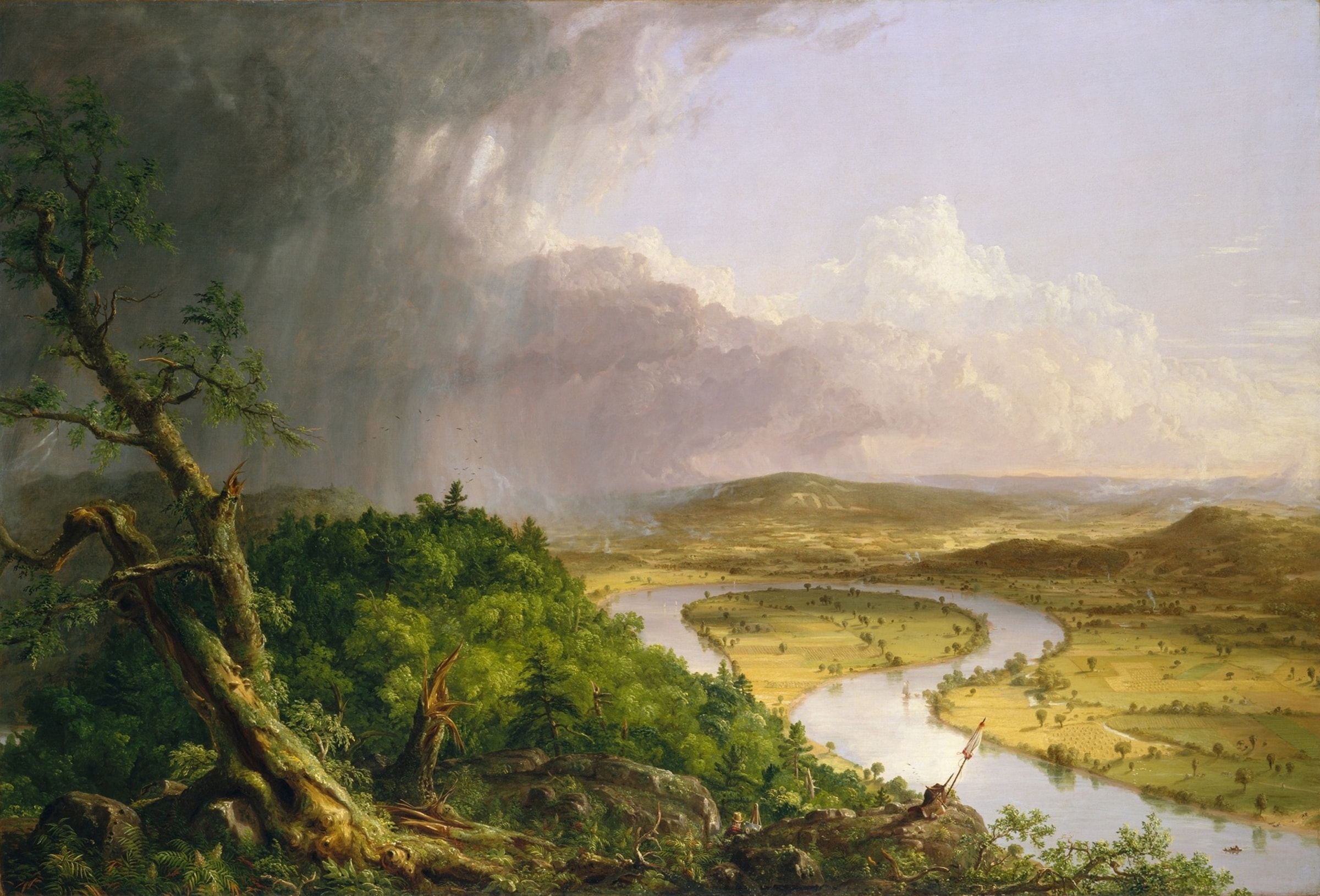
- Genre painting became popular in the 1830s, showing everyday life of ordinary people (riding riverboats, voting on election day). George Caleb Bingham depicted common people doing domestic chores; William S. Mount won popularity for lively rural scenes.
- The Hudson River School, led by Thomas Cole and Frederick Church, emphasized the heroic beauty of American landscapes, especially dramatic scenes along New York's Hudson River and the western frontier wilderness. It captured the Romantic fascination with nature.
Architecture
Architects, inspired by the democracy of classical Athens, adapted Greek styles to glorify the republic's democratic spirit. Columned facades like ancient Greek temples appeared on public buildings, banks, hotels, and even some private homes.
Literature
Most prominent writers came from New England or the Mid-Atlantic states. Beyond Emerson and Thoreau:
- Washington Irving wrote fiction with American settings, including "Rip Van Winkle" and "The Legend of Sleepy Hollow."
- James Fenimore Cooper wrote the Leatherstocking Tales (1824-1841), novels glorifying scouts and settlers on the American frontier.
- Nathaniel Hawthorne questioned intolerance and conformity in American life, notably in The Scarlet Letter (1850).
- Herman Melville wrote the innovative Moby-Dick (1855), reflecting the era's theological and cultural conflicts through Captain Ahab's pursuit of a white whale.
- Edgar Allan Poe focused on the irrational side of human behavior in works like "The Raven" and "The Tell-Tale Heart."
Key Terms to Know
| Term | Why it matters |
|---|---|
| Cultural nationalism | Patriotic pride that filled American art, books, and schools as the young nation built its own identity. |
| Romanticism | European movement valuing intuition, emotion, and nature over Enlightenment reason; it shaped American art and writing. |
| Transcendentalists | New England thinkers who sought truth through intuition and nature and challenged American materialism. |
| Ralph Waldo Emerson | Leading transcendentalist who urged Americans to create their own culture through self-reliance and independent thinking. |
| Henry David Thoreau | Wrote Walden and "On Civil Disobedience"; later inspired Gandhi and Martin Luther King Jr. |
| Brook Farm | George Ripley's 1841 Massachusetts commune uniting intellectual and manual labor; ended in 1849 after a fire and debts. |
| Margaret Fuller | Feminist writer and editor associated with Brook Farm and the transcendentalist circle. |
| Utopia | An ideal community built apart from conventional society; over a hundred were attempted in the antebellum era. |
| Antebellum | The decades before the Civil War, when reform ideas and communal experiments peaked. |
| Shakers | Religious communal group (about 6,000 members by the 1840s) that banned marriage, so it eventually died out. |
| Amana Colonies | German Pietist communities in Iowa that lived simply and communally but allowed marriage. |
| New Harmony | Robert Owen's secular utopian socialist experiment in Indiana, meant to fix Industrial Revolution problems; it failed. |
| Oneida Community | John Humphrey Noyes's 1848 New York commune practicing shared property and "free love"; prospered selling silverware. |
| Fourier Phalanxes | Communities based on French socialist Charles Fourier's ideas of shared work and housing; faded fast in individualistic America. |
| Hudson River School | Painters like Thomas Cole and Frederick Church who celebrated the heroic beauty of American landscapes. |
| Washington Irving | Early American author who set fiction like "Rip Van Winkle" in distinctly American settings. |
| James Fenimore Cooper | Wrote the Leatherstocking Tales glorifying frontier scouts and settlers. |
| Herman Melville | Author of Moby-Dick (1855), which captured the era's theological and cultural conflicts. |
Practice and Next Steps
Pair these notes with the Topic 4.9 course study guide for the College Board framing, and browse the rest of the APUSH AMSCO notes for the full Period 4 sequence. This topic flows directly into the Second Great Awakening, so read them together; both feed the same exam question about how religion, culture, and reform reshaped antebellum America.
To check yourself, run a few guided multiple-choice questions on Period 4, look up terms in the APUSH key terms glossary, or try FRQ practice with instant scoring to see how transcendentalism and utopian communities show up in essay prompts.
Frequently Asked Questions
What is AMSCO Topic 4.9 about in APUSH?
AMSCO Topic 4.9, The Development of an American Culture, covers how the U.S. built a distinct national culture from 1800 to 1848. It includes cultural nationalism after independence, romanticism and the transcendentalists (Emerson and Thoreau), antebellum utopian communities like Brook Farm and Oneida, and American art and literature such as the Hudson River School.
What did the transcendentalists believe?
Transcendentalists were New England thinkers who argued for a mystical, intuitive way of discovering one's inner self and finding the essence of God in nature. They challenged American materialism, prized individualism over organized institutions, and supported reforms like the antislavery movement. Emerson and Thoreau are the two names you need for the exam.
What were the major utopian communities in the antebellum era?
The big five are the Shakers (no marriage, eventually died out), the Amana Colonies (German Pietists in Iowa), New Harmony (Robert Owen's secular socialist experiment in Indiana), the Oneida Community (John Humphrey Noyes's shared-property and shared-marriage commune that prospered selling silverware), and the Fourier Phalanxes (shared work and housing, faded fast). Brook Farm was the transcendentalist version in Massachusetts.
Why did the Shaker communities die out but the Amana Colonies survive?
The Shakers forbade marriage and sexual relations, so they could only grow through new recruits, and the communities virtually died out by the mid-1900s. The Amana Colonies also practiced simple communal living but allowed marriage, and their communities still prosper today (though they no longer live communally). It's a useful comparison for cause-and-effect questions.
How does Topic 4.9 show up on the APUSH exam?
Topic 4.9 supports the Period 4 theme that a new national culture combined American elements, European influences, and regional sensibilities, and that Romantic beliefs in human perfectibility shaped literature, art, philosophy, and architecture. Expect it in questions linking culture to antebellum reform, often paired with the Second Great Awakening. Try guided practice questions to test the connections.
See Fiveable more often in Google
Mark Fiveable as a preferred source and Google is more likely to show you our guides in Top Stories, with a "preferred" badge in AI Mode and AI Overviews.