AMSCO 3.11 Developing an American Identity

🇺🇸AP US History Review
AMSCO 3.11 Developing an American Identity
🇺🇸 AP US History
AMSCO 1.2:Native American Societies Before European Contact Notes
AMSCO 2.1 Context: European Colonization of North America Notes
AMSCO 2.2 European Colonization Notes
AMSCO 2.3 The Regions of the British Colonies Notes
AMSCO 2.4 Transatlantic Trade Notes
AMSCO 2.5 Interactions between American Indians and Europeans Notes
AMSCO 2.6 Slavery in the British Colonies Notes
AMSCO 2.7 Colonial Society and Culture Notes
AMSCO 2.8 Comparison in Period 2 (1607-1754) Notes
AMSCO 3.1 Contextualizing Period 3
AMSCO 3.2 The Seven Year's War
AMSCO 3.3 Taxation Without Representation
AMSCO 3.4 Philosophical Foundations of the American Revolution
AMSCO 3.5 The American Revolution
AMSCO 3.6 The Influence of Revolutionary Ideals
AMSCO 3.7 The Articles of Confederation
AMSCO 3.8 The Constitutional Convention and Debates Over Ratification
AMSCO 3.9 The Constitution
AMSCO 3.10 Shaping a New Republic
AMSCO 3.11 Developing an American Identity
AMSCO 3.12 Movements in the Early Republic
AMSCO 3.13 Continuity and Change in Period 3
AMSCO 4.1 Contextualizing Period 4
AMSCO 4.2 The Rise of Political Parties and the Era of Jefferson
AMSCO 4.3 Politics and Regional Interests
AMSCO 4.4 America on the World Stage
AMSCO 4.5 Market Revolution
AMSCO 4.6 Effects of the Market Revolution on Society and Culture
AMSCO 4.7 Expanding Democracy
AMSCO 4.8 Jackson and Federal Power
AMSCO 4.9 The Development of an American Culture
AMSCO 4.10 The Second Great Awakening
AMSCO 4.11 An Age of Reform
AMSCO 4.12 African Americans in the Early Republic
AMSCO 4.13 Southern Society in the Early Republic
AMSCO 4.14 Causation in Period 4
AMSCO 5.1 Contextualizing Period 5
AMSCO 5.2 The Idea of Manfiest Destiny
AMSCO 5.3 Manifest Destiny and the Mexican-American War
AMSCO 5.4 The Compromise of 1850
AMSCO 5.5 Sectional Conflict: Regional Differences
AMSCO 5.6 Failure of Compromise
AMSCO 5.7 Election of 1860 and Secession
AMSCO 5.8 Military Conflict in the Civil War
AMSCO 5.9 Government Policies During the Civil War
AMSCO 5.10 Reconstruction
AMSCO 5.11 Failure of Reconstruction
AMSCO 5.12 Comparion in Period 5
AMSCO 6.1 Contextualizing Period 6
AMSCO 6.2 Westward Expansion: Economic Development
AMSCO 6.3 Westward Expansion: Social and Cultural Development
AMSCO 6.4 The "New South"
AMSCO 6.5 Technological Innovation
AMSCO 6.6 The Rise of Industrial Capitalism
AMSCO 6.7 Labor in the Gilded Age
AMSCO 6.8 Immigration and Migration in the Gilded Age
AMSCO 6.9 Responses to Immigration in the Gilded Age
AMSCO 6.10 Development of the Middle Class
AMSCO 6.11 Reform in the Gilded Age
AMSCO 6.12 Role of Government in the Gilded Age
AMSCO 6.13 Politics in the Gilded Age
AMSCO 6.14 Continuity and Change Period 6
AMSCO 7.1 Contextualizing Period 7
AMSCO 7.2 Imperialism: Debates
AMSCO 7.3 The Spanish-American War and U.S. Foreign Policy to 1917
AMSCO 7.4 The Progressives
AMSCO 7.5 World War I: Military and Diplomacy
AMSCO 7.6 World War I: Home Front
AMSCO 7.7 1920s: Innovations in Communication and Technology
AMSCO 7.8 1920s: Cultural and Political Controversies
AMSCO 7.9 The Great Depression
AMSCO 7.10 The New Deal
AMSCO 7.11 Inerwar Foreign Policy
AMSCO 7.12 World War II Mobilization
AMSCO 7.13 World War II Military
AMSCO 7.14 World War II and Postwar Diplomacy
AMSCO 7.15 Comparison in Period 7
AMSCO 8.1 Contextualizing Period 8
AMSCO 8.2 The Cold War from 1945 to 1980
AMSCO 8.3 The Red Scare
AMSCO 8.4 Economy after 1945
AMSCO 8.5 Culture after 1945
AMSCO 8.6 Early Steps in the Civil Rights Movement, 1945-1960
AMSCO 8.7 America as a World Power
AMSCO 8.8 The Vietnam War
AMSCO 8.9 The Great Society
AMSCO 8.10 The African American Civil Rights Movement in the 1960s
AMSCO 8.11 The Civil Rights Movement Expands
AMSCO 8.12 Youth Culture of the 1960s
AMSCO 8.13 The Environment and Natural Resources from 1968 to 1980
AMSCO 8.14 Society in Transition
AMSCO 8.15 Continuity and Change in Period 8
AMSCO 9.1 Contextualizing Period 9
AMSCO 9.2 Reagan and Conservatism
AMSCO 9.3 The End of the Cold War
AMSCO 9.4 A Changing Economy
AMSCO 9.5 Migration and Immgiration in the 1990s and 2000s
AMSCO 9.6 Challenges of the 21st Century
AMSCO 9.7 Causation in Period 9
AMSCO 1.1 Contextualizing Period 1 Notes
AMSCO 1.3 European Exploration in the Americas Notes
AMSCO 1.4 Columbian Exchange, Spanish Exploration, and Conquest Notes
AMSCO 1.5 Labor, Slavery, and Caste in the Spanish Colonial System Notes
AMSCO 1.6 Cultural Interactions in the Americas Notes
AMSCO 1.7 Causation in Period 1 Notes
Overview
AMSCO Topic 3.11, "Developing an American Identity," covers how Americans built a distinct national identity in the years after independence, roughly 1754-1800 in the course framework. The big idea is continuity and change: new forms of national culture developed in the United States while regional variations persisted, and ideas about national identity increasingly showed up in art, literature, and architecture. The chapter opens with Crèvecoeur's famous 1782 line from Letters from an American Farmer: "The American is a new man, who acts upon new principles."
The chapter's framing is worth remembering. A truly unique American identity took at least a generation to become clearly established. Admiration for the "founding fathers," the leaders who declared independence, won the war, and created a new government, became the core of that identity, and it still is. Washington's Farewell Address and his two-term tradition (covered in AMSCO 3.10) are clear examples of founding-era influence that people still debate today.
At the same time, Americans didn't invent everything from scratch. The new identity was built on the people and culture of the 13 colonies, shaped by the thought and experience of the Revolution, and enlarged by regional differences and waves of new immigrants. Keep that blend of old and new in mind. It's the whole chapter in one sentence.
Key Takeaways
- Admiration for the founding fathers became central to an identity shaped by colonial culture, the Revolution, regional differences, and immigration.
- States rejected titles of nobility and primogeniture, while most ended financial support for religious groups.
- Regional identities persisted, and slavery declined in northern states while growing stronger in southern states.
- The Federalists and Democratic-Republicans grew from the ratification debate, then developed different views shaped by region and the powers of the federal government.
- Newspapers spread political discussion, while Brown's novels, Peale and Stuart's art, and L'Enfant's Washington, D.C., design expressed a developing national culture.
Social Change After the Revolution
The War for Independence revolutionized more than politics. It profoundly changed American society. Some changes happened immediately, while others evolved gradually as Revolutionary ideas filtered into the attitudes of ordinary people. Together, these changes made Americans increasingly aware of how the United States differed from Great Britain and the rest of Europe.
Abolition of Aristocratic Titles
State constitutions and laws wiped out old institutions left over from medieval Europe.
- No legislature could grant titles of nobility.
- No court could recognize primogeniture, the feudal practice giving the first-born son the right to inherit the family's property.
- Whatever aristocracy existed in colonial America was further weakened when large Loyalist estates were confiscated. Many were subdivided and sold to raise money for the war.
The takeaway: America deliberately rejected the legal machinery of European aristocracy. No nobles, no automatic inheritance for eldest sons.
Separation of Church and State
Most states adopted separation of church and state, meaning they refused to give financial support to any religious group.
- The Anglican Church (renamed the Episcopal Church in the United States) had been closely tied to the king's government. It was disestablished in the South, meaning it lost state support.
- The holdouts were three New England states: New Hampshire, Connecticut, and Massachusetts. There the Congregational Church still received state support through a religious tax.
- New England finally discontinued that practice in the early 1830s.
Notice the change-and-continuity pattern here. Most states separated church and state quickly, but the change wasn't uniform or instant.
Regional Variations
Not all states changed at the same time, and the regional differences that emerged in the colonial period kept shaping how states evolved. The term "southerner" entered common usage in the 1780s, a sign that Americans themselves recognized regional identities.
The biggest regional difference was slavery. While slavery continued to decline in northern states, it became stronger than ever in southern states. That divergence is a thread you'll trace all the way to the Civil War in later units.
People even noticed differences in character. In 1785, Jefferson wrote to a friend in France that an observant visitor could figure out their line of latitude just by paying attention to the people around them. In general, he said, northerners were more serious and persevering in their work, while southerners were more generous and forthright in their speech.
Political Change: Parties and Identity
The development of political parties both added to and reflected the American identity. The first two parties, the Federalists and Democratic-Republicans, grew out of the ratification debate between Federalists and Anti-Federalists over the Constitution (see AMSCO 3.8).
Those party distinctions matured largely based on two things:
- Regional differences
- Distinct views of the roles, functions, and powers of the federal government
The chapter makes a point of saying this evolution continues today, just like the distinctiveness of American identity itself. For the full story of how the first party system formed under Washington and Adams, review AMSCO 3.10 Shaping a New Republic.
Cultural Change: Art, Literature, and Architecture
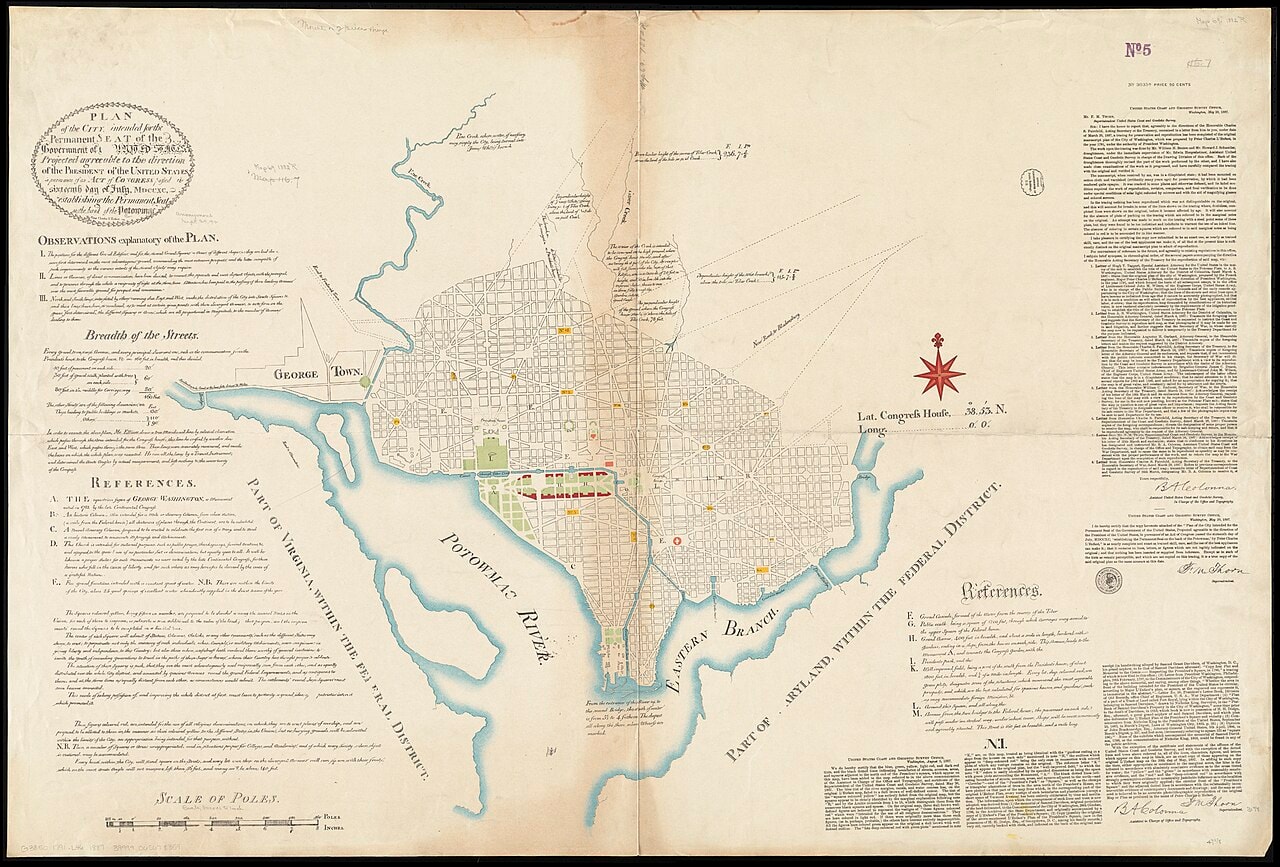
Much of the nation's culture still reflected its British origins, but a distinctive national identity gradually evolved. This is the part of the chapter that directly answers the topic's central question: how did national identity find expression in art, literature, and architecture?
Key developments to know:
- Newspapers expanded in the late 1700s, becoming a means of communication and a source for political discussion. This made cultural and political change possible on a national scale.
- Charles Brockden Brown explored the meaning of an American identity through novels.
- Charles Wilson Peale opened what is recognized as the first art gallery, in Philadelphia.
- Pierre-Charles L'Enfant developed the design for Washington, D.C., in the 1790s. That's national identity expressed in architecture and city planning.
- Gilbert Stuart painted the nation's leaders. His portraits made the founders into national icons.
- The American Academy of Fine Arts held its first exhibition in the 1790s.
- Later developments, including the first dictionary for American English and a book on American geography, continued the process of creating a distinctive culture.
If an exam question asks for evidence that "ideas about national identity increasingly found expression in works of art, literature, and architecture," these names are your specific evidence. Brown for literature, Peale and Stuart for art, L'Enfant for architecture.
Key Terms to Know
| Term | Why it matters |
|---|---|
| Founding fathers | Admiration of the leaders who won independence and built the new government became the core of American identity. |
| Crèvecoeur, Letters from an American Farmer (1782) | Declared the American "a new man" with new principles, ideas, and opinions, the classic statement of a new identity. |
| Primogeniture | The feudal first-born inheritance rule that state courts refused to recognize, part of rejecting European aristocracy. |
| Titles of nobility | State constitutions banned legislatures from granting them, another break with aristocratic Europe. |
| Loyalist estate confiscation | Large estates were seized, subdivided, and sold to fund the war, weakening colonial aristocracy. |
| Separation of church and state | Most states refused financial support to any religious group after independence. |
| Episcopal Church | The new American name for the Anglican Church, which was disestablished in the South. |
| Disestablished | Lost state support; what happened to the Anglican Church in the southern states. |
| Congregational Church | Kept receiving a religious tax in New Hampshire, Connecticut, and Massachusetts until the early 1830s. |
| "Southerner" | The term entered common usage in the 1780s, showing regional identities were hardening. |
| Federalists and Democratic-Republicans | The first political parties, rooted in the ratification debate and shaped by regional differences and views of federal power. |
| Newspapers | Their late-1700s expansion spread political discussion and helped build a national culture. |
| Charles Brockden Brown | Novelist who explored the meaning of an American identity, your go-to literature example. |
| Charles Wilson Peale | Opened the first recognized art gallery, in Philadelphia. |
| Pierre-Charles L'Enfant | Designed Washington, D.C., in the 1790s, national identity expressed in architecture. |
| Gilbert Stuart | Painted the nation's leaders, turning the founders into shared national symbols. |
| American Academy of Fine Arts | Held its first exhibition in the 1790s, a sign of an emerging American art world. |
Practice and Next Steps
This chapter pairs with the Fiveable course guide for Topic 3.11 Developing an American Identity, which frames the same material around the exam's continuity-and-change lens. Topic 3.11 wraps up Unit 3's story, so it helps to connect it back to AMSCO 3.4 on the philosophical foundations of the Revolution and AMSCO 3.6 on Revolutionary ideals, the ideas that this identity grew from.
To check yourself:
- Run APUSH guided practice questions on Period 3 to test whether you can match names like Stuart, Peale, and L'Enfant to the right cultural development.
- Browse the rest of the AMSCO notes for Unit 3 to review the full arc from the Seven Years' War to the new republic.
- Drill vocabulary with the APUSH key terms glossary if terms like primogeniture or disestablishment feel shaky.
Frequently Asked Questions
What is APUSH Topic 3.11 Developing an American Identity about?
Topic 3.11 covers how Americans built a distinct national identity after independence, from 1754-1800. New forms of national culture developed alongside continued regional variations, and national identity increasingly showed up in art, literature, and architecture. The AMSCO chapter organizes this into social, political, and cultural change.
What is primogeniture and why did the states abolish it?
Primogeniture was the feudal practice giving the first-born son the right to inherit his family's property. After independence, no American court could recognize it, and no legislature could grant titles of nobility. Both moves were deliberate rejections of European aristocracy in the new republic.
Did all states separate church and state after the Revolution?
No. Most states refused financial support to any religious group, and the Anglican (Episcopal) Church was disestablished in the South. But New Hampshire, Connecticut, and Massachusetts kept supporting the Congregational Church through a religious tax until the early 1830s.
Who are the key people to know for APUSH 3.11?
For cultural identity, know Charles Brockden Brown (novels about American identity), Charles Wilson Peale (first recognized art gallery, in Philadelphia), Pierre-Charles L'Enfant (designed Washington, D.C.), and Gilbert Stuart (painted the nation's leaders). They're your specific evidence that national identity found expression in literature, art, and architecture. Drill them with the APUSH key terms glossary.
How does Topic 3.11 show up on the AP US History exam?
It's a continuity-and-change topic: new national culture developed while regional variations continued, like slavery declining in the North but strengthening in the South. Strong answers pair a change (separation of church and state, abolition of primogeniture, new American art) with a continuity (British cultural roots, regional differences). Test yourself with APUSH guided practice.
See Fiveable more often in Google
Mark Fiveable as a preferred source and Google is more likely to show you our guides in Top Stories, with a "preferred" badge in AI Mode and AI Overviews.