10.1 Materials, Processes, and Techniques in Global Contemporary Art

🖼AP Art History Unit 10 Review
10.1 Materials, Processes, and Techniques in Global Contemporary Art
🖼 AP Art History
Global contemporary art since 1980 moves past older ideas about what counts as art. Artists use new materials, digital tools, performance, and global awareness to challenge old hierarchies around materials, training, and presentation styles.
What Materials and Techniques Define Global Contemporary Art?
Global contemporary art often uses mixed media, digital technology, installation, performance, textiles, found materials, graffiti-based marks, and video. These choices matter because they challenge older hierarchies about what counts as fine art, who gets included in art history, and how art should be presented.
For AP Art History, do not just name the material. Explain how the process or technique shapes meaning, such as how Paik's video installation comments on media networks or how Ringgold's story-quilt format brings painting, textile, and narrative together.
Why This Matters for the AP Art History Exam
This topic builds your ability to explain how materials, processes, and techniques shape a work and its meaning. For Unit 10, that means recognizing how artists mix media, repurpose materials, and use technology in ways that earlier periods did not. On the exam you will need to identify works, describe their visual and contextual elements, and connect those choices to larger ideas. The long-essay prompts in this period often ask you to explain continuity and change within a tradition or to compare works, so being able to tie specific material choices to meaning helps you support claims with real evidence instead of vague statements.
Key Takeaways
- Global contemporary art often goes beyond traditional ideas of art and leans on new technology and global awareness.
- Hierarchies of materials, tools, training, function, style, and presentation are challenged by digital works, recorded performances, graffiti, and online galleries.
- Digital technology gives artists and viewers wider access to images and context about artists and artworks across history and around the world.
- The art world has grown more inclusive since the 1960s, with artists of many backgrounds questioning who has traditionally been centered in art history.
- For each required work, connect the specific medium to the meaning. The "how it is made" is part of "what it says."
The Big Idea Behind This Topic
Earlier units often had clear rules: oil paint on canvas, marble for sculpture, formal training, a museum or church as the setting. Global contemporary art breaks those expectations. Recorded performances, ephemeral digital pieces, graffiti, found objects, and online platforms all raise questions about how art is defined, valued, and shown. At the same time, some traditional materials and skills are fading, even as people work to preserve them, and access to digital tools is uneven across the globe (the digital divide). Keep both sides in mind: artists push boundaries, but they also reference and respond to older traditions.
The Required Works for This Topic
Horn Players
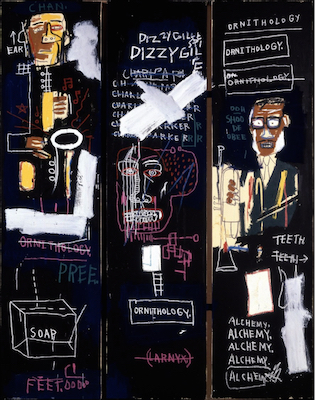
Jean-Michel Basquiat, Horn Players, 1983, acrylic and oil paintstick on three canvas panels.
- Basquiat painted across three canvas panels using acrylic and oil paintstick, a tool linked to drawing more than to formal painting.
- The work shows figures that reference jazz musicians, set against layered text, names, symbols, and crossed-out words.
- The raw, energetic mark-making blurs the line between painting, drawing, and graffiti-style writing.
- Basquiat rose out of a graffiti background, which connects this work to the idea that street-based practices were entering the fine-art world.
- The mix of words and images invites viewers to read the surface, not just look at it.
Androgyne III
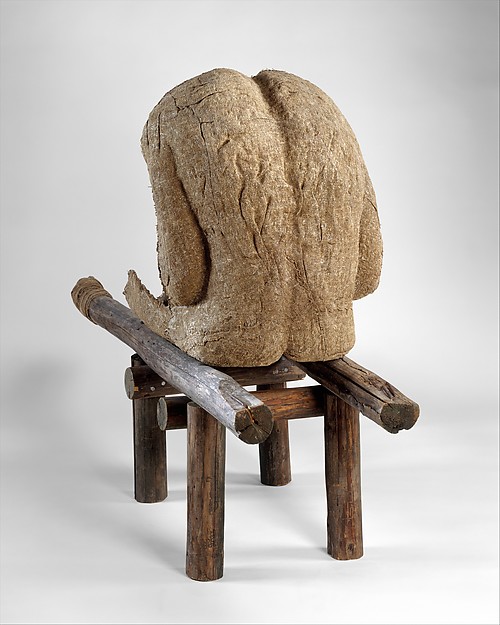
Magdalena Abakanowicz, Androgyne III, 1985, burlap, resin, wood, nails, and string.
- Abakanowicz built a humanlike figure out of burlap, resin, wood, nails, and string rather than traditional bronze or marble.
- The rough, fibrous materials give the body a worn, hollow, fragile quality.
- The figure lacks a head and arms and sits on a wooden support, which keeps it abstract and open to interpretation.
- Using fiber and textile-based materials for sculpture challenges older hierarchies that placed "craft" materials below stone or metal.
- One interpretation reads the figure as speaking to shared human experience rather than one specific person.
Dancing at the Louvre

Faith Ringgold, Dancing at the Louvre, from the series The French Collection, Part I; #1, 1991, acrylic on canvas, tie-dyed, pieced fabric border.
- Ringgold combines acrylic painting on canvas with a tie-dyed, pieced fabric border, a story-quilt format.
- Using quilting, a craft tied to domestic and African American traditions, raises its status to fine art.
- The scene shows figures in front of the Louvre, placing Black American characters inside a famous European museum space.
- Text in her French Collection series adds narrative, so the work tells a story as well as showing a scene.
- The mix of painting and textile reflects how contemporary artists question medium hierarchies and who belongs in major art institutions.
Electronic Superhighway
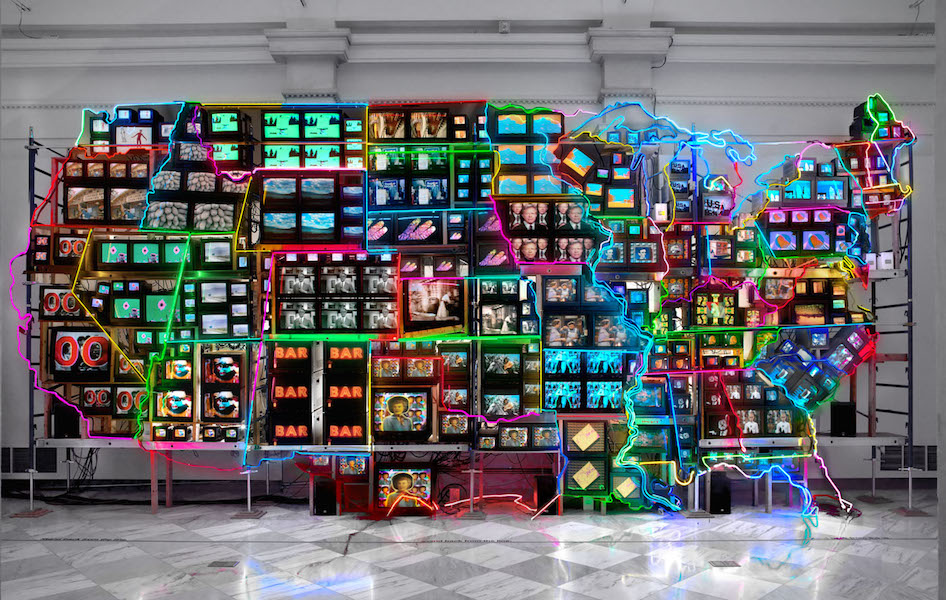
Nam June Paik, Electronic Superhighway, 1995, mixed-media installation (49-channel closed-circuit video installation, neon, steel, and electronic components).
- Paik built a map of the United States out of stacked television screens, neon outlines, and electronic parts.
- Each region plays its own looping video, so the piece is made of moving images and light rather than paint or stone.
- Neon outlines trace state borders, turning the country into a glowing, media-saturated network.
- The work treats technology and video as legitimate fine-art media, a major shift from traditional materials.
- It comments on how electronic media and connectivity shape American identity and experience.
Stadia II

Julie Mehretu, Stadia II, 2004, ink and acrylic on canvas.
- Mehretu layers ink and acrylic into dense, abstract compositions on a large canvas.
- Sharp lines, architectural fragments, flags, and symbols swirl around a central point, suggesting a stadium or arena.
- The marks evoke motion, crowds, and energy without showing a realistic scene.
- Bursts of color stand out against grayer, drawn elements, creating a sense of speed and force.
- The work connects abstract drawing techniques to ideas about global politics, power, and public space.
How to Use This on the AP Art History Exam
Identification
Be ready to name each work, its artist, approximate date, and medium. The medium matters here: "acrylic and oil paintstick on three canvas panels" or "49-channel video installation" tells the reader you know how the work was actually made.
Visual and Contextual Analysis
Describe what you see, then connect it to context. For example, point to Paik's stacked screens and neon, then explain how those materials reflect a media-driven culture. Always tie the technique to a reason or meaning.
Comparison
These works pair well with each other and with earlier units. You might compare Ringgold's quilt to a traditional painting to show continuity and change in how stories are told, or compare Abakanowicz's fiber figure to a classical marble figure to show how material choices shape meaning.
Common Trap
Do not just list materials. Saying "it is made of burlap" earns little. Explain why that choice matters, such as how the rough fiber makes the figure feel fragile and human.
Common Misconceptions
- Misconception: Contemporary art has no rules or skill.Actually: It challenges old hierarchies, but artists make deliberate choices about material, process, and meaning.
- Misconception: New media replaced traditional materials.Actually: Traditional skills and natural materials continue and are actively preserved, even as new media grow.
- Misconception: Digital tools are available everywhere.Actually: Access is uneven across the globe, a gap known as the digital divide.
- Misconception: Quilts, fiber, and graffiti are just crafts, not real art.Actually: Part of this period's point is that those medium hierarchies are being questioned and broken down.
- Misconception: Horn Players is from 1982, and Dancing at the Louvre is from 1988.Actually: Horn Players is from 1983, not 1982, and Dancing at the Louvre is from 1991, not 1988. Getting dates and media right strengthens your identification points.
Related AP Art History Guides
Practice Questions for 10.1
1 of 10
How do Basquiat's acrylics, oilstick, and text fragments in Horn Players function conceptually?
A.
Prove contemporary artists achieve Old Master technical refinement and polish
B.
Collapse boundaries between high art and street culture through marks and text
C.
Require extensive art historical training to interpret the work's complexity
D.
Preserve traditional painting techniques by combining them with modern materials
Vocabulary
The following words are mentioned explicitly in the AP® course framework for this topic.Term | Definition |
|---|---|
deconstructionist theory | A critical theory that challenges traditional interpretations by breaking down and questioning underlying assumptions in texts, culture, and history. |
digital divide | The gap between those with access to digital technology and those without access. |
digital technology | Electronic tools and systems used to create, distribute, and access art and information. |
disposable material cultures | Contemporary cultural practices emphasizing temporary, consumable, or replaceable materials in art and society. |
ephemeral digital works | Temporary or short-lived artworks created using digital technology that may not be permanently preserved. |
feminist theory | A critical approach that examines how gender, particularly the exclusion and marginalization of women, shapes art history and cultural perspectives. |
graffiti | Visual art created by applying paint or markers to public surfaces, often challenging traditional definitions of art. |
natural materials | Art materials derived from nature, such as wood, stone, clay, or fiber, traditionally used in artistic practice. |
online museums and galleries | Digital platforms that present and display artworks and collections on the internet. |
poststructuralist theory | A critical theory that questions fixed meanings and challenges the idea that there is a single, universal way to interpret culture and history. |
queer theory | A critical framework that challenges normative assumptions about sexuality, gender, and identity in culture and art history. |
traditional skills | Established artistic techniques and methods passed down through art historical practice. |
video-captured performances | Artistic performances that are recorded and documented through video media. |
Frequently Asked Questions
What materials and techniques define global contemporary art?
Global contemporary art often uses mixed media, digital technology, installation, video, performance, textiles, found materials, graffiti-based marks, and other approaches that challenge older definitions of fine art.
Why do materials matter in global contemporary art?
Materials matter because they help create meaning. A video installation, story quilt, fiber figure, or layered painting can question art hierarchies, identity, technology, history, and who gets represented.
Which works are important for AP Art History Topic 10.1?
Important works include Horn Players, Androgyne III, Dancing at the Louvre, Electronic Superhighway, and Stadia II. Each one shows how medium and process shape meaning.
How does digital technology affect contemporary art?
Digital technology expands access to images, information, and new media while also raising questions about the digital divide. Works like Electronic Superhighway use technology as both material and subject.
What does it mean that contemporary art challenges hierarchies?
It means artists question older rankings of materials, tools, training, function, style, and presentation. Media once treated as craft, street art, or popular technology can become central to fine art.
How is this topic tested on the AP Art History exam?
AP questions may ask you to identify a work, describe its medium, and explain how materials, processes, or techniques shape meaning. Listing materials is not enough; connect them to context and interpretation.
See Fiveable more often in Google
Mark Fiveable as a preferred source and Google is more likely to show you our guides in Top Stories, with a "preferred" badge in AI Mode and AI Overviews.