8.4 Buddhist literature

🪕World Literature I Unit 8 Review
8.4 Buddhist literature
🪕 World Literature I
Origins of Buddhist literature
Buddhist literature grew out of oral traditions that preserved the life and teachings of Siddhartha Gautama, the historical Buddha (c. 5th century BCE). For several centuries, monastic communities memorized and recited these teachings before anyone wrote them down. Once committed to writing in Pali and Sanskrit, these texts became the foundation for the many schools of Buddhist thought that spread across Asia.

Top images from around the web for Early Buddhist texts
Four Noble Truths - Wikipedia View original
Is this image relevant?
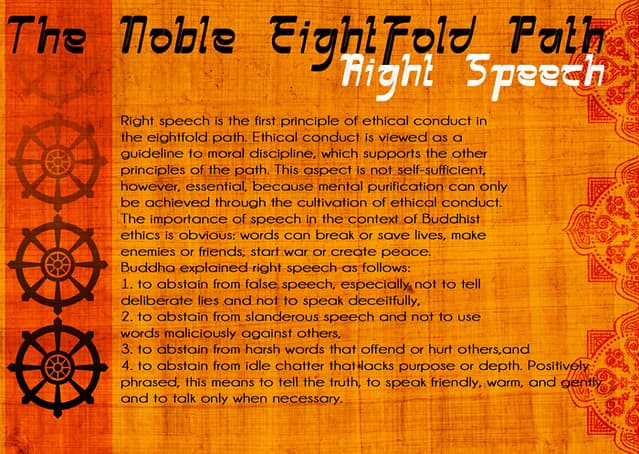
The Eightfold Path | please do not use these images unless y… | Flickr View original
Is this image relevant?
The Noble Eightfold Path View original
Is this image relevant?
Four Noble Truths - Wikipedia View original
Is this image relevant?
The Eightfold Path | please do not use these images unless y… | Flickr View original
Is this image relevant?
Early Buddhist texts
The earliest recorded Buddhist teachings date to around the 5th century BCE. The most important collection is the Tripitaka (meaning "Three Baskets"), which organizes the teachings into three sections:
- Vinaya Pitaka: rules and procedures governing monastic life
- Sutta Pitaka: discourses attributed to the Buddha and his close disciples
- Abhidhamma Pitaka: systematic philosophical and psychological analysis of the teachings
These texts were composed in both Pali and Sanskrit, reflecting different Buddhist communities and traditions. Within them you'll find the core doctrines of Buddhism, including the Four Noble Truths and the Eightfold Path.
Pali Canon overview
The Pali Canon (also called the Tipitaka) is the most complete early Buddhist canon that survives today. It was preserved by the Theravada school of Buddhism, which remains dominant in Sri Lanka and Southeast Asia.
The three divisions mirror the Tripitaka structure described above, but the Pali Canon also contains some especially well-known individual texts:
- The Dhammapada, a collection of verses on ethical living and mental discipline
- The Jataka tales, stories of the Buddha's previous lives (more on these below)
Because the Theravada tradition maintained these texts so carefully, scholars often treat the Pali Canon as the closest available record of the Buddha's original teachings.
Sanskrit Buddhist literature
Sanskrit Buddhist texts developed alongside the Pali tradition and are associated with several schools, most notably Mahayana Buddhism. These works tend to elaborate and expand on earlier material in distinctive ways:
- Biographical works like the Mahavastu and the Lalitavistara retell the Buddha's life with more mythological detail than the Pali accounts.
- Philosophical treatises like Nagarjuna's Mulamadhyamakakarika explore concepts of emptiness (sunyata) and interdependence through rigorous logical argument.
- Poetry like Asvaghosa's Buddhacarita presents the Buddha's life story as a literary epic, making it one of the earliest examples of classical Sanskrit court poetry adapted to Buddhist purposes.
Key Buddhist literary genres
Buddhist literature spans a wide range of genres, each serving a different function within the tradition. Some genres preserve the Buddha's direct teachings, others retell stories for moral instruction, and still others systematize doctrine into philosophical frameworks.
Sutras and suttas
Sutras (Sanskrit) and suttas (Pali) are the central texts of Buddhist literature. They claim to record the Buddha's own discourses and almost always open with the phrase "Thus have I heard", signaling that the text comes from a direct witness (traditionally the disciple Ananda).
These texts cover a broad range of topics:
- Ethical conduct and meditation practices
- Philosophical discussions on the nature of reality
- Narratives of the Buddha's interactions with disciples and laypeople
In the Mahayana tradition, notable sutras include the Heart Sutra (a concise teaching on emptiness) and the Lotus Sutra (which introduces the idea that all beings can attain Buddhahood).
Jataka tales
The Jataka tales are a collection of stories about the Buddha's previous lives, in both human and animal form. There are over 500 of them in the Pali Canon alone.
Each story illustrates a particular virtue, such as generosity, patience, or compassion, showing how the Buddha cultivated these qualities over many lifetimes before his final birth. Many of the tales draw on pre-existing Indian folklore and animal fables, adapted to carry Buddhist moral lessons. This makes them more accessible than philosophical texts, and they were widely used to teach both children and adults.
The Jataka tales also had a major impact on Buddhist art. The reliefs at Borobudur temple in Indonesia, for example, depict scenes from these stories across hundreds of carved stone panels.
Abhidharma texts
The Abhidharma (or Abhidhamma in Pali) texts take a very different approach from the narrative sutras. They systematically categorize and analyze Buddhist doctrine, breaking down reality and mental experience into precise components.
Key topics include:
- Analysis of consciousness and mental factors
- Theories of perception and cognition
- Detailed examinations of karma and rebirth
Different Buddhist schools produced their own Abhidharma collections, which sometimes disagree on specifics. Two particularly influential works are Vasubandhu's Abhidharmakosa (a comprehensive summary from the Sarvastivada perspective) and Buddhaghosa's Visuddhimagga (a Theravada meditation manual and doctrinal synthesis from the 5th century CE).
Mahayana Buddhist literature
Mahayana Buddhism, which emerged around the 1st century BCE to 1st century CE, introduced new literary forms and philosophical concepts that significantly expanded the Buddhist canon. These texts emphasize universal enlightenment and compassion for all beings, and they played a crucial role in spreading Buddhism into East Asia.
Perfection of Wisdom sutras
The Prajnaparamita (Perfection of Wisdom) sutras focus on two central concepts: prajna (wisdom) and sunyata (emptiness). They range dramatically in length, from the brief Heart Sutra (roughly 260 words in its shortest version) to the massive 100,000 Line Perfection of Wisdom Sutra.
These texts introduce several key Mahayana ideas:
- The Bodhisattva ideal: beings who postpone their own final enlightenment in order to help all other beings reach liberation
- Non-duality: the teaching that conceptual opposites (like form and emptiness) are not truly separate
- Skillful means (upaya): the principle that teachings should be adapted to suit different audiences and capacities
The Perfection of Wisdom sutras deeply influenced the development of Madhyamaka philosophy and, later, Zen Buddhism.
Pure Land texts
Pure Land literature centers on Amitabha Buddha and his western paradise called Sukhavati (the Pure Land). The key texts are the Longer Sukhavativyuha Sutra and the Amitabha Sutra.
These texts teach that through sincere faith and devotion to Amitabha, practitioners can be reborn in the Pure Land after death. The Pure Land isn't described as a final destination but as an ideal environment for making progress toward full enlightenment. This emphasis on faith and devotion (rather than intensive meditation or philosophical study) made Pure Land Buddhism widely popular, especially among laypeople in China, Japan, Korea, and Vietnam.
Zen Buddhist writings
Zen (Chan in Chinese) literature encompasses several distinctive genres:
- Koan collections: paradoxical stories or questions designed to push practitioners beyond ordinary logical thinking (e.g., "What is the sound of one hand clapping?")
- Recorded sayings (yulu/goroku): transcriptions of Zen masters' teachings and dialogues with students
- Poetry and calligraphy: used as direct expressions of enlightened awareness
Zen writing is often characterized by directness, simplicity, and an insistence on personal experience over doctrinal study. Notable works include:
- The Platform Sutra of the Sixth Patriarch (attributed to Huineng)
- The Gateless Gate (Mumonkan), a 13th-century koan collection
- Dogen's Shobogenzo, a complex philosophical masterwork of Japanese Zen
Vajrayana Buddhist texts
Vajrayana (Tantric) Buddhism developed a distinctive body of literature incorporating esoteric practices and elaborate symbolism. This tradition had its greatest impact on Tibetan, Nepalese, and Mongolian Buddhism.

Tantric literature
Tantric texts describe advanced meditation practices and rituals that are typically transmitted from teacher to student. They are often written in deliberately obscure or coded language to prevent misuse by those without proper initiation.
Key features of tantric literature include:
- Visualization techniques involving deities and mandalas (geometric diagrams representing the cosmos)
- Use of mantras (sacred syllables) and mudras (ritual hand gestures)
- Emphasis on the union of wisdom and compassion as a path to rapid enlightenment
Important tantric texts include the Guhyasamaja Tantra and the Hevajra Tantra.
Tibetan Buddhist canon
The Tibetan canon is organized into two major collections:
- Kangyur ("Translated Words"): texts considered to be the direct words of the Buddha, translated mainly from Sanskrit and some from Chinese
- Tengyur ("Translated Treatises"): commentaries, philosophical works, and treatises by later scholars
Beyond these translated collections, Tibetan Buddhism also produced unique literary forms:
- Terma literature: texts said to have been hidden by earlier masters and later revealed by spiritual adepts called tertons
- Namthar: spiritual biographies of important lamas and practitioners
The most widely known Tibetan Buddhist text in the West is The Tibetan Book of the Dead (Bardo Thodol), a guide to the experiences between death and rebirth.
Themes in Buddhist literature
Four Noble Truths
The Four Noble Truths form the core framework of Buddhist teaching. They are often compared to a medical diagnosis:
- Dukkha (suffering/dissatisfaction): life inevitably involves stress, pain, and dissatisfaction
- Samudaya (origin): suffering arises from craving and attachment
- Nirodha (cessation): it is possible to bring suffering to an end
- Magga (path): the Eightfold Path is the practical method for ending suffering
These truths appear throughout Buddhist literature in many forms, from direct philosophical exposition in the suttas to allegorical stories in the Jataka tales. They serve as both a diagnosis of the human condition and a framework for the entire Buddhist path.
Eightfold Path
The Eightfold Path is the practical guide that constitutes the fourth Noble Truth. Its eight factors are traditionally grouped into three categories:
Wisdom:
- Right View: understanding the Four Noble Truths and the nature of reality
- Right Intention: commitment to ethical and mental self-improvement
Ethics: 3. Right Speech: speaking truthfully, avoiding harmful or divisive speech 4. Right Action: behaving peacefully and harmoniously 5. Right Livelihood: earning a living through ethical means
Mental Discipline: 6. Right Effort: cultivating wholesome qualities and abandoning unwholesome ones 7. Right Mindfulness: developing awareness of body, sensations, mind, and mental phenomena 8. Right Concentration: practicing meditation to focus and unify the mind
The path is often depicted as a wheel with eight spokes, symbolizing that these factors are interconnected and practiced together, not as a linear sequence. Buddhist literature discusses the Eightfold Path in contexts ranging from basic ethical guidelines to advanced meditation instructions.
Karma and rebirth
Karma in Buddhist thought refers to the principle that intentional actions produce corresponding results. Positive actions lead to favorable outcomes; harmful actions lead to suffering. Unlike some Hindu conceptions, Buddhist karma emphasizes intention as the decisive factor.
Rebirth describes the ongoing cycle of death and re-becoming known as samsara. Buddhist texts describe multiple realms of rebirth (human, animal, divine, hungry ghost, hell realms, and others), with one's karma determining the realm of rebirth.
The Jataka tales illustrate karma and rebirth through narrative, while the Abhidharma texts analyze these concepts philosophically. The ultimate goal in Buddhist literature is not simply to accumulate good karma but to transcend the cycle of rebirth entirely through wisdom and liberation.
Narrative techniques
Buddhist literature uses a variety of narrative strategies to make abstract philosophical teachings concrete and memorable. These techniques helped the teachings survive centuries of oral transmission and reach audiences with very different levels of education.
Parables and allegories
Parables use familiar, concrete situations to illustrate abstract points. Two well-known examples:
- The Parable of the Burning House (Lotus Sutra): A father lures his children out of a burning house by promising them different toy carts. This illustrates how the Buddha uses different teachings (vehicles) to guide beings toward the single goal of enlightenment.
- The Allegory of the Raft (Alagaddupama Sutta): The Buddha compares his teachings to a raft used to cross a river. Once you've crossed, you don't carry the raft on your back. The point: even the teachings themselves should not become objects of attachment.
These stories work on multiple levels, offering simple moral lessons for lay audiences and deeper philosophical meanings for advanced practitioners.
Dialogues and discourses
Many Buddhist texts present teachings through conversation rather than monologue. The Buddha typically responds to a specific question or situation, tailoring his answer to the listener's level of understanding.
Techniques used in these dialogues include:
- Socratic-style questioning that leads the listener to discover the answer themselves
- Gradual exposition, starting with simple ethical teachings and building toward more complex philosophical points
The Kalama Sutta, for instance, addresses the question of how to evaluate competing truth claims. The Diamond Sutra uses a dialogue format to systematically dismantle the reader's assumptions about reality. Most discourses begin by describing the setting and circumstances, grounding the teaching in a specific moment.
Poetic devices
Buddhist texts make extensive use of literary devices, partly for aesthetic effect and partly because these devices aided memorization during the centuries of oral transmission.
Common devices include:
- Repetition: key phrases and formulas are repeated to reinforce central points and help reciters remember the text
- Metaphor: abstract concepts are compared to concrete images (e.g., the mind compared to a monkey swinging from branch to branch)
- Parallelism: balanced sentence structures create rhythm and highlight relationships between ideas
The Dhammapada is a prime example, consisting of paired verses that are both poetically compelling and easy to memorize. Buddhist hymns (gathas) scattered throughout the suttas also rely heavily on these techniques.
Influential Buddhist authors
Nagarjuna
Nagarjuna (c. 2nd-3rd century CE) was an Indian philosopher who founded the Madhyamaka (Middle Way) school of Mahayana Buddhism. His most important work, the Mulamadhyamakakarika (Fundamental Verses on the Middle Way), uses rigorous logical analysis to demonstrate that all phenomena are "empty" of inherent, independent existence.
He also wrote the Vigrahavyavartani (The Dispeller of Disputes), defending his method against critics. Nagarjuna's approach is distinctive: he doesn't propose a philosophical position of his own but instead deconstructs the positions of others, showing their internal contradictions. His concept of two truths (conventional truth and ultimate truth) became foundational for Zen, Tibetan Buddhism, and other Mahayana traditions.

Vasubandhu
Vasubandhu (c. 4th-5th century CE) was an Indian Buddhist scholar whose career spanned multiple traditions. His Abhidharmakosa (Treasury of Higher Knowledge) is a masterful synthesis of Sarvastivada Abhidharma philosophy and remains one of the most studied texts in Tibetan Buddhist education.
Later in his career, Vasubandhu turned to Mahayana thought and contributed to the development of Yogacara philosophy, which analyzes how consciousness constructs our experience of reality. His Vijnaptimatratasiddhi (Proof of Nothing but Consciousness) argues that what we take to be an external world is actually a projection of mind. His works influenced Buddhist thought across India, Tibet, China, and Japan.
Dogen
Dogen (1200-1253) was a Japanese Zen master who founded the Soto Zen school after studying Chan Buddhism in China. His primary work, the Shobogenzo (Treasury of the True Dharma Eye), is one of the most philosophically sophisticated texts in all of Buddhist literature.
Key teachings include:
- Shikantaza ("just sitting"): a form of meditation without any specific object or goal
- The unity of practice and enlightenment: the idea that meditation practice is not a means to enlightenment but is itself an expression of enlightenment
- A non-dual understanding of time and being
Dogen wrote in both Chinese and Japanese, and his prose is known for its creative, sometimes deliberately paradoxical use of language.
Buddhist literature vs other traditions
Buddhist literature developed in constant dialogue with other Indian religious and philosophical traditions. Comparing these traditions highlights what makes Buddhist texts distinctive.
Buddhist vs Hindu texts
Buddhism and Hinduism share deep roots in Indian culture, language, and philosophy. Both traditions use Sanskrit, explore concepts like karma and rebirth, and incorporate meditation practices.
The key differences in their literature reflect fundamental doctrinal disagreements:
- Buddhist texts reject the authority of the Vedas, the foundational Hindu scriptures, and do not recognize the caste system as spiritually meaningful.
- Buddhist literature emphasizes personal experience and investigation over ritual performance and priestly authority.
- Where Hindu texts discuss the atman (eternal self) and Brahman (ultimate reality), Buddhist texts argue for anatta (non-self), the teaching that there is no permanent, unchanging self.
Some Buddhist works, particularly Nagarjuna's, directly engage with and critique Hindu philosophical positions, making these texts part of a lively intellectual debate that lasted centuries.
Buddhist vs Jain literature
Buddhism and Jainism both emerged in ancient India as alternatives to Brahmanical Hinduism, and their literatures share several features: emphasis on ahimsa (non-violence), belief in karma and rebirth, and extensive use of parables and stories.
The differences are significant, though:
- Buddhist texts advocate the Middle Way between indulgence and extreme asceticism. Jain literature, by contrast, emphasizes rigorous ascetic practice as essential to spiritual progress.
- Buddhist and Jain texts present different cosmological systems and disagree on the nature of the soul (Jainism affirms a permanent soul; Buddhism denies it).
- Jain literature places greater emphasis on absolute non-harm in all circumstances, while Buddhist texts allow for more contextual ethical reasoning.
Despite these differences, there is evidence of mutual influence. Some stories and motifs appear in both traditions, suggesting ongoing dialogue between Buddhist and Jain communities.
Transmission and translation
The spread of Buddhism from India across Asia involved complex processes of textual transmission and translation that shaped how the literature developed and diversified.
Oral tradition to written texts
Buddhist teachings were transmitted orally for several centuries before being written down. Monastic communities used specific techniques to ensure accuracy:
- Repetition and mnemonic devices: the formulaic language of the suttas (repeated phrases, numbered lists) aided memorization
- Formal recitation sessions (sangiti): monks gathered to recite texts collectively, cross-checking each other's memory
- Specialization: specific monks were assigned to memorize different portions of the canon
The transition to writing happened at different times in different traditions. The earliest known Buddhist manuscripts are the Gandharan scrolls, dating to roughly the 1st century BCE, written on birch bark in the Gandhari language.
Writing allowed texts to be preserved more reliably and distributed more widely, but it also introduced new problems: variant readings crept in, and scribal errors accumulated over generations of copying.
Chinese translations
The translation of Buddhist texts into Chinese began in the 2nd century CE and continued for over a thousand years. This was one of the largest translation projects in human history.
Two figures stand out:
- Kumarajiva (4th-5th century CE): a Central Asian monk who translated many major Mahayana sutras into elegant Chinese. His versions of the Heart Sutra, Lotus Sutra, and others remain the standard Chinese editions.
- Xuanzang (7th century CE): a Chinese monk who traveled to India, studied there for years, and returned with hundreds of texts to translate.
Translators faced serious challenges. Buddhist concepts often had no direct Chinese equivalents, so translators had to either coin new terms or repurpose existing Chinese philosophical vocabulary (which sometimes introduced subtle distortions). Chinese translations became authoritative in their own right, forming the basis for Korean, Japanese, and Vietnamese Buddhist traditions. In some cases, the Chinese translation is the only surviving version of a text whose Sanskrit original has been lost.
Western translations
European scholars began translating Buddhist texts in the 19th century, working primarily with Pali and Sanskrit sources. Early translations often reflected Orientalist biases, portraying Buddhism through the lens of European philosophical categories or romanticizing it as a purely rational "philosophy" rather than a living religious tradition.
Key developments in Western translation include:
- The founding of the Pali Text Society in 1881, which systematically published Pali texts and English translations
- Growing collaboration between Western academics and Asian Buddhist scholars and practitioners
- Increased attention to Tibetan and Chinese Buddhist texts throughout the 20th century, broadening the scope beyond the Pali Canon
Modern translations aim for greater accuracy and cultural sensitivity. Digital technologies have also made it possible to compare manuscripts across traditions and languages more easily than ever before.
Impact on world literature
Influence on Asian literature
Buddhist literature shaped literary traditions across every region where Buddhism took root. Its influence went well beyond religious texts:
- China: Buddhist themes and imagery deeply influenced Tang dynasty poetry. Poets like Wang Wei and Bai Juyi drew on Chan (Zen) Buddhist ideas about nature, impermanence, and contemplation.
- Japan: Buddhist concepts of impermanence (mujo) pervade classical Japanese literature, from The Tale of Genji to Noh drama. Haiku poetry also has roots in Zen practice.
- Tibet: The namthar (spiritual biography) genre developed as a distinctly Tibetan literary form, blending historical narrative with religious teaching.
- Southeast Asia: The Jataka tales became a major source for literature, theater, and visual art across the region.
The translation of Buddhist texts also helped drive the development of vernacular literatures in several Asian languages, as translators worked to make Indian texts accessible to local audiences.
Buddhist themes in modern works
Contemporary literature continues to engage with Buddhist concepts. Western authors who have drawn on Buddhist themes include:
- Hermann Hesse: Siddhartha (1922) follows a young man's spiritual journey in the time of the Buddha, exploring themes of seeking, suffering, and awakening.
- Jack Kerouac: The Dharma Bums (1958) blends Beat Generation culture with Buddhist practice and philosophy.
- Ruth Ozeki: A Tale for the Time Being (2013) weaves Zen Buddhist ideas about time and interconnection into a contemporary novel.
Asian authors have also reinterpreted Buddhist traditions in modern contexts:
- Kazuo Ishiguro: The Buried Giant (2015) explores themes of memory and impermanence.
- Hwang Sok-yong: The Old Garden incorporates Buddhist perspectives on suffering and compassion.
Buddhist influence also extends into contemporary poetry, drama, and the growing body of non-fiction on mindfulness and meditation.
See Fiveable more often in Google
Mark Fiveable as a preferred source and Google is more likely to show you our guides in Top Stories, with a "preferred" badge in AI Mode and AI Overviews.