5.3 Renaissance drama

🪕World Literature I Unit 5 Review
5.3 Renaissance drama
🪕 World Literature I
Renaissance drama revolutionized theater in 16th- and 17th-century Europe by shifting the stage from religious instruction to secular storytelling. Playwrights blended medieval traditions with rediscovered classical texts, producing works that explored ambition, love, identity, and political power. Figures like Marlowe, Shakespeare, and Jonson didn't just entertain audiences; they shaped the English language and created theatrical conventions still in use today.
Origins of Renaissance drama
Renaissance drama didn't appear out of nowhere. It grew from medieval theater traditions, got a jolt of energy from the rediscovery of ancient Greek and Roman texts, and evolved as European society itself became more secular and urban.

Top images from around the web for Medieval theatrical traditions
Morality play - Wikipedia View original
Is this image relevant?
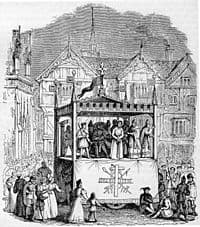
Medieval theatre - Wikipedia View original
Is this image relevant?
Mystery play - Wikipedia View original
Is this image relevant?
Morality play - Wikipedia View original
Is this image relevant?
Medieval theatre - Wikipedia View original
Is this image relevant?
Medieval theatrical traditions
Before the Renaissance, most European drama was religious. Mystery plays dramatized biblical stories and were staged by craft guilds, often on pageant wagons rolled through town streets. Morality plays like Everyman used allegorical characters (Death, Good Deeds, Fellowship) to teach moral lessons. Cycle plays strung together a sequence of biblical events from Creation to the Last Judgment, sometimes lasting entire days.
These traditions gave Renaissance playwrights a foundation: a public hungry for performance, established conventions for staging, and a habit of using drama to explore big questions about human life.
Influence of classical texts
The rediscovery of ancient Greek and Roman plays during the Renaissance transformed what drama could be. Seneca's tragedies, with their themes of revenge, ghosts, and extreme violence, became a direct model for the revenge tragedy genre. Plautus and Terence, Roman comic playwrights, inspired Renaissance comedy with their clever plots, stock characters, and witty dialogue.
Classical theory mattered too. Aristotle's Poetics introduced the idea of the three unities (time, place, and action), which held that a play should occur in one location, within a single day, and follow one main plot. Italian and French dramatists tended to follow these rules strictly. English playwrights like Shakespeare often broke them, sprawling across years and continents within a single play.
Rise of secular performances
As Renaissance culture shifted toward humanism and worldly concerns, drama followed. Court masques combined poetry, music, dance, and elaborate costumes for aristocratic audiences. Interludes, short comic plays performed between courses at banquets, bridged the gap between medieval and fully secular drama.
The most significant development was the rise of professional acting companies that performed in purpose-built public theaters. Theater was no longer tied to the church or the guild hall. It became a commercial enterprise, and playwrights wrote to fill seats.
Key Renaissance dramatists
Christopher Marlowe
Marlowe (1564–1593) was the first major English dramatist to write in blank verse (unrhymed iambic pentameter), giving English drama a flexible, powerful poetic line. His plays Doctor Faustus and Tamburlaine the Great feature protagonists who reach for extraordinary power and are destroyed by their own ambition.
Marlowe's characters are morally complex rather than simply good or evil. Faustus sells his soul for knowledge and pleasure; Tamburlaine conquers empires through sheer will. This focus on flawed, driven individuals broke from the morality play tradition and directly influenced Shakespeare's approach to tragic heroes.
William Shakespeare
Shakespeare (1564–1616) is attributed with 37 plays and 154 sonnets, spanning tragedy, comedy, history, and romance. What set him apart was range: he could write the psychological depth of Hamlet, the political intrigue of Julius Caesar, the romantic comedy of Much Ado About Nothing, and the fantastical world of The Tempest.
His characters feel psychologically real in ways that were new for the stage. Hamlet's indecision, Othello's jealousy, and Lady Macbeth's guilt aren't just plot devices; they're explorations of how people actually think and feel. Shakespeare also contributed an estimated 1,700 words to the English language and coined phrases ("break the ice," "wild goose chase") still used today.
Ben Jonson
Jonson (1572–1637) took a different approach from Shakespeare. He developed the comedy of humours, in which each character is dominated by a single personality trait or obsession. In Volpone, the title character is consumed by greed; in The Alchemist, characters are driven by gullibility and ambition.
Jonson's plays are sharp social satires that target the hypocrisy and foolishness of contemporary London life. He was deeply learned in classical literature and prided himself on careful craftsmanship. He also mentored a circle of younger poets (the "Sons of Ben") and served as an unofficial Poet Laureate, shaping English literary culture beyond the stage.
Themes in Renaissance plays
Power and ambition
Renaissance playwrights were fascinated by what happens when people pursue power without moral limits. In Macbeth, a loyal general murders his king and spirals into paranoia and tyranny. In Richard III, a ruthless schemer manipulates his way to the throne only to lose everything. Marlowe's Tamburlaine depicts conquest as both thrilling and horrifying.
These plays examine the corrupting influence of power, the tension between personal desire and duty, and the consequences of unchecked ambition. They also reflect real anxieties about political authority in an era of monarchical power struggles.
Love and romance
Love in Renaissance drama takes many forms. Shakespeare's comedies (A Midsummer Night's Dream, Twelfth Night) use mistaken identities, love triangles, and cross-dressing disguises to explore the chaos and irrationality of romantic attraction. His tragedies (Romeo and Juliet, Othello) show love destroyed by social forces, jealousy, or misunderstanding.
These plays also probe gender roles and courtship conventions. Female characters often prove sharper and more resourceful than their suitors, even when social norms constrain them.
Social commentary
Renaissance playwrights used the stage to critique their own society. Jonson's city comedies satirized greed and pretension among London's merchant class. Shakespeare's The Merchant of Venice raises uncomfortable questions about prejudice and justice. Marlowe's The Jew of Malta exposes religious hypocrisy on all sides.
Satire gave playwrights a way to address sensitive topics (class inequality, corruption, religious conflict) while maintaining enough distance to avoid direct censorship.

Theatrical conventions
Blank verse vs. prose
Renaissance plays use the contrast between blank verse and prose as a dramatic tool. Blank verse (unrhymed iambic pentameter, ten syllables per line in an unstressed-stressed pattern) is typically spoken by noble characters or during serious, elevated moments. Prose is used for common characters, comic scenes, or moments of madness and disorder.
The shift between the two signals changes in tone, status, or emotional state. In Hamlet, for example, Hamlet speaks in verse when reflecting on life and death but shifts to prose when feigning madness. This wasn't just a stylistic choice; it gave audiences an audible cue about what was happening on stage.
Soliloquies and asides
A soliloquy is a speech delivered by a character alone on stage, revealing their inner thoughts directly to the audience. Hamlet's "To be or not to be" is the most famous example. An aside is a brief remark directed at the audience while other characters are present but supposedly can't hear it.
Both techniques create dramatic irony: the audience knows things that other characters don't. This builds tension in tragedies (you know Iago is lying) and humor in comedies (you know the "boy" is really a girl in disguise).
Use of disguise
Disguise plots appear constantly in Renaissance drama, especially in comedies. In Twelfth Night, Viola disguises herself as a young man named Cesario, creating a tangle of romantic confusion. In As You Like It, Rosalind spends most of the play dressed as a male shepherd.
These plots do more than generate laughs. They let playwrights explore questions about identity, gender, and social boundaries. If a character can pass as someone of a different gender or class, what does that say about how fixed those categories really are?
Genre development
Tragedy in Renaissance drama
Renaissance tragedy typically follows a noble protagonist whose fatal flaw (or hamartia) leads to their downfall. This structure draws on Aristotle's theory that tragedy should produce catharsis, a purging of pity and fear in the audience.
Thomas Kyd's The Spanish Tragedy (c. 1587) established the revenge tragedy subgenre, featuring a protagonist driven to avenge a murdered loved one, often at the cost of their own life and sanity. Shakespeare's Hamlet is the most celebrated example. Supernatural elements like ghosts and witches frequently appear, raising questions about fate, free will, and moral responsibility.
Comedy and farce
Renaissance comedy developed several subgenres:
- Romantic comedy (A Midsummer Night's Dream) centers on love, confusion, and eventual happy marriages
- City comedy (The Alchemist) satirizes urban life, greed, and social climbing
- Comedy of manners focuses on the behavior and pretensions of the upper classes
These plays rely on wit, wordplay, physical humor, mistaken identities, and clever servants who outwit their masters. They almost always end in marriages or reconciliations, restoring social harmony.
Historical plays
Shakespeare popularized the history play with his two tetralogies covering English history from Richard II through Richard III. These plays dramatize real historical events but freely reshape them for dramatic effect.
History plays explore themes of kingship, legitimacy, and national identity. They also served as indirect commentary on contemporary politics. Staging the deposition of a king, for instance, carried obvious implications in an era when questions of royal succession were politically dangerous.
Staging and performance
Theater architecture
Purpose-built playhouses transformed English theater. The Theatre (1576) was the first, followed by The Globe (1599), where many of Shakespeare's plays premiered. These were typically circular or polygonal, open-air structures with three tiers of roofed galleries surrounding a central yard (the "pit") open to the sky.
The thrust stage projected into the audience on three sides, creating an intimate relationship between actors and spectators. Trapdoors in the stage floor allowed for dramatic entrances (ghosts rising from below), while the "heavens" (a canopy above the stage) could lower actors or props from above, representing divine or supernatural intervention.
Acting troupes and companies
Professional acting companies operated under the patronage of a nobleman, which gave them legal protection and social standing. Shakespeare's company, the Lord Chamberlain's Men (later the King's Men), was the most successful.
Casts were all-male; boy actors played female roles, which adds an extra layer of complexity to plays already full of cross-dressing disguises. Companies maintained a repertory system, performing a different play each day and keeping dozens of scripts in rotation. When London theaters closed due to plague outbreaks or political orders, companies toured the provinces.

Costumes and props
Renaissance staging was minimalist by modern standards. There were few sets or backdrops, so costumes did much of the work of establishing character and setting. Costumes were often contemporary Elizabethan dress rather than historically accurate, and they could be extremely expensive; a leading actor's costume might cost more than the playwright earned for writing the entire play.
Props were used symbolically. A crown, a sword, or a letter could carry enormous dramatic weight. The relative bareness of the stage meant audiences relied on the playwright's language to imagine forests, battlefields, and palaces.
Social context
Patronage system
Acting companies needed a noble patron to operate legally. Without patronage, actors could be classified as vagabonds under Elizabethan law. Companies took their patron's name: the Lord Chamberlain's Men, the Admiral's Men, the Queen's Men.
Patrons provided financial backing and political protection, but this relationship also shaped what got written and performed. Playwrights sometimes included flattering references to patrons or dedicated published works to them. The system allowed considerable artistic freedom, but writers had to stay aware of whose support they depended on.
Censorship and regulation
The Master of the Revels held the power to license plays and could demand cuts or revisions before a play could be performed. Political and religious content received the closest scrutiny. Depicting a living monarch on stage, for example, was extremely risky.
Playwrights developed strategies to work around censorship. Setting a politically sensitive story in ancient Rome or a fictional kingdom gave them plausible deniability. Allegory and indirect commentary became essential tools. Despite these precautions, theaters were periodically shut down by authorities concerned about public morality, plague transmission, or the potential for crowds to become unruly.
Audience demographics
Renaissance theater drew a remarkably diverse audience. Groundlings paid a penny to stand in the pit, while wealthier patrons sat in the galleries for two or three pence. The most expensive seats were on the stage itself, where wealthy audience members could show off.
Performances took place in the afternoon (there was no artificial lighting in open-air theaters), making them accessible to a range of working people. Women attended, though their presence sometimes drew criticism from moralists. Audiences were vocal and interactive, and their responses directly influenced how actors performed and how playwrights wrote.
Literary techniques
Metaphor and imagery
Renaissance playwrights used figurative language with extraordinary density and skill. Shakespeare's "All the world's a stage" speech in As You Like It develops a single extended metaphor across an entire monologue, comparing human life to a theatrical performance with seven acts.
Nature imagery frequently mirrors characters' emotional states: storms accompany political chaos in King Lear, and disordered gardens symbolize a neglected kingdom in Richard II. Playwrights drew their metaphors from mythology, astronomy, the natural world, and everyday life, creating layers of meaning that reward close reading.
Dramatic irony
Dramatic irony occurs when the audience knows something that characters on stage do not. In Othello, the audience watches Iago manipulate everyone around him while the other characters trust him completely. This creates almost unbearable tension because you can see the catastrophe coming but can't stop it.
In comedies, dramatic irony generates humor. When Viola (disguised as Cesario) is wooed by Olivia in Twelfth Night, the audience's awareness of the disguise turns a potentially awkward scene into something genuinely funny.
Character archetypes
Renaissance dramatists inherited stock characters from classical and medieval traditions: the fool, the scheming villain, the young lover, the braggart soldier. These archetypes gave audiences instant recognition and allowed playwrights to establish characters quickly in large ensemble casts.
The best playwrights then complicated these types. Shakespeare's fools (Feste in Twelfth Night, the Fool in King Lear) aren't just comic relief; they often speak the most profound truths in the play. His villains (Iago, Richard III) are charismatic and psychologically complex rather than one-dimensional. Subverting archetypes became one of the period's most powerful dramatic tools.
Legacy and influence
Impact on English language
Shakespeare alone is credited with introducing roughly 1,700 words into English, including "assassination," "eyeball," "lonely," and "generous." Phrases from Renaissance plays have become so embedded in everyday speech that people use them without knowing the source: "break the ice" (The Taming of the Shrew), "wild goose chase" (Romeo and Juliet), "green-eyed monster" (Othello).
Beyond vocabulary, Renaissance drama helped establish blank verse as a standard form in English poetry and expanded the expressive range of the language itself.
Adaptations and interpretations
Renaissance plays have been continuously reimagined across centuries and media. Romeo and Juliet has been adapted into ballet, opera, a 1990s film set in a fictional modern city, and West Side Story. The Tempest has been reinterpreted through postcolonial, feminist, and ecological lenses. Hamlet has been translated into virtually every major language.
These adaptations demonstrate that the plays aren't museum pieces. Each generation finds new meanings in them, using the original texts as frameworks for exploring contemporary concerns.
Contemporary relevance
The themes Renaissance playwrights explored haven't gone away. Questions about the abuse of political power, the performance of gender, the nature of justice, and the gap between appearance and reality remain central to public discourse. The psychological complexity of characters like Hamlet, Prospero, and Lady Macbeth continues to provide models for contemporary storytelling across theater, film, television, and literature.
See Fiveable more often in Google
Mark Fiveable as a preferred source and Google is more likely to show you our guides in Top Stories, with a "preferred" badge in AI Mode and AI Overviews.