2.2 The Printing Press and Mass Communication

📲Media Literacy Unit 2 Review
2.2 The Printing Press and Mass Communication
📲 Media Literacy
The Printing Press and Its Impact
Before Gutenberg, producing a single book could take months of hand-copying. The printing press changed that, turning books from rare luxury items into something ordinary people could actually own. This shift didn't just spread information faster; it reshaped politics, religion, science, and education across Europe and eventually the world.

Top images from around the web for Impact of printing press invention
Printing press - Wikipedia View original
Is this image relevant?
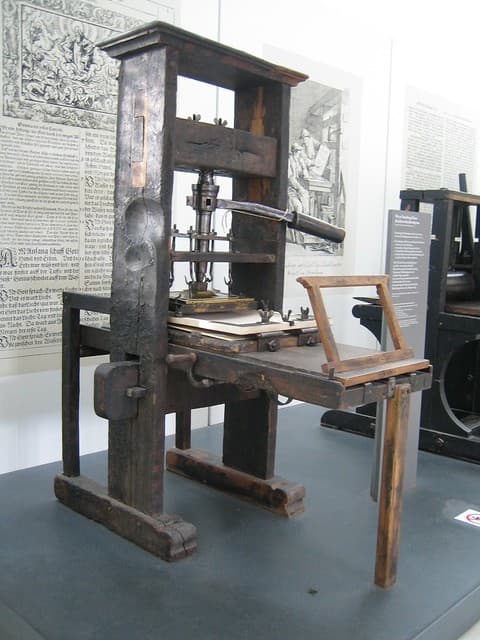
Gutenberg Press 3 | Flickr - Photo Sharing! View original
Is this image relevant?
Shifting Economies in Book Production and its Impact on Education | ETEC540: Text Technologies View original
Is this image relevant?
Printing press - Wikipedia View original
Is this image relevant?
Gutenberg Press 3 | Flickr - Photo Sharing! View original
Is this image relevant?
Impact of the Printing Press Invention
Johannes Gutenberg developed the movable type printing press around 1440 in Mainz, Germany. The key innovation was reusable metal letter blocks that could be rearranged to print any page, then reset for the next one. This made producing books dramatically faster and cheaper than hand-copying manuscripts.
The effects rippled outward quickly:
- Access to knowledge expanded. Books, pamphlets, and broadsheets could now be mass-produced, putting information into far more hands than ever before.
- Literacy rates climbed. As printed materials became affordable, more people had a reason to learn to read. Reading was no longer a skill reserved mainly for clergy and the wealthy.
- New ideas spread rapidly. Copernicus's heliocentric theory reached scientists across Europe through printed copies. Martin Luther's 95 Theses (1517), criticizing Church practices, spread across Germany within weeks thanks to the press. Without print, the Protestant Reformation would have moved far more slowly, if it happened at all.
The press also played a major role in the Renaissance and the Age of Enlightenment. Scholars could share findings with each other across borders. Texts printed in local languages (German, French, English) rather than Latin helped develop vernacular languages and strengthened national identities. People no longer needed to rely solely on the Church or ruling authorities to interpret knowledge for them.

Print Media and Mass Communication

Print Media's Influence on Public Opinion
Newspapers and pamphlets gave ordinary citizens access to political ideas and current events, making print one of the first true tools of mass persuasion. Political leaders, activists, and propagandists all recognized that whoever controlled the press could shape what people believed.
Print media played a direct role in several major movements:
- American Revolution: Thomas Paine's pamphlet Common Sense (1776) sold roughly 500,000 copies in a colonial population of about 2.5 million. It made the case for independence in plain language that everyday colonists could understand, and it helped shift public opinion toward revolution.
- French Revolution: Hundreds of newspapers and pamphlets appeared in Paris in 1789 alone, spreading revolutionary ideas and fueling public anger against the monarchy.
- Abolitionist movement: Publications like William Lloyd Garrison's The Liberator (founded 1831) kept the moral argument against slavery in front of readers for decades, building the movement that eventually helped end it.
By the 19th century, mass-circulation newspapers amplified this influence even further:
- The penny press (starting in the 1830s) sold papers for just one cent, making news affordable for working-class readers. This was a shift from earlier papers that cost six cents and targeted merchants and elites.
- Yellow journalism emerged in the 1890s, with publishers like Joseph Pulitzer and William Randolph Hearst using sensationalized headlines and dramatic stories to boost circulation. Their competing coverage of events in Cuba is widely credited with helping push the U.S. toward the Spanish-American War (1898), showing just how much power print media had gained over public opinion.
Newspapers and Magazines as Communication
The newspaper as a regular publication developed over time:
- The first regularly published newspaper, Relation, appeared in Strasbourg in 1605.
- The first American newspaper, Publick Occurrences Both Forreign and Domestick, was published in Boston in 1690 (though authorities shut it down after a single issue).
Technology drove growth. Steam-powered printing presses in the early 1800s massively increased how many copies could be printed per hour. The telegraph (1840s) let reporters transmit stories across long distances almost instantly, and railroads carried printed papers to readers in distant cities the same day.
Magazines carved out their own role starting in the 18th century. The Gentleman's Magazine, first published in London in 1731, is generally considered the first modern magazine. Unlike newspapers, magazines targeted specific audiences and interests: literary readers, women, hobbyists, and later, political commentators.
Advertising changed the business model. As newspapers and magazines attracted larger audiences, advertisers paid to reach those readers. This revenue allowed publishers to lower subscription prices, which attracted even more readers, which attracted even more advertisers. The cycle made print media a commercial enterprise, not just an information service.
That commercial shift came with a tradeoff, though. As publications grew more dependent on advertising dollars, questions arose about editorial independence. If a major advertiser didn't like a story, would the paper still run it? This tension between serving readers and serving advertisers is a theme that carries straight through to today's media landscape.
See Fiveable more often in Google
Mark Fiveable as a preferred source and Google is more likely to show you our guides in Top Stories, with a "preferred" badge in AI Mode and AI Overviews.