10.4 Digital Divide and Access Issues

📲Media Literacy Unit 10 Review
10.4 Digital Divide and Access Issues
📲 Media Literacy
The Digital Divide and Access Issues
The digital divide describes the gap between people who have meaningful access to technology and those who don't. It matters because so much of modern life now runs through the internet: applying for jobs, attending classes, accessing healthcare, and participating in democracy. Understanding this divide is central to media literacy because it shapes who gets to create, consume, and benefit from digital media.

Top images from around the web for Concept of digital divide
How digital literacy can help close the digital divide View original
Is this image relevant?
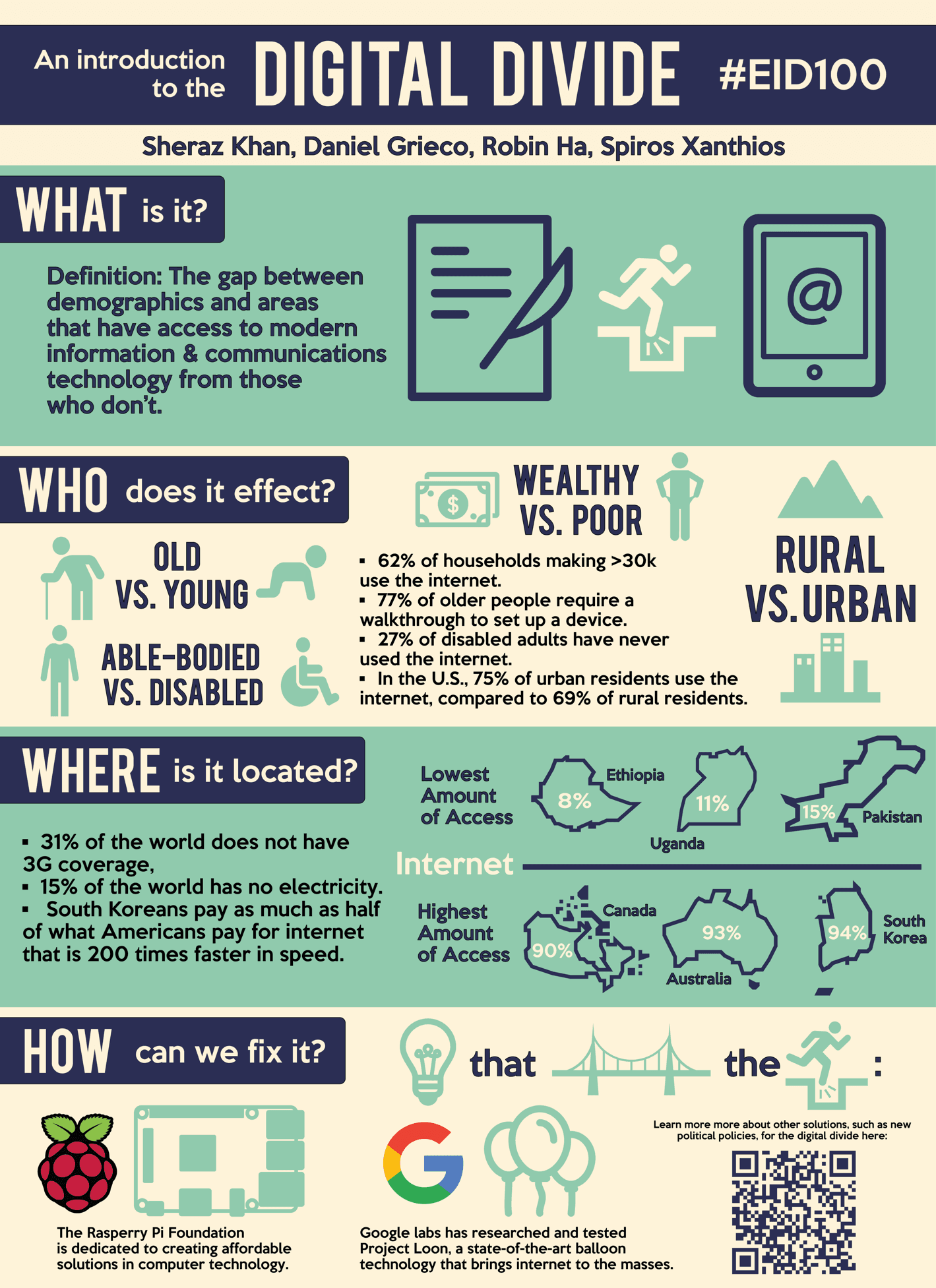
The Digital Divide – Learning in the Digital Age View original
Is this image relevant?
Digital Inclusion | OC Inc. View original
Is this image relevant?
How digital literacy can help close the digital divide View original
Is this image relevant?
The Digital Divide – Learning in the Digital Age View original
Is this image relevant?
Concept of the Digital Divide
The digital divide is the gap between individuals, households, and geographic areas in their access to information and communication technologies (ICTs) like computers and the internet. This gap doesn't just mean some people have slower Wi-Fi. It translates directly into unequal opportunities and outcomes across nearly every part of life.
People on the wrong side of the divide face real consequences:
- Education: They can't access online courses, digital textbooks, or research databases. During the COVID-19 pandemic, students without home internet fell behind when schools moved online.
- Employment: Most job applications are now online-only. Without access, even finding open positions becomes difficult.
- Healthcare: Telemedicine and online health portals are increasingly standard, but useless to people without reliable internet.
- Civic participation: E-government services, online voter registration, and digital public forums all require connectivity. Without it, people are effectively shut out of civic life.
The result is a cycle: those without access fall further behind economically and socially, which makes it even harder to gain access.

Factors in Digital Inequality
The divide isn't caused by one thing. It's driven by overlapping factors that reinforce each other.
Socioeconomic factors
- Income is the most obvious barrier. Devices like laptops and smartphones cost money, and monthly internet service adds up. A family choosing between groceries and a broadband bill will cut the broadband.
- Education and digital literacy also matter. Even when people have access to a device, they may lack the skills to use it effectively for tasks like evaluating online sources or navigating government websites.
Demographic factors
- Age: Older adults tend to adopt new technologies at lower rates and may struggle with interfaces designed for younger users.
- Race and ethnicity: In the U.S., Black and Hispanic households are statistically less likely to have home broadband than white households, reflecting broader patterns of economic inequality.
- Gender: Globally, women are less likely than men to have internet access. This gap is especially pronounced in parts of South Asia and Sub-Saharan Africa.
Geographic factors
- Urban vs. rural: Rural areas often lack the broadband infrastructure that cities take for granted. Running fiber-optic cable to remote areas is expensive, and internet service providers have less financial incentive to do it.
- National and regional disparities: Developing nations often lag far behind in ICT infrastructure. Even within wealthy countries, certain regions are significantly underserved.
Infrastructural factors
- Broadband availability and quality vary enormously. Some areas have access to high-speed fiber optic, while others rely on slow or unreliable connections.
- Electricity: In many underserved areas, especially in the developing world, unreliable power supply makes consistent internet access impossible, even where networks exist.

Strategies for Bridging the Divide
Closing the digital divide requires coordinated action from multiple sectors. Here are the main approaches currently in use.
Government policies and programs
- Universal service funds subsidize internet access for low-income households. In the U.S., the Lifeline program provides monthly discounts on phone or internet service for qualifying families.
- Broadband infrastructure investment targets underserved areas. Federal and state rural broadband initiatives fund the construction of networks where private companies won't build on their own.
- Digital literacy programs funded by government agencies teach basic and intermediate tech skills to populations that need them.
Private sector initiatives
- Companies produce low-cost devices (like Chromebooks) and offer affordable data plans designed for underserved communities.
- Partnerships with schools and libraries provide both hardware and training. Programs like Google's Connected Classrooms equip educational institutions with technology.
- Corporate social responsibility efforts like Microsoft's Airband Initiative work to extend broadband to rural areas using alternative technologies.
Community-driven efforts
- Public access points at libraries and community centers offer free internet and computer use, often the only option for people without home access.
- Grassroots organizations like EveryoneOn connect low-income families with affordable internet service and devices while providing digital skills training.
- Community Wi-Fi networks are locally built and maintained, creating connectivity tailored to a specific area's needs.
Solutions for Digital Inclusion
Bridging the divide requires more than just building networks. It takes a combination of approaches working together.
Increase affordability
- Provide subsidies and discounts so low-income families can afford both devices and internet service.
- Encourage competition among internet service providers (ISPs) to drive down prices and improve service quality.
Expand infrastructure
- Invest in broadband networks in rural and underserved areas, including newer technologies like 5G and fiber optic.
- Explore alternatives like satellite internet (Starlink) and mobile broadband to reach locations where traditional infrastructure is impractical.
Enhance digital literacy
- Integrate digital skills training into school curricula so students build competency early.
- Offer community-based workshops and free online resources (like Khan Academy) for adults and older populations who didn't grow up with these tools.
Foster public-private partnerships
- Bring together businesses, nonprofits, and community organizations to address the divide from multiple angles at once.
- Pool expertise and funding to develop solutions tailored to specific local needs rather than one-size-fits-all programs.
Promote inclusive design
- Follow accessibility standards like the Web Content Accessibility Guidelines (WCAG) so websites and apps work for people with disabilities.
- Support the creation of multilingual online content so language isn't another barrier to access.
Advocate for policy changes
- Push for legislation that prioritizes digital inclusion and net neutrality, ensuring everyone has equal access to online resources regardless of income.
- Secure dedicated funding for digital divide initiatives at local, regional, and national levels to sustain these efforts over time.
See Fiveable more often in Google
Mark Fiveable as a preferred source and Google is more likely to show you our guides in Top Stories, with a "preferred" badge in AI Mode and AI Overviews.