8.4 Add, Subtract, and Multiply Radical Expressions

📘Intermediate Algebra Unit 8 Review
8.4 Add, Subtract, and Multiply Radical Expressions
📘 Intermediate Algebra
Simplifying Radical Expressions
Adding, subtracting, and multiplying radical expressions builds directly on what you already know about combining like terms and distributing. The core idea is that radicals follow many of the same rules as variables, but you need to pay attention to what's under the radical sign.
Addition and Subtraction of Radicals
You can only add or subtract radicals that are like radicals, meaning they have the same index (square root, cube root, etc.) and the same radicand (the number or expression under the radical sign). When they match, you combine the coefficients and leave the radical part unchanged.
- (same radicand and index, so add the coefficients)
- cannot be combined (different radicands)
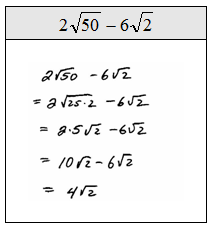
Sometimes radicals don't look like they match, but they do after simplifying. Always simplify each radical first, then check for like terms.
Example:
- Simplify
- Simplify
- Rewrite:

Multiplication of Radical Expressions
When multiplying radicals that share the same index, multiply the radicands together and then simplify.
After multiplying, always check whether you can simplify by factoring out perfect squares (or perfect cubes for cube roots).
Example:
When coefficients are involved, multiply the coefficients together and the radicands together separately:
Rational exponents can also help with simplification. The relationship is . Converting to exponents is especially useful when you need to multiply radicals with different indices, though that comes up less often at this level.
Multiplying Binomials Containing Radicals
When you multiply two binomial expressions that contain radicals, use FOIL (First, Outer, Inner, Last), just like you would with polynomial binomials.
Example:
- First:
- Outer:
- Inner:
- Last:
- Result:
No terms here are like radicals, so this is fully simplified.
Conjugate pairs are a special case worth memorizing. When you multiply a binomial by its conjugate (same terms, opposite sign in the middle), the radicals cancel out:
Example:
This pattern is the basis for rationalizing denominators. To eliminate a radical from a denominator, multiply the numerator and denominator by the conjugate of the denominator.
Example:
For simple single-term denominators, multiply by the radical itself:
Applying Radical Operations in Context
Word problems with radicals follow the same approach as any algebra word problem. The steps are:
- Identify what you know and what you need to find.
- Set up an equation using radical operations.
- Simplify the radical expressions and solve for the variable.
- Check your answer by substituting back into the original equation.
Example: A square has a side length of feet. Find its area.
- Area of a square = side side =
- FOIL:
- Combine like terms: square feet
This type of problem shows up frequently: you're given dimensions in radical form and asked to find an area, perimeter, or other measurement. Focus on applying the multiplication and addition rules cleanly, and always simplify your final answer.
See Fiveable more often in Google
Mark Fiveable as a preferred source and Google is more likely to show you our guides in Top Stories, with a "preferred" badge in AI Mode and AI Overviews.